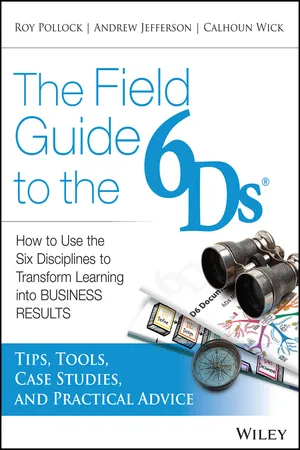
Practical guidelines for implementing the six disciplines of breakthrough learning
The Six Disciplines of Breakthrough Learning has become a standard for companies serious about increasing the return on their investment in learning and development. Now the authors help workplace learning professionals apply the concepts of their bestselling book. With real-world applications, case studies, how-to guidelines, and practical advice and examples for implementing the 6Ds, The 6Ds Fieldbook: Beyond ADDIE will help organizations substantially increase the return on investment and decrease "learning scrap," the potential value that goes unrealized in many learning and development initiatives.
Helps OD professionals apply the concepts of the bestselling Six Disciplines of Breakthrough Learning
Includes all new case studies, examples, tools, and best practices in use by organizations that have successfully used the 6Ds
Taps into the experience and expertise of 6Ds practitioners
Linking to social media to enhance the lessons of the book, The 6Ds Fieldbook is an easy-to-use and widely-applicable guide to getting the most from learning and development.
In her book, Strategic Learning Alignment, Rita Smith (2010) succinctly summarized the core concept of D1: “The only reason that learning organizations exist is to drive business outcomes” (p. 10). In other words, organizations invest in training and development with the goal of improving performance in areas critical to their strategy and objectives. Thus, training is valued to the extent to which it visibly and convincingly contributes to improved performance. When training consumes resources (time and money), but fails to demonstrably improve performance, it is seen as wasteful and expendable.
Therefore, the first and most critical discipline is to truly understand what the business needs to accomplish. As Patricia Gregory, senior director, and Steve Akram, director, North American Sales Force Development at Oracle explain in Case D1.1, focusing on business outcomes repositions training and development professionals from mere order takers to strategic business partners.
Conversely, failing to clearly define the business outcomes dramatically increases the risk of pouring time, effort, and money into a training program that won’t actually scratch the itch. In Case D1.2, Sujaya Banerjee, chief talent officer and senior vice president, and her colleagues of the Essar Group, explain how investing the time to truly understand the business needs helped their Corporate Training Group avoid creating another “feel good” training program. By focusing on business outcomes, she and her colleagues were able to make a significant contribution to business transformation and produce results that the CEO recognized and applauded.
Key steps in the practice of D1 include:
Understanding the business you support
Talking to your stakeholders
Deciding whether training is appropriate
Completing the performance-gap analysis
Differentiating learning objectives from business objectives
Using business outcomes to explain the benefits
Understand the Business You Support
A core principle of the 6Ds is that training is a business function. It follows that the better that training professionals understand the organization they serve—its goals, vision, mission, and operations—the better they are able to contribute, and the greater the respect they command. Training departments that are viewed by business leaders as truly aligned with their businesses enjoy much greater support than those that are seen as “doing their own thing” (Bersin, 2008, p. 82).
Use Quick Check D1.1 to evaluate your alignment with the business and to identify actions to take that will improve this important skill set.
QUICK CHECK D1.1: BUSINESS ALIGNMENT
Can you succinctly explain how your organization makes money (or for nonprofits, fulfills its mission) and the key challenges it faces in doing so?
Yes
No
Congratulations. Understanding the business you are part of is essential for you to become a trusted advisor rather than simply an order-taker.
You will increase your contribution and your value to your organization by deepening your knowledge of the business. Greater business savvy will allow you to design more relevant and more effective programs. Suggested actions include:
Find a mentor in the business who can help by explaining key terms and concepts.
Review the business plans for the units you support.
Ask to sit in on business reviews and planning sessions; ask your mentor about any aspect you don’t understand.
How would the business leaders rate the alignment of your training department with their business needs?
Good to Excellent
Fair to Poor
I Don’t Know
Terrific. Training departments that are seen as aligned to the business’s needs receive greater support and, interestingly, less scrutiny.
This is a problem. If Training is not seen as fully aligned with the business, then it will have to produce more data to justify its value and it is more likely to have its budget cut. Suggested actions include:
Interview business managers to find out where they feel there is misalignment.
Require a clear understanding of business needs before beginning any design work.
Interview business leaders using the Planning Wheel (page 173) to identify the real business needs and criteria for success.
You need to address this gap in your knowledge, as it could prove fatal for your department. If Training is not seen as aligned with the business, then it is likely to be viewed as expendable. Suggested actions include:
Survey or interview training’s business clients to assess their perceptions of training’s alignment with their needs.
Take appropriate action to rectify the situation based on the results.
Talk to Your Stakeholders
The business is training’s customer. Directly or indirectly, the business pays for the cost of providing training and, in the end, decides whether or not the resulting value justified the expense. What the business “buys” from training is the expectation of improved performance; courses and programs are only a means to this end. Whether the training department stays in business depends on whether its customers feel they “got their money’s worth” and are therefore willin...
Table of contents
Cover
Contents
Title
Copyright
About This Book
Acknowledgments
Contributors
Introduction
Part I: The Six Disciplines
Part II: Tools: Maps, Planners, Scorecards, and Checklists
Part III: Case Histories (“How We”)
Part IV: How-to Guides
References
Index
About the Authors
About the 6Ds Company
End User License Agreement
Trusted by 375,005 students
Access to over 1.5 million titles for a fair monthly price.
Study more efficiently using our study tools.
Frequently asked questions
Yes, you can cancel anytime from the Subscription tab in your account settings on the Perlego website. Your subscription will stay active until the end of your current billing period. Learn how to cancel your subscription
No, books cannot be downloaded as external files, such as PDFs, for use outside of Perlego. However, you can download books within the Perlego app for offline reading on mobile or tablet. Learn how to download books offline
Perlego offers two plans: Essential and Complete
Essential is ideal for learners and professionals who enjoy exploring a wide range of subjects. Access the Essential Library with 800,000+ trusted titles and best-sellers across business, personal growth, and the humanities. Includes unlimited reading time and Standard Read Aloud voice.
Complete: Perfect for advanced learners and researchers needing full, unrestricted access. Unlock 1.5M+ books across hundreds of subjects, including academic and specialized titles. The Complete Plan also includes advanced features like Premium Read Aloud and Research Assistant.
Both plans are available with monthly, semester, or annual billing cycles.
We are an online textbook subscription service, where you can get access to an entire online library for less than the price of a single book per month. With over 1.5 million books across 990+ topics, we’ve got you covered! Learn about our mission
Look out for the read-aloud symbol on your next book to see if you can listen to it. The read-aloud tool reads text aloud for you, highlighting the text as it is being read. You can pause it, speed it up and slow it down. Learn more about Read Aloud
Yes! You can use the Perlego app on both iOS and Android devices to read anytime, anywhere — even offline. Perfect for commutes or when you’re on the go. Please note we cannot support devices running on iOS 13 and Android 7 or earlier. Learn more about using the app
Yes, you can access The Field Guide to the 6Ds by Andy Jefferson,Roy V. H. Pollock,Calhoun W. Wick,Andrew McK. Jefferson in PDF and/or ePUB format, as well as other popular books in Business & Human Resource Management. We have over 1.5 million books available in our catalogue for you to explore.