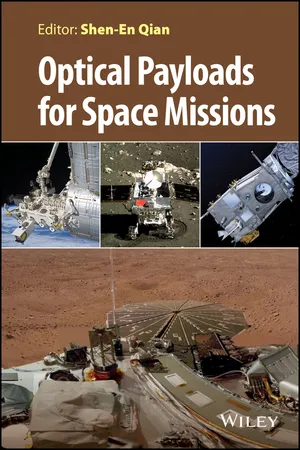
Optical Payloads for Space Missions is a comprehensive collection of optical spacecraft payloads with contributions by leading international rocket-scientists and instrument builders.
Covers various applications, including earth observation, communications, navigation, weather, and science satellites and deep space exploration
Each chapter covers one or more specific optical payload
Contains a review chapter which provides readers with an overview on the background, current status, trends, and future prospects of the optical payloads
Provides information on the principles of the optical spacecraft payloads, missions' background, motivation and challenges, as well as the scientific returns, benefits and applications
The objectives of a space mission are accomplished by the hardware (i.e., instruments) and software, which are referred to as payloads, onboard the platform of a spacecraft. Payloads sense or interact with the subject, are typically unique to each mission, and are the fundamental reason that the spacecraft is flown. The purpose of the rest of the subsystems is to keep the payloads healthy, happy, and pointed in the right direction. The payloads largely determine the mission’s cost, complexity, and effectiveness. A critical part of a mission analysis and design is to understand what drives a particular set of payloads so that these demands can become part of the overall system trade process designed to meet mission objectives at minimum cost and risk.
Payloads of space missions can be roughly classified into two categories in terms of the wavelength of their operating: optical and microwave. Optical payloads, or sensors, measure reflective light in wavelength range from ultraviolet, visible, to infrared (including near infrared, intermediate infrared, thermal infrared), while microwave sensors measure microwaves whose wavelength is longer than visible light and infrared (IR) rays. Microwaves are radio waves with wavelengths ranging from as long as 1 m to as short as 1 mm, or equivalently, with frequencies between 300 MHz (0.3 GHz) and 300 GHz. The observation of microwave sensors is not affected by day, night, or weather. Radar sensors and synthetic aperture radar (SAR) sensors are the typical microwave sensors.
There are two types of observation methods for both optical and microwave payloads: passive and active. Passive payloads detect and measure natural radiation that is emitted or reflected by the objects or surrounding area being observed. Reflected sunlight is the most common source of radiation measured by passive sensors. Active sensors, on the other hand, emit energy in order to scan the area of objects and then detect and measure the radiation that is reflected or backscattered from the objects. Radar and lidar sensors are active sensors, where the time delay between emission and return is measured, establishing the location, height, speed, and direction of an object.
The focus of this book is optical payloads for space missions. Radar payloads are beyond the scope of this book.
Optical payloads can be roughly classified into following six types based on their functions:
Panchromatic sensors
Multispectral sensors
Imaging spectroscopy sensors
Fourier transform spectroscopy sensors
Light detection and ranging (lidar) sensors
Spectrometers and radiometers
This book consists of eight parts (Part One – Part Eight) and covers all these six types of optical payloads. Part One (Chapter 1) is the overview of spaceborne optical sensors. Parts Two through Six each describe one type of optical sensors except for the panchromatic sensors, which are included in Part Two or Part Three together with their hyperspectral or multispectral sensors onboard the same platform. Part Seven describes spaceborne optical sensors other than these six types. Part Eight describes optical sensors onboard microsatellites and nanosatellites.
1.1.1 Panchromatic Sensors
Panchromatic refers to black and white imagery exposed by all visible light. However, a spaceborne panchromatic sensor often acquires visible light within a wavelength range typically between 0.50 and 0.80 μm using a minus blue filter to reduce the scattering that occurs in the blue wavelengths. A panchromatic sensor produces images with a much finer ground footprint size (or spatial resolution) than those produced by the multispectral sensor or hyperspectral sensor onboard the same satellite. For example, the QuickBird satellite produces panchromatic imagery having a ground footprint size of 0.6 m × 0.6 m, while the multispectral pixels represent an area of 2.4 m × 2.4 m.
1.1.2 Multispectral Sensors
Unlike a panchromatic sensor that records the total intensity of radiation falling on each pixel and generates only a panchromatic image, a multispectral sensor acquires multiple images of the scene simultaneously at specific spectral bands, or wavelength ranges. Multispectral images acquired by multispectral sensors are the main type of remote sensing images. Usually, a multispectral sensor has three or more spectral imagers (Landsat 7 has seven). Each one is a scene image in a band of visible spectra, ranging from 0.4 μm to 0.7 μm, called red (635–700 nm), green (490–560 nm), and blue (450–490 nm) (RGB) region, and going to IR wavelengths of 0.8 μm to 10 μm or longer, classified as near infrared (NIR), middle infrared (MIR), and far infrared (FIR or thermal). In the case of Landsat 7, the acquired images comprise seven-band multispectral images. A list of spaceborne multispectral sensors together with their satellite platforms and detailed technical information can be found in Table 1.1 of Reference 1.
Table 1.1 Summary of Optical payloads collected in the book
No.
Ch.
Payload Type
Payload name
Acronym name
Platform or Mission
Launch year
Active? (in Dec. 2014)
Country
1
2
Imaging Spectroscopy Sensor
Hyperspectral Imager for the Coastal Ocean
HICO
International Space Station
2009
until Sept. 2014
DoD, USA
2
3
Moderate Resolution Imaging Spectroradiometer
MODIS
Terra, Aqua
1999, 2002
Yes
NASA, USA
3
4
Medium Resolution Imaging Spectrometer for Ocean Color
MERIS
ENVISAT
2002
Until 2012
ESA
4
5
Visible and Near-infrared Imaging Spectrometer
VNIS
Chang’E 3
2013
Yes
China
5
6
Hyperspectral Imager HySI
HySI
IMS-1
2008
Yes
India
6
7
Environmental Mapping and Analysis Program
EnMap
EnMap
2018
–
Germany
7
8
PRecursore IperSpettrale della Missione Applicativa
PRISMA
PRISMA
2017
–
Italy
8
9
Hyperspectral Imager Suite
HISUI
HISUI
2018
–
Japan
9
10
Ocean and Land Color Imager
OLCI
Sentinel–3
2015
–
ESA
10
11
Spaceborne Hyperspectral Applicative Land and Ocean Mission
Thermal And Near infrared Sensor for carbon Observation Fourier Transform Spectrometer
TANSO-FTS
GOSAT
2009
Yes
Japan
21
22
Geostatio...
Table of contents
Cover
Title Page
Table of Contents
Contributors List
Preface
Part One: Overview
Part Two: Imaging Spectrometers
Part Three: Multispectral Sensors
Part Four: Fourier Transform Spectrometers
Part Five: Lidar and Active Sensors
Part Six: Spectrometers and Radiometers
Part Seven: Other Types of Optical Sensors
Part Eight: Nanosatellites and Microsatellites
Index
End User License Agreement
Trusted by 375,005 students
Access to over 1.5 million titles for a fair monthly price.
Study more efficiently using our study tools.
Frequently asked questions
Yes, you can cancel anytime from the Subscription tab in your account settings on the Perlego website. Your subscription will stay active until the end of your current billing period. Learn how to cancel your subscription
No, books cannot be downloaded as external files, such as PDFs, for use outside of Perlego. However, you can download books within the Perlego app for offline reading on mobile or tablet. Learn how to download books offline
Perlego offers two plans: Essential and Complete
Essential is ideal for learners and professionals who enjoy exploring a wide range of subjects. Access the Essential Library with 800,000+ trusted titles and best-sellers across business, personal growth, and the humanities. Includes unlimited reading time and Standard Read Aloud voice.
Complete: Perfect for advanced learners and researchers needing full, unrestricted access. Unlock 1.5M+ books across hundreds of subjects, including academic and specialized titles. The Complete Plan also includes advanced features like Premium Read Aloud and Research Assistant.
Both plans are available with monthly, semester, or annual billing cycles.
We are an online textbook subscription service, where you can get access to an entire online library for less than the price of a single book per month. With over 1.5 million books across 990+ topics, we’ve got you covered! Learn about our mission
Look out for the read-aloud symbol on your next book to see if you can listen to it. The read-aloud tool reads text aloud for you, highlighting the text as it is being read. You can pause it, speed it up and slow it down. Learn more about Read Aloud
Yes! You can use the Perlego app on both iOS and Android devices to read anytime, anywhere — even offline. Perfect for commutes or when you’re on the go. Please note we cannot support devices running on iOS 13 and Android 7 or earlier. Learn more about using the app
Yes, you can access Optical Payloads for Space Missions by Shen-En Qian in PDF and/or ePUB format, as well as other popular books in Technology & Engineering & Mechanical Engineering. We have over 1.5 million books available in our catalogue for you to explore.