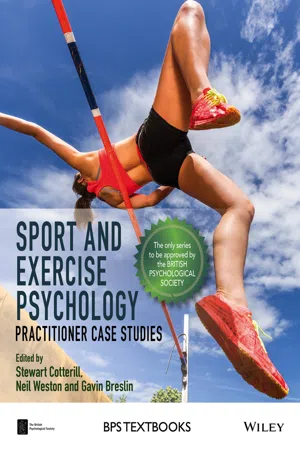
Sport and Exercise Psychology
eBook - ePub

Sport and Exercise Psychology

Practitioner Case Studies

  1. English
  2. ePUB (mobile friendly)
  3. Available on iOS & Android
eBook - ePub

Sport and Exercise Psychology

Practitioner Case Studies

About this book

SPORT AND EXERCISE PSYCHOLOGICAL

"This book is a joy to read and greatly needed. The overall scholarly quality is very strong, and the chapters are clear, accessible, helpful and interesting - a rare combination. There are few texts that examine sport and exercise from a practitioner's perspective, and fewer that help students and trainees navigate the complex terrain of practice. The editors should be congratulated on pulling together a book that educates, inspires, provokes, and will be of practical use."
Professor Brett Smith, School of Sport, Exercise and Rehabilitation Sciences, University of Birmingham

Sport and Exercise Psychology: Practitioner Case Studies is a contemporary text focusing on current issues in the discipline of sport and exercise psychology. Integrating research and practice in order to develop a coherent understanding of existing knowledge, future research directions and applied implications within the field, the text explores issues pertinent to the applied practitioner/supervisor and draws on expert commentary to investigate potential solutions to many key issues. Each chapter uses a case study approach to allow internationally recognized contributors to highlight and evaluate their experience across a broad range of sport and exercise performance areas. Practitioners are provided with a full range of available interventions to address specific types of psychological issue including performing under pressure, working with teams, injury rehabilitation, working with coaches, mental toughness, career transitions, athlete well- being, physical activity promotion, exercise and body image, lifestyle interventions, exercise dependence, and motor learning and control.

Sport and Exercise Psychology is supported by a range of online materials designed to help both study and practice. It presents content that is directly applicable to those seeking to enter the profession, and which can also inform the ongoing development of reflective practitioners.
Frequently asked questions

Yes, you can cancel anytime from the Subscription tab in your account settings on the Perlego website. Your subscription will stay active until the end of your current billing period. Learn how to cancel your subscription.
At the moment all of our mobile-responsive ePub books are available to download via the app. Most of our PDFs are also available to download and we're working on making the final remaining ones downloadable now. Learn more here.
Perlego offers two plans: Essential and Complete
  • Essential is ideal for learners and professionals who enjoy exploring a wide range of subjects. Access the Essential Library with 800,000+ trusted titles and best-sellers across business, personal growth, and the humanities. Includes unlimited reading time and Standard Read Aloud voice.
  • Complete: Perfect for advanced learners and researchers needing full, unrestricted access. Unlock 1.4M+ books across hundreds of subjects, including academic and specialized titles. The Complete Plan also includes advanced features like Premium Read Aloud and Research Assistant.
Both plans are available with monthly, semester, or annual billing cycles.
We are an online textbook subscription service, where you can get access to an entire online library for less than the price of a single book per month. With over 1 million books across 1000+ topics, we’ve got you covered! Learn more here.
Look out for the read-aloud symbol on your next book to see if you can listen to it. The read-aloud tool reads text aloud for you, highlighting the text as it is being read. You can pause it, speed it up and slow it down. Learn more here.
Yes! You can use the Perlego app on both iOS or Android devices to read anytime, anywhere — even offline. Perfect for commutes or when you’re on the go.
Please note we cannot support devices running on iOS 13 and Android 7 or earlier. Learn more about using the app.
Yes, you can access Sport and Exercise Psychology by Stewart Cotterill, Neil Weston, Gavin Breslin, Stewart Cotterill,Neil Weston,Gavin Breslin in PDF and/or ePUB format, as well as other popular books in Psychology & Applied Psychology. We have over one million books available in our catalogue for you to explore.

Information

Part 1
Sport and Performance Psychology

1
Introduction

Stewart Cotterill, Neil Weston, and Gavin Breslin
images

Introduction to the book

The field of sport and exercise psychology has grown significantly over the last 20 years in line with a notable increase in the number of applied sport and exercise psychology practitioners globally. This growth has, in turn, driven the formalization and enhancement of sport and exercise psychologist training and qualification routes. While there is diversity in the approaches adopted in different countries and across different continents, the ultimate aim is the same, to enhance the quality of the service that we, as sport and exercise psychologists, offer to our clients and organizations.
While these developments are important for the field of sport and exercise psychology, less emphasis has been placed on sharing sport and exercise psychology practitioner experiences. In particular, it is evident that there has been a lack of discussion and dissemination of the different approaches to practice that sport and exercise psychologists have employed to meet the needs of their clients. As a consequence, in our experience trainee sport and exercise psychologists have historically not been exposed enough at a developmental level to the range of possible approaches that might be available to them. This is however changing and a number of education providers are now providing more comprehensive educational programmes for those students/practitioners interested in a career as a sport and/or exercise psychologist.
There has also recently been an encouraging increase in the volume of applied sport and exercise psychology books and peer-reviewed academic journal articles. However the detail as to the interventions employed by the practitioners and the evidence base to justify them, is still insufficient. Hence the present book seeks to overcome these limitations and provide a broad range of sport and exercise case studies covering a range of diverse approaches to practice, and crucially articulating the evidence base underpinning these approaches.
The book is designed to achieve a number of outcomes. First, it provides trainee and qualified practitioners alike with an opportunity to read a wide range of case studies detailing client initial assessment, intervention selection and implementation, as well as the consultant’s reflection and evaluation of their experiences. Second, the book seeks to provide readers with an evidence-based approach to the consultancy experience through initial assessment and intervention to evaluation. Third, the book aims to provide a broad range of practitioner approaches to assessing and addressing key performance issues evident in the modern day sport and exercise environments. Finally, authors in each chapter recommend further reading for exploration if the reader is keen to develop a greater understanding of a particular approach or technique.
This book is designed to be a contemporary text, with each chapter integrating both research and applied practice in developing a coherent understanding of current knowledge, future research directions and applied implications within the field. In particular, the text explores issues pertinent to the trainee/applied practitioner/supervisor within the field, and through the use of expert commentary explores potential solutions to many of these key issues.
The specific aims of this book are to:
  • Present a range of case studies examining how sport psychology practitioners initially assess the needs of their client(s), in addition to how they approach an intervention to improve the client’s situation.
  • Provide an evidence-based approach to solving client problems while also allowing practitioners the scope to discuss and reflect upon alternative creative strategies that could have informed their interventions.
  • Provide practitioners with a contemporary knowledge base in a range of sport and exercise discipline areas in addition to future research suggestions and applied implications.
  • Explore issues pertinent to the applied practitioner/supervisor within the field and through the use of expert commentary explore potential solutions to many of these key issues.

The nature of applied work in sport and exercise psychology

Applied practice within the domain of sport and exercise psychology is both diverse and eclectic in its nature. Indeed, the broad range of case studies presented in this book serves to reinforce this view. The domain for the applied practitioner ranges from working with individual athletes, coaches, and patients to teams, clubs, public health organizations, and broader settings. Coupled with this, practitioners can work with current or future Olympic champions, professional athletes, talented young performers, individuals and groups seeking to make healthier life choices, influence public-policy decisions, and to facilitate recovery and adaptation following serious health conditions such as strokes, cancer, and diabetes; and mental health issues such as depression and anxiety disorders. Indeed, the breadth of the field of sport and exercise psychology is truly astounding. Such a range of potential applications of psychology across the sport and exercise field raises questions about whether this can be covered in a single training/development programme. This is though beyond the focus of the current text. This book seeks to explore and highlight the diversity of applied practice facing current sport and exercise psychology practitioners, sharing a range of approaches and crucially their underpinning theoretical and empirical basis.

Overview of the book

The book is comprised of 25 chapters, arranged in four parts: Part I, Sport and Performance Psychology; Part II, Coaching Psychology; Part III, Motor Learning and Control; and Part IV, Psychology of Physical Activity and Exercise. Each chapter is designed to offer the reader an in-depth understanding of the particular case study and approach adopted. Also specific learning outcomes are articulated, and a number of key areas to consider when reading the chapter. Each chapter then presents an overview of the client and the issue before outlining the needs analysis process that guided the decisions regarding the interventions adopted. The framework underpinning the intervention and the associated processes are explained before the authors reflect upon the effectiveness of the approaches adopted. Finally, avenues for further exploration and reading are described to develop a greater understanding of the approaches and interventions presented in the chapter. It is important to state at this point that some of the chapters are real experiences that the clients have given their consent to be published, and some are hypothetical case studies. The chapters are supported by online resources including ‘Talking Heads’ videos from the authors, sample essays, questions, and further weblinks.

Sport and Performance Psychology

This part of the book explores a range of interventions where the presenting problems are sport and performance focused. In particular, Part I explores psychological factors including managing interpersonal relationships, confidence, concentration and rumination, stress management, personality and group functioning, injury rehabilitation, supporting athletes through career transitions; and the provision of psychological support during major events.

Coaching Psychology

This second part of the book focuses explicitly on the coach, and the potential psychological challenges coaches face. In particular, this part of the book focuses on case studies examining the coach’s stress and coping experience, impression management in coach/athlete interactions, creating successful coach/athlete relationships, and nurturing mental toughness through autonomous supportive coaching.

Motor Learning and Control

This part of the book explores motor learning and control and the use of these approaches in applied practice. Specifically, this part of the book explores the cognitive processes involved in the development of motor skills in practice, the development of visual anticipation skills, and the development of perception and action through an ecological-based approach.

Psychology of Physical Activity and Exercise

This final part of the book considers the use of physical activity and exercise as a medium through which a range of health and wellbeing outcomes can be achieved. Specifically, this part of the book explores the challenges of physical activity promotion on a population level, the relationship between exercise and wellbeing, the links between physical activity, self-esteem, and self-concept, intellectual disability and exercise, exercise and body image, exercise dependence, physical activity in children, physical activity and the environment around us, and exercise use in cancer care.
Taking all these chapters collectively, we hope you will enjoy the read and in so doing get a real feeling for the diverse nature of the applied field of sport and exercise psychology. It has been our pleasure working with the authors of each chapter to bring the reader an international, contemporary, informative and diverse textbook.
Stewart, Neil, and Gavin

2
Managing Difficult Interpersonal Relationships: A Basic Psychological Needs Approach

Richard Hampson and Chris Harwood
images

Learning objectives

After reading this chapter you should be able to:
  1. Critically understand how a knowledge of Basic Psychological Needs Theory can be used as a motivational tool to help develop professional relationships and performance.
  2. Differentiate how psychological need thwarting may present itself in applied situations from challenges associated with low levels of need satisfaction.
  3. Critically appreciate the role of the psychologist in mediating conflict when interpersonal challenges arise in elite athlete dyads.
  4. Consider the humanistic processes and solution-focused techniques of a consultant involved in an effective dyadic needs analysis and relationship intervention.
Areas to consider when reading the chapter:
  1. The psychological and relational issues that can occur in partnerships at the highest level of elite sport.
  2. The benefit of a full-time employed sport psychology practitioner who has the time and availability to offer continued support (as needed) through the athletes’ challenging pha...

Table of contents

  1. Cover
  2. BPS Textbooks in Psychology
  3. Title page
  4. Copyright
  5. About the Contributors
  6. Acknowledgements
  7. About the Companion Website
  8. Part 1 Sport and Performance Psychology
  9. Part 2 Coaching Psychology
  10. Part 3 Motor Learning and Control
  11. Part 4 Psychology of Physical Activity and Exercise
  12. Index
  13. EULA