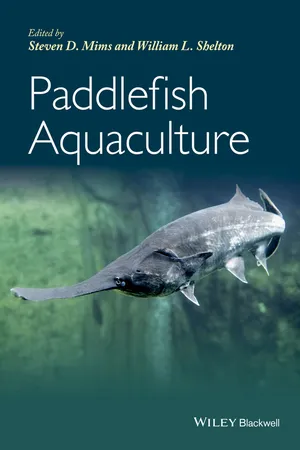
Paddlefish have become of increasing interest to the aquaculture community in recent years, particularly as a potential new source of seafood and caviar. Native to North America, paddlefish show great promise both domestically and internationally as a commercially viable farmed species.
Paddlefish Aquaculture examines all aspects of the biology and culture of these fish, exploring their physiology, production, end products and the economics underlying a successful paddlefish operation. Chapters specifically cover paddlefish biology, propagation and early culture techniques, production for meat and caviar, international culture and history, paddlefish food products, bioaccumulants of contaminants in paddlefish, parasites and diseases, and the economics of paddlefish aquaculture.
Paddlefish Aquaculture is a timely practical reference for researchers and producers interested in paddlefish.
The paddlefish Polyodon spathula (Walbaum 1792) is a large, long-lived, late maturing fish that retains many non-derived anatomical characteristics and possesses several special biological features. Its appearance alone stimulates interest, but many other attributes of this unique fish add to its attractiveness. Native distribution is limited to North America and it is one of the only two extant members of the family Polyodontidae. The family is included in the order Acipenseriformes, superorder Chondrostei, subclass Actinopterygii, class Osteichthyes.
The other surviving member of the family, the Chinese paddlefish Psephurus gladius (Martens 1861), is endemic to the Yangtze River of mainland China (Chenhan & Yongjun 1988; Rochard et al. 1991; Birstein 1993). Our discussion in this book will focus on the culture of the American paddlefish, but reference to the Chinese paddlefish will be specified when appropriate, and we will include more detailed information on the Southeast Asian species in Chapter 5.
A symposium on paddlefish biology and culture was organized and convened in the mid-1980s; the published proceedings was a milestone in collating and integrating important information, and providing an extensive bibliography (Dillard et al. 1986). An updated collection of literature citations was subsequently published (Georgi & Dingerkus 2001). In 1998, a symposium on exploitation and conservation of North American paddlefish and sturgeons was convened, and the proceedings were published (Williamson et al. 1999). Many other symposia and proceedings have focused on sturgeons and some of these have included material on paddlefish, for example, LeBreton et al. (2004). A comprehensive book was recently published on paddlefish biology (Paukert & Scholten 2009).
In the present volume, detailed information on the life history of the American paddlefish will be discussed in Chapter 2; however, some of the more unusual anatomical and physiological characteristics are worthy of mention by way of introduction (Coker 1923). The paddle-shaped rostrum has been the object of much conjecture. It has been speculated to play a mechanical role in feeding. Jordan and Evermann (1896) stated that “They feed chiefly on mud and minute organisms contained in it, stirring it up with the spatulate snout…” (Alexander 1914). Although an interesting thesis, this putative digging function would logically damage the delicate sensory elements that are now known to be a part of this structure. Alternatively, their swimming movement suggests another benefit of the flattened snout that has not been studied nor widely discussed. The paddlefish swim continuously, and as the snout passes through water in alternating side-to-side arcs, some upward force is obviously generated, which probably supplements the buoyancy afforded by the swim bladder. The swim bladder of paddlefish is relatively smaller than most other fishes, and does not appear to produce neutral buoyancy. The rostrum is vulnerable to damage and even loss, which probably has an adverse effect on swimming, but it also presents some potential problems for measurements of length. Thus, Ruelle and Hudson (1977) suggested reporting eye-fork length (body length) rather than the more conventional total length (TL) or standard length (SL).
Some less obvious morphological characteristics of paddlefish, but worthy of note, are the fins. The paired pectoral and pelvic fins, unlike most teleosts, are relatively fixed and inflexible, functioning during forward motion primarily as hydrodynamic maneuvering structures; they provide minimal maneuverability for backing or sculling. The dorsal and anal fins also have a rather rigid structural base. The caudal fin retains a primitive heterocercal morphology, in contrast to the more flexible homocercal tail fin of higher teleosts. The operculum projects backward in an extended flap and there is a functional spiracle behind each eye. The body surface generally lacks scales, except for a few bony rhomboid-shaped scales on, and partially embedded on either side of the caudal peduncle and under the opercular flap. A single pair of minute barbels are located just in front of the mouth on the ventral surface of the snout.
Internally, similarly primitive features in the digestive system include a large, fan-shaped pyloric cecum and a spiral valve in the hind gut. The reproductive organs are of an unusual type among fishes. The paired ovaries are described as gymnovarian, where the mature eggs rupture through the ovarian wall at ovulation and are shed into the body cavity instead of collecting in a central ovarian cavity. From the coelomic cavity, the eggs must enter into dorsally attached oviducts that adhere to the caudad portion of the ovaries. During spawning, the eggs must enter one of the dorsally located open funnels of the paired oviducts (Müllerian ducts). Spermatozoa pass from the testes through the kidneys via vasa deferentia, which are directly attached to the gonads, even though males retain vestigial Müllerian ducts and funnels. Mature ova are highly pigmented; consequently, these dark eggs are quite valuable in the caviar trade, and thus providing the impetus for heavy fishing exploitation. Paddlefish eggs are equivalent to sturgeon caviar in appearance, texture, and taste. Further, like other acipenserids, the eggs have multiple micropyles; paddlefish eggs have an average of about eight, but range from 3 to 20 (Linhart & Kudo 1997; Debus et al. 2002).
1.2 HISTORICAL FISHERY OVERVIEW
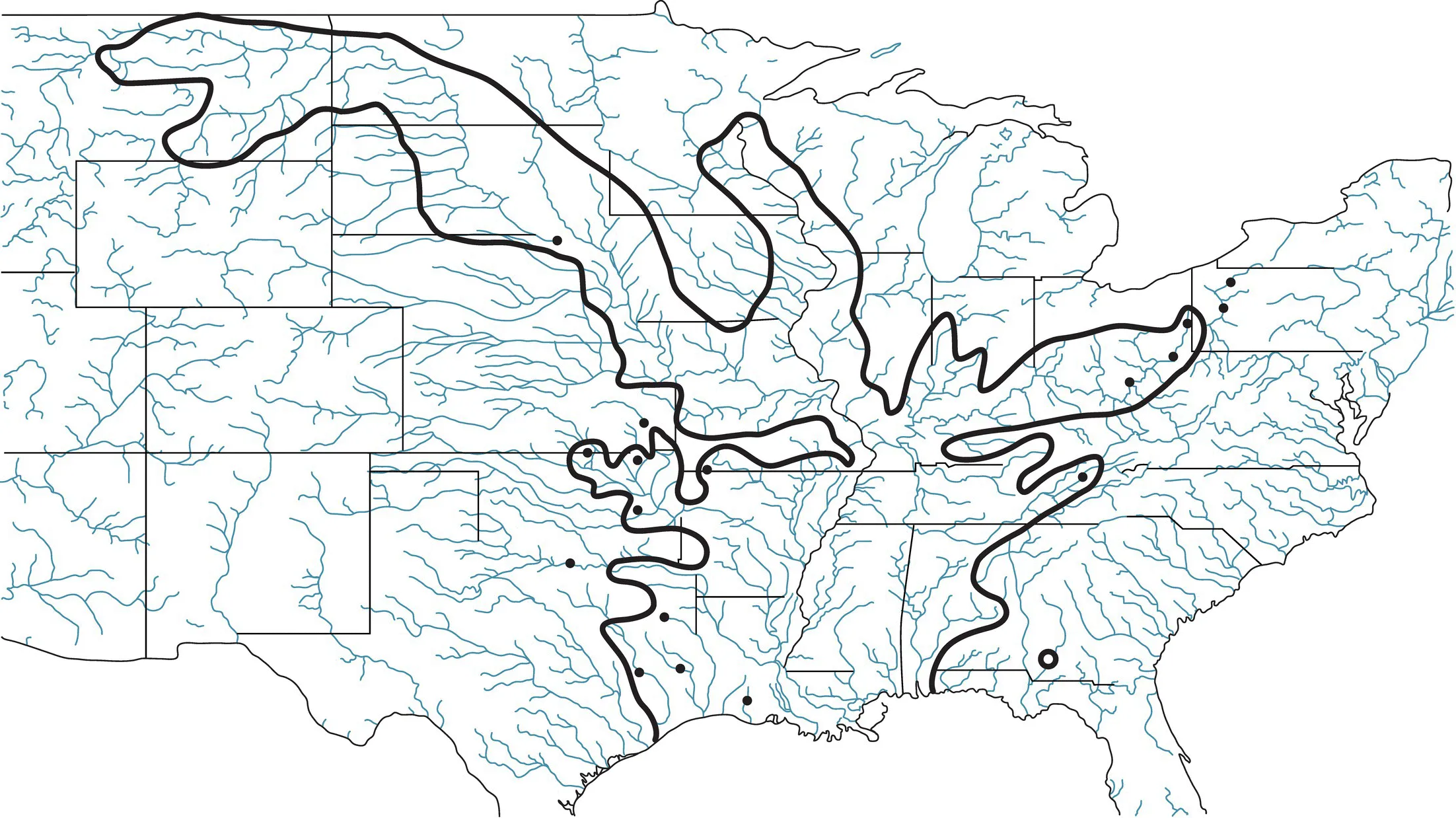
Generally, paddlefish inhabit large rivers, but they also occur in natural lakes, and frequently maintain populations that thrive in large impoundments, particularly if inflowing tributaries have conditions that will support reproduction. The natural historical range of the paddlefish included 26 states within the Mississippi River and Mobile Bay basins, and other Gulf of Mexico drainages westward to tributaries of Galveston Bay, Texas, but not eastward to the Apalachicola River system (Figure 1.1) (Smith-Vaniz 1968; Lee et al. 1980; Gengerke 1986; Hocutt & Wiley 1986; Pitman & Parks 1994; Jennings & Zigler 2009). Some other older records include the Great Lakes within the range (Hubbs & Lagler 1958).
Figure 1.1. Paddlefish distribution. Dots indicate some of the recent stockings, and the single open circle in Georgia is the one known escape into previously uninhabited waters.
(Redrawn from Jennings & Zigler 2009.)
Despite some decline at the extremes of their range and extirpation from four states – Maryland, New York, North Carolina, and Pennsylvania – all declines are in the northeastern portion; paddlefish populations currently in 22 states are considered by most resource agencies to be generally in good condition – increasing in three states, stable in 14 states, unknown in three states, and declining in only two states (Graham 1997; Jennings & Zigler 2009). Between 1994 and 2006, despite continued vacillation, there has been no basin-wide collapse in stocks as was earlier predicted (Bettoli et al. 2009). However, there have been recent efforts to re-establish paddlefish in some extirpated areas and restore former levels through supplemental stocking in others (Argent et al. 2009; Bettoli et al. 2009; Grady & Elkington 2009) Reintroduction has proceeded in New York, Pennsylvania, West Virginia, and in select Oklahoma reservoirs. A 10-year stocking program (1990–99) was conducted in Texas, including several rivers within the previous range (Sabine and Trinity Rivers systems). Viable reservoir populations have been reproducing for decades in Lake of the Cherokees on the Grand/Neosho River but restocking efforts have occurred in that watershed in Kansas, and populations have been re-established within Keystone Reservoir on the Arkansas River, Oologah Reservoir on the Verdigris River, Eufaula Reservoir on the North and South Canadian Rivers, and in Lake Texoma on the Red River (Figure 1.1) (Patterson 2009; ODWC 2010).
Production and population dynamics are vital to managing and harvesting only surplus yield, and thus factors that affect individual growth can impact population yields. Growth varies in different bodies of water in relation to the abundance of food. Consequently, weight-length relations may vary considerably based on population differences. Sexual dimorphism in adults is minimal, but males are generally thinner than the more rotund condition of females; the contrast is much more evident in fish from rivers compared to one from reservoirs or ponds.
Paddlefish exploitation has varied from spates of elevated intense harvest, to intervals of low fishing pressure. For example, the harvest was high in the 1890s, reaching about 1000 metric tonnes (MT) in 1899, then rapidly declined in the early 1900s (Coker 1923), only to escalate more recently in the 1970s and 1980s (Carlson & Bonislawsky 1981). The periods of heavy harvest were stimulated by demand for caviar in conjunction with shortfalls from Caspian Sea production; the recent fishing pressure was also related to trade in this product, much of which was illicit (Waldman & Secor 1999; W.L. Shelton, Chair, ad hoc committee on paddlefish, 1981–83, unpublished data, Southern Division,...
Table of contents
Cover
Title page
Table of Contents
Contributors
Foreword
Preface
Chapter 1: Introduction
Chapter 2: Biology
Chapter 3: Propagation and Early Culture Techniques
Chapter 4: Paddlefish Production for Meat and Caviar
Chapter 5: Paddlefish: International Status
Chapter 6: Paddlefish Food Products
Chapter 7: Bioaccumulation of Contaminants in Paddlefish
Chapter 8: Paddlefish Diseases
Chapter 9: The Economics of Paddlefish Aquaculture
Index
End User License Agreement
Trusted by 375,005 students
Access to over 1.5 million titles for a fair monthly price.
Study more efficiently using our study tools.
Frequently asked questions
Yes, you can cancel anytime from the Subscription tab in your account settings on the Perlego website. Your subscription will stay active until the end of your current billing period. Learn how to cancel your subscription
No, books cannot be downloaded as external files, such as PDFs, for use outside of Perlego. However, you can download books within the Perlego app for offline reading on mobile or tablet. Learn how to download books offline
Perlego offers two plans: Essential and Complete
Essential is ideal for learners and professionals who enjoy exploring a wide range of subjects. Access the Essential Library with 800,000+ trusted titles and best-sellers across business, personal growth, and the humanities. Includes unlimited reading time and Standard Read Aloud voice.
Complete: Perfect for advanced learners and researchers needing full, unrestricted access. Unlock 1.5M+ books across hundreds of subjects, including academic and specialized titles. The Complete Plan also includes advanced features like Premium Read Aloud and Research Assistant.
Both plans are available with monthly, semester, or annual billing cycles.
We are an online textbook subscription service, where you can get access to an entire online library for less than the price of a single book per month. With over 1.5 million books across 990+ topics, we’ve got you covered! Learn about our mission
Look out for the read-aloud symbol on your next book to see if you can listen to it. The read-aloud tool reads text aloud for you, highlighting the text as it is being read. You can pause it, speed it up and slow it down. Learn more about Read Aloud
Yes! You can use the Perlego app on both iOS and Android devices to read anytime, anywhere — even offline. Perfect for commutes or when you’re on the go. Please note we cannot support devices running on iOS 13 and Android 7 or earlier. Learn more about using the app
Yes, you can access Paddlefish Aquaculture by Steven D. Mims,William L. Shelton in PDF and/or ePUB format, as well as other popular books in Tecnología e ingeniería & Pesca y acuicultura. We have over 1.5 million books available in our catalogue for you to explore.