- Presents a collection of original, ethnographically-informed essays exploring the wide variety of beliefs, practices, and religious experiences in the contemporary world
- Explores a broad range of topics including the 'perspectivism' debate, the rise of religious nationalism, reflections on religion and new media, religion and politics, and ideas of self and gender in relation to religious belief
- Includes examples drawn from different religious traditions and from several regions of the world
- Features newly-commissioned articles reflecting the most up-to-date research and critical thinking in the field, written by an international team of leading scholars
- Adds immeasurably to our understanding of the complex relationships between religion, culture, society, and the individual in today's world
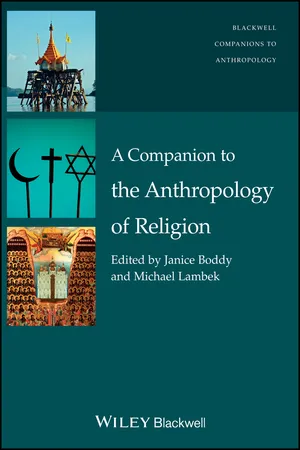
eBook - ePub
A Companion to the Anthropology of Religion
- English
- ePUB (mobile friendly)
- Available on iOS & Android
eBook - ePub
A Companion to the Anthropology of Religion
About this book
A Companion to the Anthropology of Religion presents a collection of original, ethnographically-informed essays that explore the variety of beliefs, practices, and religious experiences in the contemporary world and asks how to think about religion as a subject of anthropological inquiry.
Information
PART I
Worlds and Intersections
CHAPTER 1
Presence, Attachment, Origin: Ontologies of “Incarnates”
Most anthropologists dealing with non-Western societies tend to see the notion of “religion” as translating very inadequately the range of phenomena they study. And it is true that none of the traditional definitions of religion is really satisfying. Those that emphasize the contents always miss at least one of them or, on the contrary, pile them on in excess. Marcel Mauss, for instance, who was quite aware that religion is neither an essence nor a substance and that it can only be identified when embedded in social phenomena that are historically contextualized, classified these phenomena as “representations” (myths, beliefs, dogma), “practices” (acts, performances, utterances), “organizations” (churches, colleges of priests, monasteries) and “religious systems” (particular religions or groups of religions) (Mauss 1902). By doing so, he left aside the very qualities that peoples infer in the beings (deities, gods, spirits, immortals, ghosts, genies …) with which humans maintain all kinds of relations that religious systems may qualify and foster; even though, most of the time, these beings do not require institutions for them to materialize and become operative in human life. In that matter as well as in a few others, Mauss followed his uncle and mentor Émile Durkheim, whose ambitions were to determine religion as an intelligible object – that is, as a reasonable one – and to render manifest the mechanism of its instauration – sacredness as a transfiguration of society – without ever having to ask the embarrassing questions about the attributes with which these “sacralized” nonhumans were endowed, or about the mode of presence through which they became known. Both questions would have attracted too much attention to the seemingly irrational aspects of all religious ontologies, including the one underlying modern European forms of worship.
The same kind of Eurocentric – or rather circum-Mediterranean – bias affects the attempts to define religion in terms of contrastive oppositions. For instance, the one that was propounded by Dumézil between the sacra (that which goes from the humans to the gods) and the signa (that which goes from the gods to the humans), a distinction where one cannot fail to detect the heavy apparatus of oblation, sacrifice, and the interpretation of omens which binds in the same conceptual parcel the Greek and Roman gods with those of Mesopotamia and ancient Egypt (Dumézil 1968: 277). For these mechanisms of intertwined connectedness are entirely foreign to other peoples, far more numerous than usually stated, who offer nothing to their deities or who maintain with them a wholly unmediated dialogue, one that dispenses with ritual specialists, priests, diviners, or even shamans. In many parts of Oceania, South America or Northern Asia, no sacra go to the multifaceted spirits who lurk in the background, because no proper signa are expected from them: they may leave discreet clues as to their presence, they may even fleetingly intimate their desire to establish a relation with so-and-so, but this is a far cry from Heavenly decrees descending on mortals.
The same kind of implicit theocentrism goes with the classical distinction between, on the one hand, gods who are a mere guarantee of the world's order, who act as stewards and perpetrators of an uncreated cosmos and whose good will and zeal must be fueled by humans, and on the other hand, an omnipotent creator god to whom one owes the world itself and everything it contains, an inflexible warden of the order which he instituted and the maintenance of which depends upon the proper maintenance of the alliance that he imposes on (some) humans. The first category embraces the religions of the cosmos, various expressions of Daoism, the religions focusing on dharma, as well as all those functional polytheisms in which deities with a high degree of specialization are entrusted with the task of looking after the adequate working of such and such a sector of the world; the second category is restricted to the monotheisms born on the periphery of the Mediterranean Sea. However, both these categories leave aside a large part of humankind. In particular they exclude all those peoples who do not deem it necessary that the world be ordered – they content themselves with trying to maintain fruitful relations with its inhabitants, whether visible or invisible; they also exclude all those peoples who judge that an order once instantiated becomes sufficiently robust for it not to require a permanent struggle against its disaggregation – in Australia, for example, where the great cosmic classes instituted by the Beings of Dreamtime do not need to be constantly consolidated. In short, it remains quite difficult, and rather unwise, to characterize reflexively a universal essence of religion or of sacredness. Thus, it should not come as a surprise that most European scholars who attempted to do so in the latter half of the nineteenth century and the first decades of the twentieth, scholars who were themselves witnesses of, and often actors in, the process of disenchantment of the world, have used for that purpose what was most familiar to them: the transcendence of the sacred and the finitude of Man, divine wrath and the necessity to placate it, obedience and repentance, the magnificence of liturgy and the worldly influence of priests. Hence the emphasis in the definition of religion laid on what was, in Durkheim's words, “separate and forbidden,” on cosmological order and hierarchies, on the necessary mediation of ritual, corporate groups and dogma.
However, the quest for some common ground that might account for at least a dimension of all religious phenomena may not be entirely hopeless. For there is a universal function which brings Christianity back into the common lot of immanent states and ordinary paganisms, a function that Christianity shares with art but which artists have forsaken progressively in the course of the last century when they deemed it necessary, following Marcel Duchamp's “ready-made,” to question the self-evidence of iconicity. This function is figuration, that is, the public instauration of an invisible quality through a speech act or an image. Under all the guises chosen to consider it, religion embodies, religion incarnates, religion renders present in visible and tangible manifestations the various alterations of being, the manifold expressions of non-self, and the potencies which contain all their acts. The diverse populations of beings that religion institutes in the various parts of the world, and in the heavens that border them, have this peculiarity that, by contrast with organisms, mountains or philosophical concepts, they are all lying in wait for an incarnation, however insubstantial that may be. This is indeed a defining feature of the central figure of Christianity, but a feature it shares with the different kinds of paganism. What differentiates the various entities instituted by religion are their ontological qualities, the kind of metaphysical coherence that they exhibit, and thus the manner in which they can be rendered perceptually present to those for whom they are a matter of concern. The present chapter is thus an attempt to throw a light on religion by tackling one of its aspects: the ontological pluralism of religious beings and the different ways in which they become known to humans. It can be seen as a contribution to a natural history, not of religion per se – as in the anthropological approach inspired by evolutionary psychology – but of the various populations of “incarnates” that peoples deal with when engaged in the kind of intercourse traditionally labeled as “religious.” In sum, rather than the straightforward “anthropology of religion” – usually focused solely on humans – what this essay wishes to explore is a comparative anthropology of a kind of nonhumans characterized by their intermittent mode of being, and of the very diverse ways according to which these go about actualizing their presence.
Ontological Pluralism
A rapid examination of the classical literature on religion suggests that there exist at least three major classes of entities that can become embodied and operative in certain circumstances; let's call them “spirits,” “deities,” and “antecedents.” Each of these classes of “incarnates” appears to be typical of a specific ontology, although some of them may coexist in a single conceptual or physical space, a point I shall return to later. An ontology is taken here as an unfolding of the phenomenological consequences of different kinds of inferences about the identities of things around us, inferences which operate by lumping together, or dissociating, elements of the lived world that appear to have similar or dissimilar qualities. One of the universal features of the human mind upon which such dispositions can be predicated is the awareness of a duality between, on the one hand, physical substances and material processes (here called “physicality”) and, on the other hand, inner dispositions and mental states (here called “interiority”). By using this grid, humans are able to emphasize or minimize continuity and difference between humans and nonhumans. Thus, on the physicality axis, it may be inferred that all physical bodies are essentially ruled by identical “natural” principles, while the opposing inference stresses species differences and postulates that what marks out different kinds of entities is, precisely, the bodies they inhabit. Similarly, on the interiority axis, the emphasis may be on continuity (all beings have the same kind of inner dispositions) or on discontinuities (humans form a kind apart because of their souls or minds). When stabilized, systematized and transmitted, each of these basic inferences results in a specific ontology, that is, a guiding principle for perceiving how and with what the world is furnished; I have labeled these ontologies “animism,” “totemism,” “naturalism,” and “analogism” (Descola 2005).
In an animist ontology, nonhumans are endowed with the same interiority as humans, but every class of beings is differentiated by the body they inhabit. It is most common among native populations of Amazonia, northern North America, Siberia, and some parts of Southeast Asia and Melanesia who maintain that animals, plants, and even inanimate objects have a human-like intentionality, lodged within a mobile bodily clothing which nevertheless determines, because of its anatomical features, the type of world they have access to and how they see it. Naturalism is the mirror opposite of animism and characterizes the modern world and Western thought. It insists on the differences between humans and nonhumans on the interiority axis: humans alone are supposed to have a meaningful selfhood, whether individual (mind, language, capacity for symbolism) or collective (Volksgeist, cultures). By contrast, humans and nonhumans are linked by their shared physicality: they belong to a continuum where the same laws of Nature apply. As for totemism, it is taken here not in the sense, rendered common by Lévi-Strauss (1962b), of a universal classificatory device using natural discontinuities to signify social segmentation, but rather as an ontology that stresses the continuity between humans and nonhumans both on the physicality axis (common substances) and on the interiority one (common essences). It is best exemplified by Australian Aboriginal cultures where specific plant and animal species are believed to share with particular sets of humans an identical complex of essential qualities, but one that is absolutely different from other similar groupings. Finally, in an “analogist” ontology, discontinuities are assumed on both axes, with the recognition that there exist microdifferences between the components of the world at an infra-individual level. But a world thus made of singularities requires in turn, to become intelligible and manageable, that various kinds of correspondences be set up between these heterogeneous elements (hence “analogism”). Analogism was the dominant ontology in Europe until the Renaissance, and it is still extremely common elsewhere: in the Far East and India, in western Africa or among native cultures of Mexico and the Andes.
These various manners of detecting and emphasizing folds in our surroundings should not be taken as a typology of tightly isolated “worldviews,” but rather as an outcome of different kinds of assumptions about what the world is made of. According to circumstances, each human is capable of making any of the four inferences, but will most likely pass a judgment of identity according to the ontological context – that is, the systematization for a group of humans of one of the inferences only – where he or she was socialized. The most usual milieu for that is a collective, understood as the outcome of a specific way of assembling humans and nonhumans in a network of relations. That notion of collective, which was initially coined by Bruno Latour (1993), is meant here as an aggregating device, the purpose of which is to gather within an operational assemblage certain types of beings that each ontology distinguishes, and to exclude others. For instance, plants and animals are excluded from naturalist collectives – “societies” or “ethnic groups” exclusively composed of humans – while they form their own collectives, one for each species, in animist ontologies. It should come as no surprise, then, that incarnates find themselves distributed into different kinds of collectives according to the ontological features that go with their particular mode of presence. Let's examine that for each class in turn.
Spirits
Spirits are the typical incarnates in what I have called animist ontologies, that i...
Table of contents
- Cover
- Blackwell Companions to Anthropology
- Title page
- Copyright page
- List of Figures
- Notes on Contributors
- Preface and Acknowledgments
- What Is “Religion” for Anthropology? And What Has Anthropology Brought to “Religion”?
- PART I: Worlds and Intersections
- PART II: Epistemologies
- PART III: Time and Ethics
- PART IV: Practices and Mediations
- PART V: Languages and Conversions
- PART VI: Persons and Histories
- PART VII: Powers
- Index
Trusted by 375,005 students
Access to over 1.5 million titles for a fair monthly price.
Study more efficiently using our study tools.
Frequently asked questions
Yes, you can cancel anytime from the Subscription tab in your account settings on the Perlego website. Your subscription will stay active until the end of your current billing period. Learn how to cancel your subscription
No, books cannot be downloaded as external files, such as PDFs, for use outside of Perlego. However, you can download books within the Perlego app for offline reading on mobile or tablet. Learn how to download books offline
Perlego offers two plans: Essential and Complete
- Essential is ideal for learners and professionals who enjoy exploring a wide range of subjects. Access the Essential Library with 800,000+ trusted titles and best-sellers across business, personal growth, and the humanities. Includes unlimited reading time and Standard Read Aloud voice.
- Complete: Perfect for advanced learners and researchers needing full, unrestricted access. Unlock 1.5M+ books across hundreds of subjects, including academic and specialized titles. The Complete Plan also includes advanced features like Premium Read Aloud and Research Assistant.
We are an online textbook subscription service, where you can get access to an entire online library for less than the price of a single book per month. With over 1.5 million books across 990+ topics, we’ve got you covered! Learn about our mission
Look out for the read-aloud symbol on your next book to see if you can listen to it. The read-aloud tool reads text aloud for you, highlighting the text as it is being read. You can pause it, speed it up and slow it down. Learn more about Read Aloud
Yes! You can use the Perlego app on both iOS and Android devices to read anytime, anywhere — even offline. Perfect for commutes or when you’re on the go.
Please note we cannot support devices running on iOS 13 and Android 7 or earlier. Learn more about using the app
Please note we cannot support devices running on iOS 13 and Android 7 or earlier. Learn more about using the app
Yes, you can access A Companion to the Anthropology of Religion by Janice Boddy, Michael Lambek, Janice Boddy,Michael Lambek in PDF and/or ePUB format, as well as other popular books in Social Sciences & Cultural & Social Anthropology. We have over 1.5 million books available in our catalogue for you to explore.