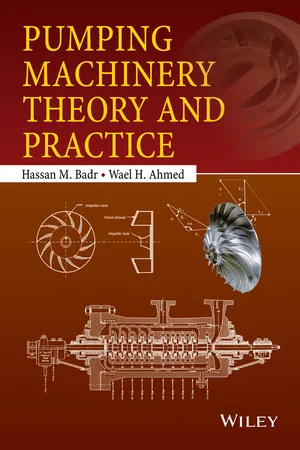
Pumping Machinery Theory and Practice
eBook - ePub

Pumping Machinery Theory and Practice

  1. English
  2. ePUB (mobile friendly)
  3. Available on iOS & Android
eBook - ePub

Pumping Machinery Theory and Practice

About this book

Pumping Machinery Theory and Practice comprehensively covers the theoretical foundation and applications of pumping machinery. Key features:

  • Covers characteristics of centrifugal pumps, axial flow pumps and displacement pumps
  • Considers pumping machinery performance and operational-type problems
  • Covers advanced topics in pumping machinery including multiphase flow principles, and two and three-phase flow pumping systems
  • Covers different methods of flow rate control and relevance to machine efficiency and energy consumption
  • Covers different methods of flow rate control and relevance to machine efficiency and energy consumption

Frequently asked questions

Yes, you can cancel anytime from the Subscription tab in your account settings on the Perlego website. Your subscription will stay active until the end of your current billing period. Learn how to cancel your subscription.
At the moment all of our mobile-responsive ePub books are available to download via the app. Most of our PDFs are also available to download and we're working on making the final remaining ones downloadable now. Learn more here.
Perlego offers two plans: Essential and Complete
  • Essential is ideal for learners and professionals who enjoy exploring a wide range of subjects. Access the Essential Library with 800,000+ trusted titles and best-sellers across business, personal growth, and the humanities. Includes unlimited reading time and Standard Read Aloud voice.
  • Complete: Perfect for advanced learners and researchers needing full, unrestricted access. Unlock 1.4M+ books across hundreds of subjects, including academic and specialized titles. The Complete Plan also includes advanced features like Premium Read Aloud and Research Assistant.
Both plans are available with monthly, semester, or annual billing cycles.
We are an online textbook subscription service, where you can get access to an entire online library for less than the price of a single book per month. With over 1 million books across 1000+ topics, we’ve got you covered! Learn more here.
Look out for the read-aloud symbol on your next book to see if you can listen to it. The read-aloud tool reads text aloud for you, highlighting the text as it is being read. You can pause it, speed it up and slow it down. Learn more here.
Yes! You can use the Perlego app on both iOS or Android devices to read anytime, anywhere — even offline. Perfect for commutes or when you’re on the go.
Please note we cannot support devices running on iOS 13 and Android 7 or earlier. Learn more about using the app.
Yes, you can access Pumping Machinery Theory and Practice by Hassan M. Badr,Wael H. Ahmed in PDF and/or ePUB format, as well as other popular books in Technology & Engineering & Mechanical Engineering. We have over one million books available in our catalogue for you to explore.

1
Essentials of Fluid Mechanics

The basic fundamentals of fluid mechanics are essential for understanding the fluid dynamics of pumping machinery. This chapter aims to provide a quick revision of the definitions and basic laws of fluid dynamics that are important for a thorough understanding of the material presented in this book. Of particular interest are the kinematics of fluid flow; the three conservation principles of mass, momentum, and energy; relevant dimensionless parameters; laminar and turbulent flows; and friction losses in piping systems. Some applications of relevance to pumping machinery are also considered.

1.1 Kinematics of Fluid Flow

To fully describe the fluid motion in a flow field it is necessary to know the flow velocity and acceleration of fluid particles at every point in the field. This may be a simple task in laminar flows but may be difficult in turbulent flows. If we use the Eulerian method and utilize Cartesian coordinates, the velocity vector at any point in a flow field can be expressed as
(1.1)
images
where
images
is the velocity vector; u, v, and w are the velocity components in the x, y, and z directions; and
images
, and
images
are unit vectors in the respective directions. In general, each of the velocity components can be a function of position and time, and accordingly we can write
(1.2)
images
The components of acceleration in the three directions can be expressed as
(1.3a)
images
(1.3b)
images
(1.3c)
images
The acceleration vector becomes
(1.4)
images
This vector can be split into two components, the local component,
images
, and the convective component,
images
, that can be expressed as
(1.5a)
images
(1.5b)
images

1.1...

Table of contents

  1. Cover
  2. Title page
  3. Copyright page
  4. Dedication page
  5. Preface
  6. Nomenclature
  7. 1 Essentials of Fluid Mechanics
  8. 2 Introduction and Basic Considerations
  9. 3 Fundamentals of Energy Transfer in Centrifugal Pumps
  10. 4 Axial and Radial Thrusts in Centrifugal Pumps
  11. 5 Common Problems in Centrifugal Pumps
  12. 6 Axial Flow Pumps
  13. 7 Displacement Pumps
  14. 8 Introduction to Fans and Compressors
  15. 9 Multiphase Flow Pumping
  16. 10 Pump Selection Guidelines
  17. Index
  18. End User License Agreement