The bestselling analysis of higher education's impact, updated with the latest data
How College Affects Students synthesizes over 1,800 individual research investigations to provide a deeper understanding of how the undergraduate experience affects student populations. Volume 3 contains the findings accumulated between 2002 and 2013, covering diverse aspects of college impact, including cognitive and moral development, attitudes and values, psychosocial change, educational attainment, and the economic, career, and quality of life outcomes after college. Each chapter compares current findings with those of Volumes 1 and 2 (covering 1967 to 2001) and highlights the extent of agreement and disagreement in research findings over the past 45 years. The structure of each chapter allows readers to understand if and how college works and, of equal importance, for whom does it work. This book is an invaluable resource for administrators, faculty, policymakers, and student affairs practitioners, and provides key insight into the impact of their work.
Higher education is under more intense scrutiny than ever before, and understanding its impact on students is critical for shaping the way forward. This book distills important research on a broad array of topics to provide a cohesive picture of student experiences and outcomes by:
Reviewing a decade's worth of research;
Comparing current findings with those of past decades;
Examining a multifaceted analysis of higher education's impact; and
Informing policy and practice with empirical evidence
Amidst the current introspection and skepticism surrounding higher education, there is a massive body of research that must be synthesized to enhance understanding of college's effects. How College Affects Students compiles, organizes, and distills this information in one place, and makes it available to research and practitioner audiences; Volume 3 provides insight on the past decade, with the expert analysis characteristic of this seminal work.
CHAPTER ONE Studying College Outcomes in the 2000s
Overview and Organization of the Research
The purpose and value of higher education are under fire. As national confidence in the aims of higher education and the subsequent value of degree attainment erode (see Arum & Roksa, 2011, 2014), scholars interested in college and its influence on students are faced with a series of emergent challenges, ranging from the decoupling of the once tightly held belief that participation in higher education was the primary means for learning and thus social mobility to ontological questions about learning itself: Is learning about making money? Why is learning important if it does not lead to financial gain? Indeed, some students are paid to forgo college-going for pursuing entrepreneurial start-ups. Peter Thiel, founder of the Thiel Foundation, an organization that pays up-and-coming entrepreneurs to leave formal education, noted, “University administrators are the equivalent of mortgage brokers, selling you a story that you should go into debt massively, that it's not a consumption decision, it's an investment decision. Actually, no, it's a bad consumption decision. Most colleges are four-year parties” (Jenkins, 2010, p. A.13). This comment exemplifies the emergent American learning conundrum: How utilitarian and pragmatic does learning need to be in order to hold value in and to American society? Is higher education an investment in one's future or a consumable good of questionable value?
In light of these questions and challenges, educators from across disciplines are designing and executing rigorous college impact studies that draw on the scholarly work of generations past to further develop a robust understanding of college as critical to not only the learning enterprise but to other social and economic factors as well. Rather than shy away from the difficulties of studying outcomes that many think are ineffable and even irrelevant, these scholars are approaching the study of college impact with the thoroughness needed to appraise historic claims regarding the roles and purposes of higher education and the innovation needed to tackle questions once believed too challenging to address. Our aim in this volume is not to provide silver-bullet answers to these pressing and difficult questions but to review carefully the evidence for helping educators make claims about college and its impact on students.
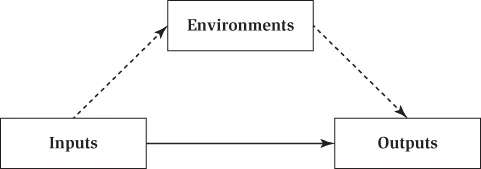
Conceptually, this volume is based on Astin's (1984) framework for understanding how college affects students. Put simply, this framework deconstructs the college experiences into three discrete categories: inputs, environments, and outcomes. Inputs include demographic characteristics, academic preparedness, and predispositions that students bring with them to campus (e.g., race, high school grade point average, SAT scores, degree aspirations, and academic motivation, to name a few). Environments include, but are not limited to, institutional cultures and climates and specific educational experiences designed to shape students in some meaningful way. Outcomes relate to the attitudes (e.g., student satisfaction), aptitudes (e.g., critical thinking), and behaviors (e.g., departure) that students exhibit as a result of going to college.
Of critical importance to this review is how these categories work together to explain college and its effects on students. When organizing studies, we based our review on two relationships: that which we call “general” to describe the relationship between environments and outcomes (i.e., how exposure to and participation in college generally affect all college students) and that which we call “conditional” to underscore the relationship between environments and outcomes as it relates to student inputs (i.e., how exposure to and participation in college experiences affect students differentially based on students' input characteristics).
Figure 1.1 is a graphic representation of Astin's model. These relationships are represented by the dotted arrows in the figure. Note that the relationship between inputs and outcomes is displayed with a solid arrow to reflect that the review did not focus on studies that examined this relationship.
Figure 1.1 Astin's Framework (1984) for Understanding College and Its Influence on Students
With this conceptual map as our guide, we used the organizational framework developed by Ernest Pascarella and Patrick Terenzini (1991, 2005) to synthesize the many thousands of empirically based articles designed to better understand college and its relationship to student outcomes. Building on the generous work of many scholars and employing the organizational framework used in the previous two volumes of this work, we addressed each of these six issues for each set of outcomes: the development of verbal, quantitative, and subject matter competence; cognitive skills and intellectual growth; psychosocial change; attitudes and values; moral development; educational attainment and persistence; career and economic impacts of college; and quality of life after college. Specifically, we adopted Pascarella and Terenzini's six-question framework for organizing the literature within each chapter. This framework, which developed out of previous work by G. Gurin (1971), Nucci and Pascarella (1987), and Pascarella (1985), asks six basic questions that serve as the organizing feature for each chapter:
What evidence is there that individuals change during the time in which they are attending college?
What evidence is there that change or development during college is the result of college attendance?
What evidence is there that attending different kinds of postsecondary institutions have a differential influence on student change and development during college?
What evidence exists that engaging in different experiences in the same institution are associated with student change and development during college?
What evidence is there that the collegiate experience produces conditional, as opposed to general, effects on student change or development?
What are the long-term effects of college?
Question 1, which we sometimes refer to by the shorter phrasing of “change during college,” refers to whether change occurred while students were exposed to postsecondary education. Question 2, regarding the net effects of college, focuses on whether the change is attributed to postsecondary exposure, as opposed to precollege characteristics, maturation, or other noncollege experiences. Question 3, between-college effects, explores the degree to which institutional conditions (e.g., size, control, geographic location) or organizational characteristics (e.g., average level of peer cognitive development, whether the school is bureaucratic or collegial, structural diversity of the faculty) have an influence on the learning and development of the student. Question 4, within-college effects, summarizes the articles that address student change as a function of exposure to or participation in specific collegiate experiences. Question 5, conditional effects of college, gauges the extent to which the relationship between student change and any given college experience differs based on student characteristics, such as race, gender, or academic major. Question 6, long-term effects of college, addresses the duration or permanence of the college influence based on student's postcollege activities, attitudes, beliefs, and behaviors. Table 1.1 summarizes the framework used to guide this review.
Table 1.1 Overview of Review Framework
Conceptual Orientation
Shorthand
Description
Example Research Question
Question 1
General
Change during college
Whether change occurred while in college
Do college students demonstrate gains in moral development during college?
Question 2
General
Net effects of college
Whether the change can be attributed to college-going, as opposed to maturation, for example
Does moral development occur as a result of college-going, accounting for a host of potential confounding influences?
Question 3
General
Between-college effects
Whether the change can be explained by institutional conditions, organizational characteristics, and/or peer socialization
What role does institutional type and public (versus private) control play in shaping students' moral development?
Question 4
General
Within-college effects
Whether the change can be explained by exposure to and participation in specific educational experiences
How does participation in a service-learning experience influence moral development?
Question 5
Conditional
Conditional effects of college
Whether the change that occurs as a result of participation in any given college experience differs based on student inputs such as race, gender, living status
Does the relationship between participating in a service-learning experience and moral development differ between residential and commuter students?
Question 6
General
Long-term college effects
If the changes due to college are sustained after graduation
Are the moral development gains made during college sustained beyond graduation?
Building on these six questions used to frame the literature, we organized studies within each question based on themes emerging from the articles reviewed for each chapter. This decision came from our collective value to review articles in the spirit in which they were written. We wanted to stay as close to the authors' intentions as possible. Of course, this decision produced a distinctive set of challenges regarding structural continuity across chapters. For example, for the within-college effects section of each chapter, some authors studied honors colleges while others did not; some articles discussed interactional diversity while others examined quality of diversity interaction or non-classroom-based diversity peer interaction; some studies investigated work on campus while others reflected interest in part-time employment. Given these and the many more examples of themes that emerged from the studies themselves, we chose not to try to force articles into categories for the sake of consistency across chapters; rather, we let the literature base specific to the chapter's focus inform the organization of that chapter, at least to some degree. Similarly, a number of outcomes examined in the literature do not fit neatly and discretely into one chapter or another. For example, one could argue that a self-reported gain in general education is a measure of the general skills, like verbal and quantitative competence, that students develop in college; ...
Table of contents
Cover
Title Page
Copyright Page
Table of Contents
List of Figures and Tables
Acknowledgments
About the Authors
Chapter 1: Studying College Outcomes in the 2000s
Chapter 2: Development of Verbal, Quantitative, and Subject Matter Competence
Chapter 3: Cognitive and Intellectual Development
Chapter 4: Psychosocial Change
Chapter 5: Attitudes and Values
Chapter 6: Moral Development
Chapter 7: Educational Attainment and Persistence
Chapter 8: Career and Economic Impacts of College
Chapter 9: Quality of Life after College
Chapter 10: How College Affects Students
Chapter 11: Implications for Policy, Research, and Practice
Methodological Appendix: Considerations for Research on College Impact
References
Name Index
Subject Index
End User License Agreement
Trusted by 375,005 students
Access to over 1.5 million titles for a fair monthly price.
Study more efficiently using our study tools.
Frequently asked questions
Yes, you can cancel anytime from the Subscription tab in your account settings on the Perlego website. Your subscription will stay active until the end of your current billing period. Learn how to cancel your subscription
No, books cannot be downloaded as external files, such as PDFs, for use outside of Perlego. However, you can download books within the Perlego app for offline reading on mobile or tablet. Learn how to download books offline
Perlego offers two plans: Essential and Complete
Essential is ideal for learners and professionals who enjoy exploring a wide range of subjects. Access the Essential Library with 800,000+ trusted titles and best-sellers across business, personal growth, and the humanities. Includes unlimited reading time and Standard Read Aloud voice.
Complete: Perfect for advanced learners and researchers needing full, unrestricted access. Unlock 1.5M+ books across hundreds of subjects, including academic and specialized titles. The Complete Plan also includes advanced features like Premium Read Aloud and Research Assistant.
Both plans are available with monthly, semester, or annual billing cycles.
We are an online textbook subscription service, where you can get access to an entire online library for less than the price of a single book per month. With over 1.5 million books across 990+ topics, we’ve got you covered! Learn about our mission
Look out for the read-aloud symbol on your next book to see if you can listen to it. The read-aloud tool reads text aloud for you, highlighting the text as it is being read. You can pause it, speed it up and slow it down. Learn more about Read Aloud
Yes! You can use the Perlego app on both iOS and Android devices to read anytime, anywhere — even offline. Perfect for commutes or when you’re on the go. Please note we cannot support devices running on iOS 13 and Android 7 or earlier. Learn more about using the app
Yes, you can access How College Affects Students by Matthew J. Mayhew,Alyssa N. Rockenbach,Nicholas A. Bowman,Tricia A. D. Seifert,Gregory C. Wolniak,Ernest T. Pascarella,Patrick T. Terenzini in PDF and/or ePUB format, as well as other popular books in Education & Education Administration. We have over 1.5 million books available in our catalogue for you to explore.