eBook - ePub
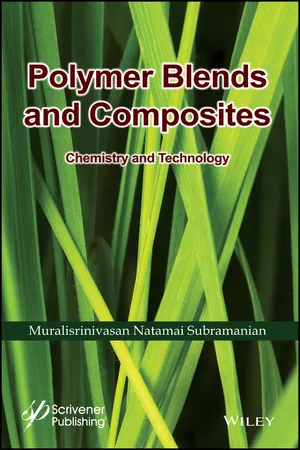
Polymer Blends and Composites
Chemistry and Technology
- English
- ePUB (mobile friendly)
- Available on iOS & Android
eBook - ePub
About this book
Because it is critically important to manufacture quality products, a reasonable balance must be drawn between control requirements and parameters for improved processing method with respect to plastics additives. An important contribution to the commercial polymer industry, Polymer Blends and Composites is one of the first books to combine plastics additives, testing, and quality control. The book is a comprehensive treatise on properties that provides detailed guidelines for selecting and using blends and composites for applications. A valuable resource for operators, processors, engineers, chemists, the book serves to stimulate those already active in natural polymer composites.
Information
Chapter 1
Introduction
Polymers are considered as matrix materials in blends and composites. These polymers, which are a result of the mixing of two or more polymers, enable the production of blends and composites with required properties. As the performance requirements of polymers become more demanding, their physical properties through the use of blends and composites has become increasingly important.
Polymers have recently been used more frequently as blends and composites, resulting in good technological qualities of each of the components. Polymer blend processing has emerged as an inexpensive and versatile route to control the microstructural characteristics of polymers and enhance their properties [1–4].
Polymers are macromolecules and are insoluble material. The physical properties of the material dictate the complex structure of polymer by their ability to establish a structure-property relationship that predicts various physical properties. With the introduction of food packaging, the use of polymers has grown greatly, particularly the use of thermoplastic polymers such as high- and low-density polyethylene (HDPE and LDPE), polypropylene (PP), polyethylene terephtalate (PET), polyvinyl chloride (PVC), and polystyrene (PS). Polymers have been widely used as a route to develop a combination of desired properties by blending or by composites.
1.1 Polymer Blends
Polymer blends have become a broad field that aims to tailor polymer functionality. The blending of polymers is an inexpensive route to the modification of various polymer properties. It is a viable and versatile way to control the performance of polymeric materials with available polymers [5]. There has been a significant increase in the use of polymer blends to obtain new high-performance organic materials without any synthesis, resulting in a new polymeric material. Polymer blends are composed of two or more polymers with or without compatibilizer, depending on the composition and viscoelastic properties of individual components. They have complicated properties which display elasticity and viscosity at different strain rates and temperatures [6, 7].
Polymer blending is a relatively simple process and cheaper than polymer synthesis. The blending of conventional polymers has been extensively employed to develop new polymeric materials. Polymer blends have become a traditional method for producing new, high-performance polymeric materials. Mechanical, optical and electrical properties of polymer blends depend on their morphological characteristics [8]. They are produced in order to achieve improvements in properties such as thermal stability, mechanical properties or chemical resistance [9]. Many important polymer blends are incompatible polymers [4]. Due to its utility and simplicity, blending is currently a feasible method for improving polymer surface properties [10, 11]. Polymer blends and composites improve product performance by combining different polymers with specific properties in order to combine as one material.
1.2 Polymer Composites
Polymer matrix composite is a material with at least two phases, a continuous phase as polymer and a dispersed phase as filler or fiber. The continuous phase is responsible for filling the volume and transferring loads to the dispersed phase. The dispersed phase is responsible for enhancing one or more properties of the composite.
Polymer matrix composites, due to their outstanding mechanical properties, are widely used as special engineering materials in applications for aerospace, automotive and civil engineering structures. Therefore, it is of great interest to have knowledge of the durability of these materials [12, 13]. Polymer composites are controlled by the reinforcing material content present in them. Volume fraction and orientation of reinforcing material decides the properties such as stiffness, strength, thermal conductivity, and other properties of composites. Instead of synthesizing new polymers, composites have several features in comparison with metallic and other products.
Composites have been developed to meet several industrial requirements such as the need for easier processing and broadening of the range of properties, either by varying the type, relative amounts or morphology of each component. These materials can be prepared so as, for example, to combine their high mechanical strength to a better dimensional stability and thermal resistance. Sometimes a higher stiffness is also attained with the use of reinforcing fillers [14–16]. Most of the composites target an enhancement of mechanical properties such as stiffness and strength, but other properties may be of interest such as density, thermal properties, etc.
One of the key parameters in controlling the successful design of polymer matrix composites is the efficient control of the interface between the continuous phase (polymer) and the discontinuous phase (reinforcement). The greatest advantage of composite materials is that they offer the possibility of tailoring their properties by playing with the volume fraction of the discontinuous phase, dimension of the particles (particularly when in fiber form), and their orientation [17].
1.3 Blends and Composites – Advantages
Polymers have been widely used as routes to develop a combination of desired properties by blending or by composites. Polymer blends and composites with useful combinations have increased considerably and rapidly. There has been a long practice of tailoring specific processing and performance requirements which combine both physical and mechanical properties of the existing polymers depending on the composition and level of compatibility of the materials.
Blends and composites are relatively
- Low cost;
- Light weight, thereby easily transported;
- Easy to fabricate using extrusion, injection molding, compression molding, etc.;
- Durable against environmental degradation such as corrosion, rust and higher thermal stresses which are present in metallic products.
Therefore, polymer blends and composites can be converted into products or components. They have thermal-oxidative stability with mechanical properties. Apart from consumer products, polymer blends are widely used in industrial and engineering applications, all over the world [18]. However, their conversion is not easy because most polymers are generally not miscible [19, 20].
1.4 Summary
- Simple blends have poor mechanical properties and unstable morphologies.
- Polymer blends offer attractive opportunities for developing new materials with a useful combination of properties.
- Development of composites for replacement application is particularly demanding from a mechanical, chemical and functional point of view.
- Blends and composites of commercial products are normally much cheaper than the synthesis of a new class of polymers.
References
1. Olabisi, O., Robeson L.M., Shaw M.T., Polymer-Polymer Miscibility, Academic Press, New York, 1979.
2. Ehlers, W. and Markert, B., Int. J. Plast. 19, 961–976, 2003.
3. Prince, L.M., in: Microemulsions: Theory and Practice, Academic Press, New York, 1977.
4. Mansion, J.A. and Sperling, L.H., in: Polymer Blends and Composites, 51, Plenum Press, New York, 1970.
5. Vigild, M.E., et al., Macromolecules 34, 951, 2001.
6. Haupt, P., Lion, A., and Backhaus, E., Int. J. Solids Struct. 37, 3633–3646, 2000.
7. Ehlers, W. and Markert, B., Int. J. Plast. 19, 961–976, 2003.
8. Xie, X.-M., Xiao, T.-J., Zhang, Z.-M., and Tanioka, A.J., Colloid Interface Sci. 206, 189, 1998.
9. Prince, L.M., in: Microemulsions: Theory and Practice, Academic Press, New York, 1977.
10. Xie, X.-M., Xiao, T.-J., Zhang, Z.-M., and Tanioka, A.J., Colloid Interface Sci. 206, 189, 1998.
11. Schroeder, K., Klee, D., Hocker, H., Leute, A., Benninghoven, A., and Mittermayer, C.J., Appl. Polym. Sci. 58, 699, 1995.
12. Al-Haik, M.S., Garmestani, H., and Savran, A., Int. J. Plasticity 20, 1875–1907, 2004...
Table of contents
- Cover
- Title page
- Copyright page
- Preface
- Chapter 1: Introduction
- Chapter 2: Polymers
- Chapter 3: Polymer Properties
- Chapter 4: Additives
- Chapter 5: Polymer Blends and Composites
- Chapter 6: Polymer Blends: Thermodynamics
- Chapter 7: Polymer Blends
- Chapter 8: Polymer Composites
- Chapter 9: Biocomposites
- Chapter 10: Processing Technology
- Chapter 11: Blends, Composites and the Environment
- Chapter 12: Future Trends
- Index
- End User License Agreement
Trusted by 375,005 students
Access to over 1.5 million titles for a fair monthly price.
Study more efficiently using our study tools.
Frequently asked questions
Yes, you can cancel anytime from the Subscription tab in your account settings on the Perlego website. Your subscription will stay active until the end of your current billing period. Learn how to cancel your subscription
No, books cannot be downloaded as external files, such as PDFs, for use outside of Perlego. However, you can download books within the Perlego app for offline reading on mobile or tablet. Learn how to download books offline
Perlego offers two plans: Essential and Complete
- Essential is ideal for learners and professionals who enjoy exploring a wide range of subjects. Access the Essential Library with 800,000+ trusted titles and best-sellers across business, personal growth, and the humanities. Includes unlimited reading time and Standard Read Aloud voice.
- Complete: Perfect for advanced learners and researchers needing full, unrestricted access. Unlock 1.5M+ books across hundreds of subjects, including academic and specialized titles. The Complete Plan also includes advanced features like Premium Read Aloud and Research Assistant.
We are an online textbook subscription service, where you can get access to an entire online library for less than the price of a single book per month. With over 1.5 million books across 990+ topics, we’ve got you covered! Learn about our mission
Look out for the read-aloud symbol on your next book to see if you can listen to it. The read-aloud tool reads text aloud for you, highlighting the text as it is being read. You can pause it, speed it up and slow it down. Learn more about Read Aloud
Yes! You can use the Perlego app on both iOS and Android devices to read anytime, anywhere — even offline. Perfect for commutes or when you’re on the go.
Please note we cannot support devices running on iOS 13 and Android 7 or earlier. Learn more about using the app
Please note we cannot support devices running on iOS 13 and Android 7 or earlier. Learn more about using the app
Yes, you can access Polymer Blends and Composites by Muralisrinivasan Natamai Subramanian in PDF and/or ePUB format, as well as other popular books in Technology & Engineering & Chemical & Biochemical Engineering. We have over 1.5 million books available in our catalogue for you to explore.