![]()
Part I
Deterministic Signals
![]()
Chapter 1
Signal Fundamentals
Although this work is mainly focused on discrete-time signals, a discussion of continuous-time signals cannot be avoided, for at least two reasons:
– the first reason is that the quantities we will be using – taken from numeric sequences – are taken from continuous-time signal sampling. What is meant is that the numeric value of a signal, such as speech, or an electroencephalogram reading, etc., is measured at regular intervals;
– the second reason is that for some developments, we will have to use mathematical tools such as Fourier series or Fourier transforms of continuous-time signals.
The objective is not an extensive display of the knowledge needed in the field of deterministic signal processing. Many other books have already done that quite well. We will merely give the main definitions and properties useful to further developments. We will also take the opportunity to mention systems in a somewhat restricted meaning, this word referring to what are called filters.
1.1 The concept of signal
A deterministic continuous-time signal is defined as a function of the real time variable t:
The space made up of these functions is completed by the Dirac pulse distribution, or δ(t) function. Actually a distribution (a linear functional), this object can be handled just like a function without any particular problems in the exercises we will be dealing with.
The following functions spaces are considered:
–
L1(
) is the vector space of summable functions such that
|
x(
t)|
dt < + ∞;
–
L1(
a,
b) is the vector space (vector sub-space of
L1(
)) of functions such that
;
–
L2(
) is the vector space of
finite energy functions such that
|
x(
t)|
2dt < + ∞;
–
L2(
a,
b) is the vector space (vector sub-space of
L2(
)) of functions such that
;
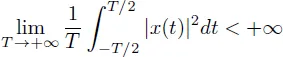
– the set of “finite power” functions characterized by:
L2(0, T) has the structure of what is called a Hilbert space structure with respect to the scalar product ∫ x(t)y*(t)dt, a property that is often used for decomposing functions, for example in the case of Fourier series.
In the course of our work, we will need to deal with a particular type of signal, in sets that have already been defined, taken from
+.
Definition 1.1 (Causal and anticausal signals) Signals x(t) such that x(t) = 0 for t < 0 are said to be causal. Signals x(t) such that x(t) = 0 for t ≥ 0 are said to be anticausal.
1.1.1 A few signals
We will often be using particular functions characteristic of typical behaviors. Here are some important examples:
– the
unit step function or
Heaviside function is defined by:
Its value at the origin, t = 0, is arbitrary. Most of the time, it is chosen equal to 1/2. The unit step can be used to show causality: x(t) is causal if x(t) = x(t)u(t);
– the sign function is defined using the unit step by sign (t) = 2u(t) – 1;
– the gate or rectangle function is defined by:
It will be used to express the fact that a signal is observed over a finite time horizon, with a duration of T. The phrases rectangular windowing and rectangular truncation of x(t) are also used: XT(t) = x(t)rectT(t);
– the
pulse, or
Dirac function, has the following properties which serve the purpose of calculation rules:
1.
δ(
t)
dt = 1 and
δ(
t)
x(
t)
dt =
x(0).
2.
x(
t) =
x(
u)
δ (
t –
u)
du = (
x *
δ)(
t) = (* is the
convolution operation).
3. x(t)δ(t – t0) = x(t0) δ (t – t0)
4. (x(u) * δ(u – t0))(t) = (x * δ)(t – t0) = x(t – t0),
5. δ(at) = δ(t)/|a| for a ≠ 0.
6.
and therefore
du(
t)/
dt =
δ(
t). This result makes it possible to define the derivative of a function with a jump discontinuity at a time
t0. Let
x(
t) =
x0(
t) +
au(
t –
t0) where
x0(
t) is assumed to be differentiable. We have
dx(
t)/
dt =
dx0(
t)/
dt +
aδ(
t –
t0);
– the
sine function is defined by:
where x0 is the peak amplitude of the signal, ω0 its angular frequency (in radians/s), ϕ its phase at the origin, f0 = ω0/2π its frequency (in Hz) and T = 1/f0 its period;
– the complex exponential function is defined by:
– the
sine cardinal is defined by sinc(
t) = sin(
πt)/
πt. It is equal to 0 for all integers except
t = 0 (hence its name). We have
sinc(
t)
dt = 1,
sinc(
u)sinc(
u –
t)
du...