Musculoskeletal Examination
eBook - ePub

Musculoskeletal Examination

  1. English
  2. ePUB (mobile friendly)
  3. Available on iOS & Android
eBook - ePub

Musculoskeletal Examination

About this book

MUSCULOSKELETAL EXAMINATION

Musculoskeletal Examination is a user-friendly textbook on the techniques of physical examination. Written by a physiatrist, orthopedic surgeon, and physical therapist, it has a uniquely multidisciplinary approach. Musculoskeletal Examination covers the complete basic examination and basic principles of normal and abnormal musculoskeletal function are fully explained, leading you to the correct differential diagnosis.

The new fourth edition is now in full colour throughout and includes over 750 detailed illustrations, X-rays and MRIs, and more than 100 photographs showing examination techniques. It also includes a companion website at www.wiley.com/go/musculoskeletalexam featuring 107 MCQs and videos demonstrating key examination methods.

Musculoskeletal Examination is perfect as a quick reference guide, while the detailed descriptions and clinically relevant examples of frequently encountered conditions will help even the most novice practitioner gain the understanding necessary to make a correct diagnosis and determine a successful treatment plan. It is ideal for physical therapists, physiatrists, orthopedists, medical students, practitioners, and all those involved in sports medicine and clinical massage.

All content reviewed by students for students

Wiley Medical Education books are designed exactly for their intended audience. All of our books are developed in collaboration with students. This means that our books are always published with you, the student, in mind.
Frequently asked questions

Yes, you can cancel anytime from the Subscription tab in your account settings on the Perlego website. Your subscription will stay active until the end of your current billing period. Learn how to cancel your subscription.
No, books cannot be downloaded as external files, such as PDFs, for use outside of Perlego. However, you can download books within the Perlego app for offline reading on mobile or tablet. Learn more here.
Perlego offers two plans: Essential and Complete
  • Essential is ideal for learners and professionals who enjoy exploring a wide range of subjects. Access the Essential Library with 800,000+ trusted titles and best-sellers across business, personal growth, and the humanities. Includes unlimited reading time and Standard Read Aloud voice.
  • Complete: Perfect for advanced learners and researchers needing full, unrestricted access. Unlock 1.4M+ books across hundreds of subjects, including academic and specialized titles. The Complete Plan also includes advanced features like Premium Read Aloud and Research Assistant.
Both plans are available with monthly, semester, or annual billing cycles.
We are an online textbook subscription service, where you can get access to an entire online library for less than the price of a single book per month. With over 1 million books across 1000+ topics, we’ve got you covered! Learn more here.
Look out for the read-aloud symbol on your next book to see if you can listen to it. The read-aloud tool reads text aloud for you, highlighting the text as it is being read. You can pause it, speed it up and slow it down. Learn more here.
Yes! You can use the Perlego app on both iOS or Android devices to read anytime, anywhere — even offline. Perfect for commutes or when you’re on the go.
Please note we cannot support devices running on iOS 13 and Android 7 or earlier. Learn more about using the app.
Yes, you can access Musculoskeletal Examination by Jeffrey M. Gross,Joseph Fetto,Elaine Rosen in PDF and/or ePUB format, as well as other popular books in Medicine & Medical Education. We have over one million books available in our catalogue for you to explore.

Information

Publisher
Wiley
Year
2015
Print ISBN
9781118962763
eBook ISBN
9781118962749
Edition
4

CHAPTER 1
Introduction

The intention of this book is to provide the reader with a thorough knowledge of regional anatomy and the techniques of physical examination. A second and equally important intention is to describe a method for the interpretation and logical application of the knowledge obtained from a physical examination.

What Is a Physical Examination?

The physical examination is the inspection, palpation, measurement, and auscultation of the body and its parts. It is the step that follows the taking of a patient history and precedes the ordering of laboratory tests and radiological evaluation in the process of reaching a diagnosis.

What Is the Purpose of the Physical Examination?

The physical examination has two distinct purposes. The first is to localize a complaint, that is, to associate a complaint with a specific region and, if possible, a specific anatomical structure. The second purpose of a physical examination is to qualify a patient's complaints. Qualifying a complaint involves describing its character (i.e., dull, sharp, etc.), quantifying its severity (i.e., visual analog scale; grade I, II, III), and defining its relationship to movement and function.

How Is the Physical Examination Useful?

By relating a patient's complaints to an anatomical structure, the physical examination brings meaning to a patient's history and symptoms.
This, however, presupposes that the clinician possesses a thorough knowledge of anatomy. It also requires a methodology for the logical analysis and application of the information obtained from the patient's history and physical examination. This methodology is derived from a clinical philosophy based on specific concepts. These concepts are as follows:
  1. If one knows the structure of a system and understands its intended function, it is possible to predict how that system is vulnerable to breakdown and failure (injury).
  2. A biological system is no different from an inorganic system in that it is subject to the same laws of nature (physics, mechanics, engineering, etc.). However, the biological system, unlike the inorganic system, has the potential not only to respond but also to adapt to changes in its environment.
Such concepts lay the foundation for understanding the information obtained on physical examination. They also lead to a rationale for the treatment and rehabilitation of injuries. A correlation of this type of analysis is that it becomes possible to anticipate injuries. This in turn permits proactive planning for the prevention of injuries.

How Does the Musculoskeletal System Work?

The musculoskeletal system, like any biological system, is not static. It is in a constant state of dynamic equilibrium. This equilibrium is termed homeostasis.
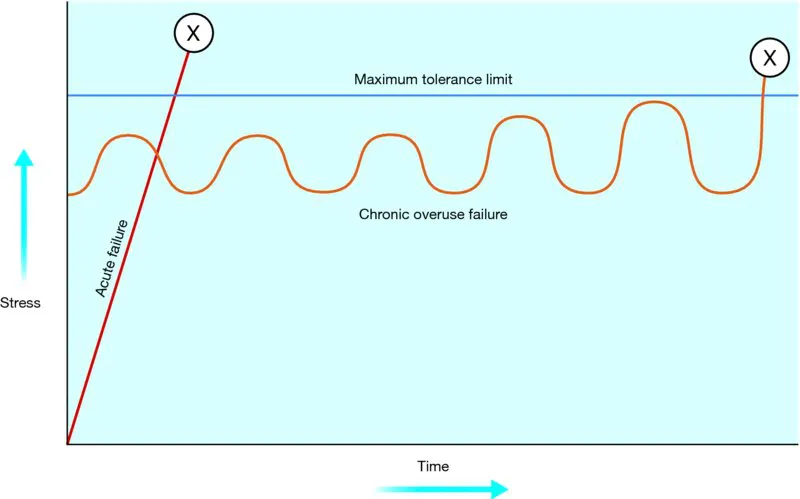
As such, when subjected to an external force or stress, a biological system will respond in a very specific manner. Unlike the inorganic system (i.e., an airplane wing that is doomed to fail after a predictable number of cycles of load), the biological system will attempt to reestablish an equilibrium state in response to a change that has occurred in its environment. In doing so, the biological system will experience one of three possible scenarios: adaptation (successful establishment of a new equilibrium state without breakdown), temporary breakdown (injury), or ultimate breakdown (death). These scenarios can be expressed graphically. Any system can be stressed in one of the two modes: acute single supratolerance load or chronic repetitive submaximal tolerance load (Figure 1.1). In the first mode, the system that suffers acute failure is unable to resist the load applied. In the second mode, the system will function until some fatigue limit is reached, at which time failure will occur. In the biological system, either failure mode will initiate a protective-healing response, termed the inflammatory reaction. The inflammatory reaction is composed of cellular and humoral components, each of which initiates a complex series of neurological and cellular responses to the injury. An important consequence of the inflammatory reaction is the production of pain. The sole purpose of pain is to bring one's attention to the site of injury. Pain prevents further injury from occurring by causing protective guarding and limited use of the injured structure. The inflammatory response is also characterized by increased vascularity and swelling in the area of injury. These are the causes of the commonly observed physical signs (i.e., redness and warmth) associated with the site of injury.
images
Figure 1.1 Biological systems, like inorganic systems, can fail under one of two modes: an acute single supramaximal stress or repetitive submaximal chronic loading.
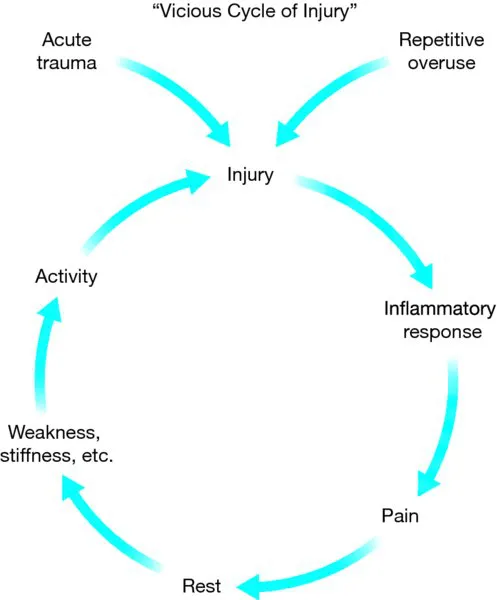
However, the problem with pain is that although it brings protection to the area of injury (the conscious or unconscious removal of stress from the injured area), and permits healing to take place by removing dynamic stimuli from the biological system, this removal of stimuli (rest) promotes deterioration of a system's tolerance limit to a lower threshold. In this way, when the injury has resolved, the entire system, although “healed,” may actually be more vulnerable to reinjury when “normal” stresses are applied to the recently repaired structures. This initiates the “vicious cycle of injury” (Figure 1.2).
images
Figure 1.2 The “vicious cycle of injury” results from the reinjury of a vulnerable, recently traumatized system. This increased vulnerability occurs due to a diminishing of a system's tolerance limit as a result of adaptation to a lower level of demand during the period of rest necessitated by pain.
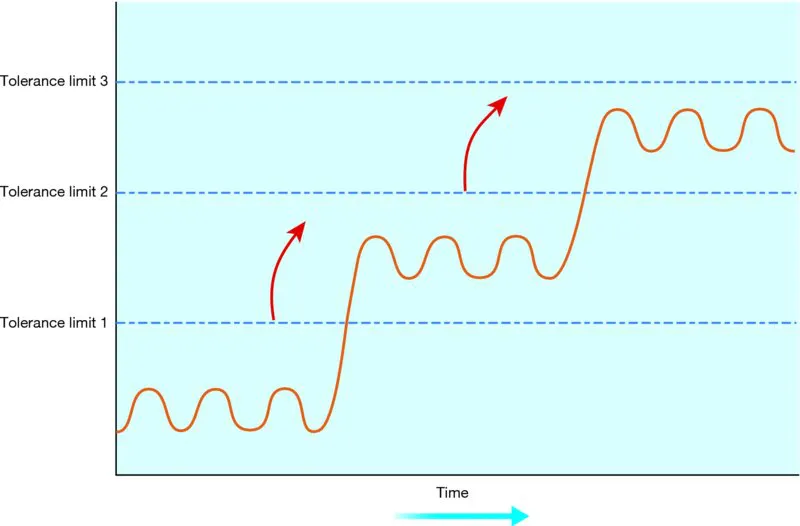
Contrary to this scenario is one in which the biological system successfully adapts to its new environment before failure occurs. This situation represents conditioning of a biological system. The result is hypertrophy, enhanced function, and a consequent increase in the system's tolerance limit. The concept acting here is that the biological system's tolerance limit will adapt to increased demands if the demands are applied at a frequency, intensity, and duration within the system's ability to adapt (Figure 1.3).
images
Figure 1.3 Conditioning is the adaptation of a biological system to the controlled application of increasing stress at a frequency, intensity, and duration within the system's tolerance limit, with a resultant increase in the system's tolerance limit.
Therefore, during the physical examination, asymmetry must be noted and analyzed as representing either adaptation or deconditioning of a given system. Any of these fundamental principles under which the musculoskeletal system functions makes it possible to organize the information obtained fro...

Table of contents

  1. Cover
  2. QR code
  3. Title page
  4. Copyright
  5. How to Use This Book
  6. Acknowledgments
  7. About the Companion Website
  8. Chapter 1 Introduction
  9. Chapter 2 Basic Concepts of Physical Examination
  10. Chapter 3 Overview of the Spine and Pelvis
  11. Chapter 4 The Cervical Spine and Thoracic Spine
  12. Chapter 5 The Temporomandibular Joint
  13. Chapter 6 The Lumbosacral Spine
  14. Chapter 7 Overview of the Upper Extremity
  15. Chapter 8 The Shoulder
  16. Chapter 9 The Elbow
  17. Chapter 10 The Wrist and Hand
  18. Chapter 11 The Hip
  19. Chapter 12 The Knee
  20. Chapter 13 The Ankle and Foot
  21. Chapter 14 Gait
  22. Appendices
  23. Bibliography
  24. Index
  25. EULA