Basic Math & Pre-Algebra For Dummies
eBook - ePub

Basic Math & Pre-Algebra For Dummies

  1. English
  2. ePUB (mobile friendly)
  3. Available on iOS & Android
eBook - ePub

Basic Math & Pre-Algebra For Dummies

About this book

Basic Math & Pre-Algebra For Dummies, 2nd Edition (9781119293637) was previously published as Basic Math & Pre-Algebra For Dummies, 2nd Edition (9781118791981). While this version features a new Dummies cover and design, the content is the same as the prior release and should not be considered a new or updated product.


Tips for simplifying tricky basic math and pre-algebra operations

Whether you're a student preparing to take algebra or a parent who wants or needs to brush up on basic math, this fun, friendly guide has the tools you need to get in gear. From positive, negative, and whole numbers to fractions, decimals, and percents, you'll build necessary math skills to tackle more advanced topics, such as imaginary numbers, variables, and algebraic equations.

  • Explanations and practical examples that mirror today's teaching methods
  • Relevant cultural vernacular and references
  • Standard For Dummies materials that match the current standard and design

Basic Math & Pre-Algebra For Dummies takes the intimidation out of tricky operations and helps you get ready for algebra!

Frequently asked questions

Yes, you can cancel anytime from the Subscription tab in your account settings on the Perlego website. Your subscription will stay active until the end of your current billing period. Learn how to cancel your subscription.
At the moment all of our mobile-responsive ePub books are available to download via the app. Most of our PDFs are also available to download and we're working on making the final remaining ones downloadable now. Learn more here.
Perlego offers two plans: Essential and Complete
  • Essential is ideal for learners and professionals who enjoy exploring a wide range of subjects. Access the Essential Library with 800,000+ trusted titles and best-sellers across business, personal growth, and the humanities. Includes unlimited reading time and Standard Read Aloud voice.
  • Complete: Perfect for advanced learners and researchers needing full, unrestricted access. Unlock 1.4M+ books across hundreds of subjects, including academic and specialized titles. The Complete Plan also includes advanced features like Premium Read Aloud and Research Assistant.
Both plans are available with monthly, semester, or annual billing cycles.
We are an online textbook subscription service, where you can get access to an entire online library for less than the price of a single book per month. With over 1 million books across 1000+ topics, we’ve got you covered! Learn more here.
Look out for the read-aloud symbol on your next book to see if you can listen to it. The read-aloud tool reads text aloud for you, highlighting the text as it is being read. You can pause it, speed it up and slow it down. Learn more here.
Yes! You can use the Perlego app on both iOS or Android devices to read anytime, anywhere — even offline. Perfect for commutes or when you’re on the go.
Please note we cannot support devices running on iOS 13 and Android 7 or earlier. Learn more about using the app.
Yes, you can access Basic Math & Pre-Algebra For Dummies by Mark Zegarelli in PDF and/or ePUB format, as well as other popular books in Mathematics & Algebra. We have over one million books available in our catalogue for you to explore.

Information

Publisher
For Dummies
Year
2016
Print ISBN
9781119293637
eBook ISBN
9781119298885
Edition
2
Subtopic
Algebra
Part 1

Getting Started with Basic Math and Pre-Algebra

IN THIS PART …
See how the number system was invented and how it works.
Identify four important sets of numbers: counting numbers, integers, rational numbers, and real numbers.
Use place value to write numbers of any size.
Round numbers to make calculating quicker.
Work with the Big Four operations: adding, subtracting, multiplying, and dividing.
Chapter 1

Playing the Numbers Game

IN THIS CHAPTER
Finding out how numbers were invented
Looking at a few familiar number sequences
Examining the number line
Understanding four important sets of numbers
One useful characteristic about numbers is that they’re conceptual, which means that, in an important sense, they’re all in your head. (This fact probably won’t get you out of having to know about them, though — nice try!)
For example, you can picture three of anything: three cats, three baseballs, three cannibals, three planets. But just try to picture the concept of three all by itself, and you find it’s impossible. Oh, sure, you can picture the numeral 3, but the threeness itself — much like love or beauty or honor — is beyond direct understanding. But when you understand the concept of three (or four, or a million), you have access to an incredibly powerful system for understanding the world: mathematics.
In this chapter, I give you a brief history of how numbers came into being. I discuss a few common number sequences and show you how these connect with simple math operations like addition, subtraction, multiplication, and division.
After that, I describe how some of these ideas come together with a simple yet powerful tool: the number line. I discuss how numbers are arranged on the number line, and I also show you how to use the number line as a calculator for simple arithmetic. Finally, I describe how the counting numbers (1, 2, 3, …) sparked the invention of more unusual types of numbers, such as negative numbers, fractions, and irrational numbers. I also show you how these sets of numbers are nested — that is, how one set of numbers fits inside another, which fits inside another.

Inventing Numbers

Historians believe that the first number systems came into being at the same time as agriculture and commerce. Before that, people in prehistoric, hunter-gatherer societies were pretty much content to identify bunches of things as “a lot” or “a little.”
But as farming developed and trade between communities began, more precision was needed. So people began using stones, clay tokens, and similar objects to keep track of their goats, sheep, oil, grain, or whatever commodity they had. They exchanged these tokens for the objects they represented in a one-to-one exchange.
Eventually, traders realized that they could draw pictures instead of using tokens. Those pictures evolved into tally marks and, in time, ...
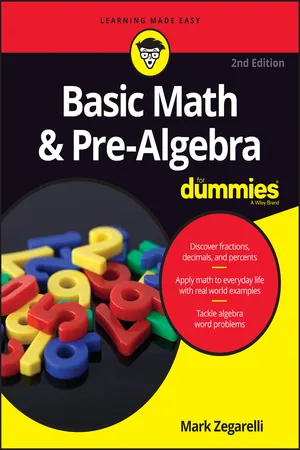
Table of contents

  1. Cover
  2. Title Page
  3. Table of Contents
  4. Introduction
  5. Part 1: Getting Started with Basic Math and Pre-Algebra
  6. Part 2: Getting a Handle on Whole Numbers
  7. Part 3: Parts of the Whole: Fractions, Decimals, and Percents
  8. Part 4: Picturing and Measuring — Graphs, Measures, Stats, and Sets
  9. Part 5: The X-Files: Introduction to Algebra
  10. Part 6: The Part of Tens
  11. About the Author
  12. Advertisement Page
  13. Connect with Dummies
  14. End User License Agreement