Systems with Delays
eBook - ePub

Systems with Delays

Analysis, Control, and Computations

  1. English
  2. ePUB (mobile friendly)
  3. Available on iOS & Android
eBook - ePub

Systems with Delays

Analysis, Control, and Computations

About this book

The main aim of the book is to present new constructive methods of delay differential equation (DDE) theory and to give readers practical tools for analysis, control design and simulating of linear systems with delays. Referred to as "systems with delays" in this volume, this class of differential equations is also called delay differential equations (DDE), time-delay systems, hereditary systems, and functional differential equations. Delay differential equations are widely used for describing and modeling various processes and systems in different applied problems

At present there are effective control and numerical methods and corresponding software for analysis and simulating different classes of ordinary differential equations (ODE) and partial differential equations (PDE). There are many applications for these types of equations, because of this progress, but there are not as many methodologies in systems with delays that are easily applicable for the engineer or applied mathematician. there are no methods of finding solutions in explicit forms, and there is an absence of generally available general-purpose software packages for simulating such systems.

Systems with Delays fills this void and provides easily applicable methods for engineers, mathematicians, and scientists to work with delay differential equations in their operations and research.


Frequently asked questions

Yes, you can cancel anytime from the Subscription tab in your account settings on the Perlego website. Your subscription will stay active until the end of your current billing period. Learn how to cancel your subscription.
No, books cannot be downloaded as external files, such as PDFs, for use outside of Perlego. However, you can download books within the Perlego app for offline reading on mobile or tablet. Learn more here.
Perlego offers two plans: Essential and Complete
  • Essential is ideal for learners and professionals who enjoy exploring a wide range of subjects. Access the Essential Library with 800,000+ trusted titles and best-sellers across business, personal growth, and the humanities. Includes unlimited reading time and Standard Read Aloud voice.
  • Complete: Perfect for advanced learners and researchers needing full, unrestricted access. Unlock 1.4M+ books across hundreds of subjects, including academic and specialized titles. The Complete Plan also includes advanced features like Premium Read Aloud and Research Assistant.
Both plans are available with monthly, semester, or annual billing cycles.
We are an online textbook subscription service, where you can get access to an entire online library for less than the price of a single book per month. With over 1 million books across 1000+ topics, we’ve got you covered! Learn more here.
Look out for the read-aloud symbol on your next book to see if you can listen to it. The read-aloud tool reads text aloud for you, highlighting the text as it is being read. You can pause it, speed it up and slow it down. Learn more here.
Yes! You can use the Perlego app on both iOS or Android devices to read anytime, anywhere — even offline. Perfect for commutes or when you’re on the go.
Please note we cannot support devices running on iOS 13 and Android 7 or earlier. Learn more about using the app.
Yes, you can access Systems with Delays by A. V. Kim,A. V. Ivanov in PDF and/or ePUB format, as well as other popular books in Mathematics & Mathematics General. We have over one million books available in our catalogue for you to explore.

Information

Year
2015
Print ISBN
9781119117582
eBook ISBN
9781119117735

Chapter 1

Linear time-delay systems

1.1 Introduction

1.1.1 Linear systems with delays

In this book we consider methods of analysis, control and computer simulation of linear systems with delays
(1.1)
equation
where A(t), Aτ(t) are n × n matrices with piece-wise continuous elements, G(t, s) is n × n matrix with piece-wise continuous elements on R × [−τ, 0], u is a given n-dimensional vector-function, τ(t) : R → [−τ, 0] is a continuous function, τ is a positive constant.
Much attention will be paid to the special class of linear time-invariant systems
(1.2)
equation
where A, Aτ are n × n constant matrices, G(s) is n × n matrix with piece-wise continuous elements on [−τ, 0], τ is a positive constant1.
Usually we will consider u as the vector of control parameters. There are two possible variants:
1) u = u(t) is the function of time t;
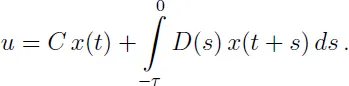
2) u depend on the current and previous state of the system, for example,
(1.3)
equation
Consider some models of control systems with delays.

1.1.2 Wind tunnel model

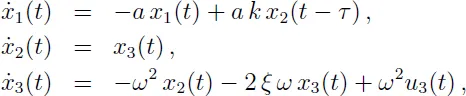
A linearized model of the high-speed closed-air unit wind tunnel is [134, 135]
(1.4)
equation
with
.
The state variable x1, x2, x3 represent deviations from a chosen operating point (equilibrium point) of the following quantities: x1 = Mach number, x2 = actuator position guide vane angle in a driving fan, x3 = actuator rate. The delay represents the time of the transport between the fan and the test section.
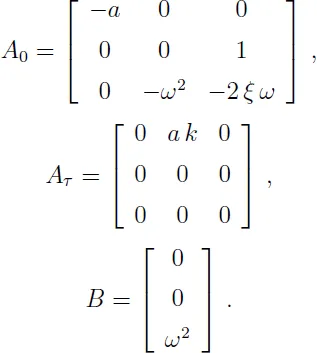
The system can be written in matrix form
(1.5)
equation
where
equation

1.1.3 Combustion stability in liquid propellant rocket motors

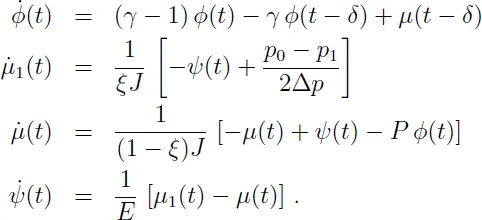
A linearized version of the feed system and combustion chamber equations, assuming nonsteady flow, is given by2
(1.6)
equation
Here
ϕ(t) = fractional variation of pressure in the combustion chamber,
t is the unit of time normalized with gas residence time,
θg, in steady operation,
= value of time lag in steady operation,
= pressure in combustion chamber in steady operation,
= const for some number γ,
μ(t) = fractional variation of injection and burning rate,
ψ(t) = relative variation of p1,
p1 = instantaneous pressure at that place in the feeding line where the capacitance representing the elasticity is located,
ξ = fractional length for the constant pressure supply,
J = inertial parameter of the line,
P = pressure drop parameter,
μ1(t) = fractional variation of instantaneous mass flow upstream of the capacitance,
Δp = injector pressure drop in steady operation,
p0 = regulated gas pressure for constant pressure supply,
E = ...

Table of contents

  1. Cover
  2. Half Title page
  3. Title page
  4. Copyright page
  5. Preface
  6. Chapter 1: Linear Time-Delay Systems
  7. Chapter 2: Stability Theory
  8. Chapter 3: Linear Quadratic Control
  9. Chapter 4: Numerical Methods
  10. Chapter 5: Appendix
  11. Bibliography
  12. Index