Achieve greater success by increasing the agility of analytics lifecycle management
Agile by Design offers the insight you need to improve analytic lifecycle management while integrating the right analytics projects into different frameworks within your business. You will explore, in-depth, what analytics projects are and why they are set apart from traditional development initiatives. Beyond merely defining analytics projects, Agile by Design equips you with the information you need to apply agile methodologies in a way that tailors your approach to individual initiatives—and the needs of your projects and team.
Lifecycle management is a complex subject area, and with the increasingly important integration of analytics into multiple facets of business models, understanding how to use agile tools while managing a product lifecycle is essential to maintaining a competitive edge in today's professional world.
Gain an understanding of the principles, processes, and practices associated with effective analytic lifecycle management
Discover techniques that will enable you to successfully initiate, plan, and execute analytic development projects with an eye for the opportunity to engage agile methodologies
Understand agile development frameworks
Identify which agile methodologies are best for different frameworks—and how to apply them throughout the analytic development lifecycle
With analytics becoming increasingly important in today's business world, you need to understand and apply agile methodologies in order to meet rising standards of efficiency and effectiveness. Agile by Design is the perfect reference for project managers, CFOs, IT managers, and marketing managers who want to cultivate a relevant, forward-thinking lifecycle management style.
Chapter 1 Adjusting to a Customer-Centric Landscape
Emerging customer needs and demands are driving a new imperative to align business, technology, and analytic strategies. With consumer forces forcing both rapid and dramatic change throughout every industry, companies need to take an outside-in approach to enable customer-centricity. A customer-centric organization aligns their business model to the customer's point of view, integrating functional areas, product lines, and channels to create 360° customer-centric business processes. Analytics facilitate the decision-making within those processes. Most companies lack the organizational structure to innovate quickly and are challenged by the scale of this transformational change. Agile approaches can be used to incrementally (ergo, more quickly) drive the transformation and create a fail-fast/succeed-sooner culture.
It's a Whole New World
Just a few short years ago, if you wanted to buy something, you likely got into your car and drove to a store. Maybe the product you wanted was special and only one store in town offered the item. You arrived at the store and paid whatever price the store was asking because you really, really wanted it. Fast forward to today—instead of going to the store, you pick up your mobile device, tap a few buttons, and you find that same item available from dozens of online marketplaces. You select the cheapest price, and a drone drops it off on your doorstep the same day. You've also sold your car, since you don't need to drive to the store as much. It's much simpler to rent from a car-share service or be picked up by a ride-share service when you need it! This is a simple but common example of what tens of millions of people do every day.
The traditional businesses in this example—the physical stores, product manufacturers and distributors, and automakers—have all gone through tremendous change. Suppliers like Amazon.com changed the retail market by offering products quickly, increasing competition from suppliers from all over the world and putting pressure on them to offer those products at low prices. The landscape of online shopping has changed so much that you don't necessarily have to gravitate to the Amazons of the world anymore. Aggregation services have become pivotal in finding a particular item at the lowest price to be delivered in the quickest time (with minimal or free shipping & handling). Products can be sent directly from the manufacturer, obviating the need for the distributor. Car and ride-sharing services—part of our new “peer-to-peer” economy—are transforming (and disintermediating) the auto manufacturer and taxi industry.
This is great news for consumers: Globalization opens up new markets for companies while technology makes it easier to connect customers directly with products and services. But when traditional barriers to market entry are reduced or the market changes entirely, good and services become commodified and power shifts to the hands of the buyer. As consumers, the determination of how and when we get our goods and services has changed dramatically: We get to decide! Social media give us a voice, providing us with the opportunity to publicly promote or criticize a brand.
There are very few industries that have not been impacted by this change. Companies are struggling for relevance in an increasingly crowded and democratized marketplace. Here's why:
Technology connects consumers with products and services previously out of reach.
With ubiquitous access to products, services, and content in real-time, consumer expectations are heightened, and consumers are more educated and empowered.
As the cost of switching providers decreases, customers become less loyal.
With barriers to market entry reduced, new entrants flood the market, disrupting traditional business models.
Increased availability and accessibility commodifies products and services.
Distribution and communication channels rapidly evolve.
Product development cycles become shorter, decreasing first-to-market competitive advantage.
With so much access and buyer empowerment, many companies are unable to keep up with the pace of change. Many react by trying to compete on price. Yet differentiation isn't necessarily about the cost of goods. Organizations recognize that creating a positive and proactive customer experience across the customer lifecycle (from awareness to purchase to loyalty to advocacy) is critical to attracting and retaining profitable customers. In fact, as customers, we expect you to do it!
From Customer-Aware to Customer-Centric
With the explosion of digital media, people engage with each other—and the companies they do business with—in new ways. The relevance of traditional print and broadcast channels are on the decline, completely changing the consumer-corporation dynamic. Digital channels open doors for consumers, who no longer are passive participants in a one-sided marketing conversation, but empowered authors, publishers, and critics. The digital landscape is participatory, an area where consumers exchange ideas. Marketers no longer drive the discussion. Everyday people are the style makers and trendsetters.
For companies competing in this new medium, it's incredibly difficult to surface your message above the noise. While the amount of time consumers spend on web and mobile has increased dramatically, the amount of available content has increased exponentially: More digital content is created in a day than most people can consume in a year. With so many distractions and choices, your audience has a very short attention span.
The exponential growth in digital channels has given rise to the importance of digital marketing. But digital marketing isn't just about the channel; it's the mechanism by which people are creating and sharing experiences: engaging not only with each other, but with companies they do business with.
For your financial services customers, there is no longer a traditional “path-to-purchase.” The customer journey is no longer linear, and purchasing decisions are taking place across multiple channels: both physical and virtual. With such high channel fragmentation, making strategic decisions on audience, content, and platforms is critical. Companies need the capability to leverage data to define their market, build outstanding content, tailor messaging, and provide that messaging in the right medium—quickly!
With customer interactions constantly changing through your brand relationship, consumer behavior is difficult to predict. New consumer-driven tactics are emerging every week, making multi-month planning cycles a thing of the past: Your customer-centric strategy has to be adaptive and relevant. Slow and predictable internal processes must be replaced with quick and creative execution. You need to create a messaging that speaks to each audience segment differently. Data-driven approaches give you the ability to create that level of precision. Agility can speed up time-to-market cycles.
The entry point for becoming customer-centric is different for every organization. Many customer-centric strategies start with operational transformations, with the contact center as the new customer-centric hub. Around the hub, disjointed marketing campaign and contact strategies, customer relationship management strategies, product development, pricing and risk strategies, analytics, and operational strategies begin to synchronize—at least conceptually! For the first time, many companies are starting to view their operations from the outside in by mapping out the customer lifecycle and looking at ways to optimize that lifecycle across the organization.
There's a lot of complexity there. Executing on a large-scale transformation like this requires significant change. Organizationally, it necessitates a shift away from product silos to customer segments. Customer contact planning and execution strategies need to be coordinated and streamlined. The underlying operational technology platforms and systems need to connect in way to accommodate the customer-centric perspective. Cross-functional operational workflows need to be redesigned around a consumer view. The customer data needs to be integrated, analyzed, and modeled in a way to provide a comprehensive view of that customer. Analytics and predictive modeling provide insights to help anticipate customer needs and behavior. The entire organization mobilizes around the analytic customer-centric hub.
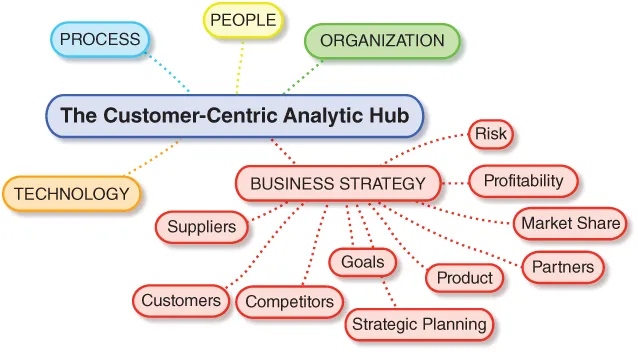
Our hub encompasses five core areas, as shown in Figure 1.1.
Business strategy The business strategy defines the types of projects that are important to the organization based on the needs of the market, customers, and the business. Analytic work must link back to strategic business goals.
Organization Organization defines the structure of the company, including the composition of teams and how they engage.
People The people category relates to individual roles, responsibilities, and skillsets needed to support the analytic hub.
Process Process defines the day-to-day interactions of internal and external parties throughout the organization. While this can include how teams engage in order to achieve a business objective, it also encompasses how your employees and operational systems interact with customers and suppliers.
Technology Technology provides the underlying platform to support the hub. Technology also includes the data needed to perform analysis.
Figure 1.1 The Customer-Centric Analytic Hub Linked to Business Strategy
Being Customer-Centric, Operationally Efficient, and Analytically Aware
In our customer-centric world, business strategies are more enterprise in focus, requiring the integration and automation of business processes crossing functional, product, and channel...
Table of contents
Cover
Title Page
Copyright
Table of Contents
Introduction
About the Author
Chapter 1: Adjusting to a Customer-Centric Landscape
Chapter 2: The Analytic Lifecycle
Chapter 3: Getting Your Analytic Project off the Ground
Chapter 4: Project Justification and Prioritization
Chapter 5: Analytics—the Agile Way
Chapter 6: Analytic Planning Hierarchies
Chapter 7: Our Analytic Scrum Framework
Chapter 8: Analytic Scrum Roles and Responsibilities
Chapter 9: Gathering Analytic User Stories
Chapter 10: Facilitating Your Story Workshop
Chapter 11: Collecting Knowledge Through Spikes
Chapter 12: Shaping the Analytic Product Backlog
Chapter 13: The Analytic Sprint: Planning and Execution
Chapter 14: The Analytic Sprint: Review and Retrospective
Chapter 15: Building in Quality and Simplicity
Chapter 16: Collaboration and Communication
Chapter 17: Business Implementation Planning
Chapter 18: Building Agility into Test-and-Learn Strategies
Chapter 19: Operationalizing Your Model Deployment Strategy
Chapter 20: Analytic Ever After
Sources
Index
End User License Agreement
Trusted by 375,005 students
Access to over 1.5 million titles for a fair monthly price.
Study more efficiently using our study tools.
Frequently asked questions
Yes, you can cancel anytime from the Subscription tab in your account settings on the Perlego website. Your subscription will stay active until the end of your current billing period. Learn how to cancel your subscription
No, books cannot be downloaded as external files, such as PDFs, for use outside of Perlego. However, you can download books within the Perlego app for offline reading on mobile or tablet. Learn how to download books offline
Perlego offers two plans: Essential and Complete
Essential is ideal for learners and professionals who enjoy exploring a wide range of subjects. Access the Essential Library with 800,000+ trusted titles and best-sellers across business, personal growth, and the humanities. Includes unlimited reading time and Standard Read Aloud voice.
Complete: Perfect for advanced learners and researchers needing full, unrestricted access. Unlock 1.5M+ books across hundreds of subjects, including academic and specialized titles. The Complete Plan also includes advanced features like Premium Read Aloud and Research Assistant.
Both plans are available with monthly, semester, or annual billing cycles.
We are an online textbook subscription service, where you can get access to an entire online library for less than the price of a single book per month. With over 1.5 million books across 990+ topics, we’ve got you covered! Learn about our mission
Look out for the read-aloud symbol on your next book to see if you can listen to it. The read-aloud tool reads text aloud for you, highlighting the text as it is being read. You can pause it, speed it up and slow it down. Learn more about Read Aloud
Yes! You can use the Perlego app on both iOS and Android devices to read anytime, anywhere — even offline. Perfect for commutes or when you’re on the go. Please note we cannot support devices running on iOS 13 and Android 7 or earlier. Learn more about using the app
Yes, you can access Agile by Design by Rachel Alt-Simmons in PDF and/or ePUB format, as well as other popular books in Business & Decision Making. We have over 1.5 million books available in our catalogue for you to explore.