An introductory book that provides theoretical, practical, and application coverage of the emerging field of type-2 fuzzy logic control
Until recently, little was known about type-2 fuzzy controllers due to the lack of basic calculation methods available for type-2 fuzzy sets and logic—and many different aspects of type-2 fuzzy control still needed to be investigated in order to advance this new and powerful technology. This self-contained reference covers everything readers need to know about the growing field.
Written with an educational focus in mind, Introduction to Type-2 Fuzzy Logic Control: Theory and Applications uses a coherent structure and uniform mathematical notations to link chapters that are closely related, reflecting the book's central themes: analysis and design of type-2 fuzzy control systems. The book includes worked examples, experiment and simulation results, and comprehensive reference materials. The book also offers downloadable computer programs from an associated website.
Presented by world-class leaders in type-2 fuzzy logic control, Introduction to Type-2 Fuzzy Logic Control:
Is useful for any technical person interested in learning type-2 fuzzy control theory and its applications
Offers experiment and simulation results via downloadable computer programs
Features type-2 fuzzy logic background chapters to make the book self-contained
Provides an extensive literature survey on both fuzzy logic and related type-2 fuzzy control
Introduction to Type-2 Fuzzy Logic Control is an easy-to-read reference book suitable for engineers, researchers, and graduate students who want to gain deep insight into type-2 fuzzy logic control.
Fuzzy control (also known as fuzzy logic control) is regarded as the most widely used application of fuzzy logic and is credited with being a well-accepted methodology for designing controllers that are able to deliver satisfactory performance in the face of uncertainty and imprecision (Lee, 1990; Sugeno, 1985); Feng, 2006). In addition, fuzzy logic theory provides a method for less skilled personnel to develop practical control algorithms in a user-friendly way that is close to human thinking and perception, and to do this in a short amount of time. Fuzzy logic controllers (FLCs) can sometimes outperform traditional control systems [like proportional–integral–derivative (PID) controllers] and have often performed either similarly or even better than human operators. This is partially because most FLCs are nonlinear controllers that are capable of controlling real-world systems (the vast majority of such systems are nonlinear) better than a linear controller can, and with minimal to no knowledge about the mathematical model of the plant or process being controlled.
Fuzzy logic controllers have been applied with great success to many real-world applications. The first FLC was developed by Mamdani and Assilian (1975), in the United Kingdom, for controlling a steam generator in a laboratory setting. In 1976, Blue Circle Cement and SIRA in Denmark developed a cement kiln controller (the first industrial application of fuzzy logic), which went into operation in 1982 (Holmblad and Ostergaard, 1982). In the 1980s, several important industrial applications of fuzzy logic control were launched successfully in Japan, including a water treatment system developed by Fuji Electric. In 1987, Hitachi put a fuzzy logic based automatic train operation control system into the Sendai city's subway system (Yasunobu and Miyamoto, 1985). These and other applications of FLCs motivated many Japanese engineers to investigate a wide range of novel applications for fuzzy logic. This led to a “fuzzy boom” in Japan, a result of close collaboration and technology transfer between universities and industry.
According to Yen and Langari (1999), in 1988, a large-scale national research initiative was established by the Japanese Ministry of International Trade and Industry (MITI). The initiative established by MITI was a consortium called the Laboratory for International Fuzzy Engineering Research (LIFE). In late January 1990, Matsushita Electric Industrial (Panasonic) named their newly developed fuzzy-controlled automatic washing machine the fuzzy washing machine and launched a major commercial campaign of it as a fuzzy product. This campaign turned out to be a successful marketing effort not only for the product but also for fuzzy logic technology (Yen and Langari, 1999). Many other home electronics companies followed Panasonic's approach and introduced fuzzy vacuum cleaners, fuzzy rice cookers, fuzzy refrigerators, fuzzy camcorders (for stabilizing the image under hand jittering), fuzzy camera (for smart autofocus), and other applications. As a result, consumers in Japan recognized the now en-vogue Japanese word “fuzzy,” which won the gold prize for a new word in 1990 (Hirota, 1995). Originating in Japan, the “fuzzy boom” triggered a broad and serious interest in this technology in Korea, Europe, the United States, and elsewhere. For example, Boeing, NASA, United Technologies, and other aerospace companies developed FLCs for space and aviation applications (Munakata and Jani, 1994).
Today FLCs are used in countless real-world applications that touch the lives of people all over the world, including white goods (e.g., washing machines, refrigerators, microwaves, rice cookers, televisions, etc.), digital video cameras, cars, elevators (lifts), heavy industries (e.g., cement, petroleum, steel), and the like.
While this book focuses on type-2 fuzzy logic control, it will also provide background material about type-1 fuzzy logic control. Indeed, before we can explain what type-2 fuzzy logic control is we must briefly explain what type-1 fuzzy sets, type-1 fuzzy logic control, and type-2 fuzzy sets are. In this chapter we do this from a high-level perspective without touching on the mathematical aspects in order to give a feel for the nature of fuzzy sets and their applications. Later chapters in this book provide rigorous treatments of mathematical underpinnings of the subjects just mentioned.
1.2 What Is a Type-1 Fuzzy Set?
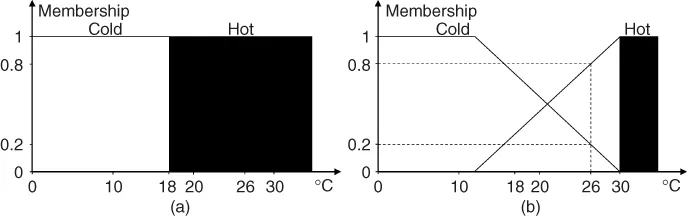
Suppose that a group of people is asked about the temperature values they associate with the linguistic concepts Hot and Cold. If crisp sets are employed, as shown in Fig. 1.1a, then a threshold must be chosen above which temperature values are considered Hot and below which they are considered Cold. Reaching a consensus about such a threshold is difficult, and even if an agreement can be reached—for example, 18°C—, is it reasonable to conclude that 17.99999°C is Cold whereas 18.00001°C is Hot?
Figure 1.1 Representing Cold and Hot using (a) crisp sets, and (b) type-1 fuzzy sets.
On the other hand, Hot and Cold can be represented as type-1 fuzzy sets (T1 FSs) whose membership functions (MFs) are shown in Fig. 1.1b. Note that, prior to the appearance of type-2 fuzzy sets, the phrase fuzzy set was used instead of the phrase T1 fuzzy set. Even today, in many publications that focus only on T1 FSs, such sets are called fuzzy sets. In this book we shall use the phrase type-1 fuzzy set. Returning to Fig. 1.1b, observe that no sharp boundaries exist between the two sets and that each value on the horizontal axis may simultaneously belong to more than one T1 FS but with different degrees of membership. For example, 26°C, which is in the crisp Hot set with a membership value of 1.0 (Fig. 1.1a), is now in that set to degree 0.8, but is also in the Cold set to degree 0.2 (Fig. 1.1b).
Type-1 FSs provide a means for calculating intermediate values between the crisp values associated with being absolutely true (1) or absolutely false (0). Those values range between 0 and 1 (and can include them); thus, it can be said that a fuzzy set allows the calculation of shades of gray between white and black (or true and false). As will be seen in this book, the smooth transition that occurs between T1 FSs gives a good decision response for a type-1 fuzzy logic control system in the face of noise and other uncertainties.
1.3 What Is a Type-1 Fuzzy Logic Controller?
With the advent of type-2 fuzzy sets and type-2 fuzzy logic control, it has become necessary to distinguish between type-2 fuzzy logic control and all earlier fuzzy logic control that uses type-1 fuzzy sets (the distinctions between such fuzzy sets are explained in Section 1.4). We refer to fuzzy logic control that uses type-1 fuzzy sets as type-1 fuzzy logic control. When it does not matter whether the fuzzy sets are type-1 or type-2, we just use fuzzy logic control or fuzzy control.
Fuzzy logic control aims to mimic the process followed by the human mind when performing control actions. For example, when a person drives (controls) a car, he/she will not think:
If the temperature is 10 degrees Celsius and the rainfall is 70.5 mm and the road is 40% slippery and the distance between my car and the car in front of me is 3 meters, then I will depress the acceleration pedal only 10%.
Instead, it is much more likely that he/she thinks:
If it is Cold and the rainfall is High and the road is Somewhat Slippery and the distance between my car and the car in front of me is Quite Close, then I will depress the acceleration pedal Slightly.
So, in systems controlled by humans, the control cycle starts by a person converting a physical quantity (e.g., a distance) from numbers into words or perceptions (e.g., Quite Close distance). The input words (or perceptions) then trigger a person's knowledge, accumulated through ...
Chapter 4: Analytical Structure of Various Interval Type-2 Fuzzy PI and PD Controllers
Chapter 5: Analysis of Simplified Interval Type-2 Fuzzy PI and PD Controllers
Chapter 6: On the Design of IT2 TSK FLCs
Chapter 7: Looking into the Future
Appendix A: T2 FLC Software: From Type-1 to zSlices-Based General Type-2 FLCs
Index
Series
End User License Agreement
Trusted by 375,005 students
Access to over 1.5 million titles for a fair monthly price.
Study more efficiently using our study tools.
Frequently asked questions
Yes, you can cancel anytime from the Subscription tab in your account settings on the Perlego website. Your subscription will stay active until the end of your current billing period. Learn how to cancel your subscription
No, books cannot be downloaded as external files, such as PDFs, for use outside of Perlego. However, you can download books within the Perlego app for offline reading on mobile or tablet. Learn how to download books offline
Perlego offers two plans: Essential and Complete
Essential is ideal for learners and professionals who enjoy exploring a wide range of subjects. Access the Essential Library with 800,000+ trusted titles and best-sellers across business, personal growth, and the humanities. Includes unlimited reading time and Standard Read Aloud voice.
Complete: Perfect for advanced learners and researchers needing full, unrestricted access. Unlock 1.5M+ books across hundreds of subjects, including academic and specialized titles. The Complete Plan also includes advanced features like Premium Read Aloud and Research Assistant.
Both plans are available with monthly, semester, or annual billing cycles.
We are an online textbook subscription service, where you can get access to an entire online library for less than the price of a single book per month. With over 1.5 million books across 990+ topics, we’ve got you covered! Learn about our mission
Look out for the read-aloud symbol on your next book to see if you can listen to it. The read-aloud tool reads text aloud for you, highlighting the text as it is being read. You can pause it, speed it up and slow it down. Learn more about Read Aloud
Yes! You can use the Perlego app on both iOS and Android devices to read anytime, anywhere — even offline. Perfect for commutes or when you’re on the go. Please note we cannot support devices running on iOS 13 and Android 7 or earlier. Learn more about using the app
Yes, you can access Introduction To Type-2 Fuzzy Logic Control by Jerry Mendel,Hani Hagras,Woei-Wan Tan,William W. Melek,Hao Ying in PDF and/or ePUB format, as well as other popular books in Tecnologia e ingegneria & Ingegneria elettronica e telecomunicazioni. We have over 1.5 million books available in our catalogue for you to explore.