Sequencing Apple's DNA
eBook - ePub

Sequencing Apple's DNA

  1. English
  2. ePUB (mobile friendly)
  3. Available on iOS & Android
eBook - ePub

Sequencing Apple's DNA

About this book

This book aims to extract the "molecular genes" leading to craziness! Geniuses are the ones who are "crazy enough to think they can change the world" and boldly go where no one has gone before. Where no past habit and usage are available, there is no proof of viability, as nobody has done it yet, or even imagined it, and no roadmap for guidance or market study has come up with it.

The authors call upon Leonardo Da Vinci, the Renaissance genius, who as strange as it seems, shared many traits of personality with that of Steve Jobs, in terms of the ways of performing. Da Vinci helps in understanding Jobs, and hence Apple, with his unique way of designing radically novel concepts, which were actually quite crazy for his time.

In order to shed light on a special creative posture, the indomitable sense of specifying undecidable objects – a hallmark of the late Steve Jobs – is what led the authors to match it with a specific design innovation theory. A real theory, backed by solid mathematical proof, exists and can account for the business virtue of a prolific ability to move into unknown crazy fields! The authors postulate that, by bringing the power of C-K theory to crack open a number of previous observations made about Apple's methods, it is possible to identify most of the genes of this company.

The authors analyze how and why an Apple way of doing business is radically different from standard business practices and why it is so successful. Genes are a measure of the entity at hand and can encourage past business education routine approaches, then become transferable across the spectrum of the socio-economic world.

Frequently asked questions

Yes, you can cancel anytime from the Subscription tab in your account settings on the Perlego website. Your subscription will stay active until the end of your current billing period. Learn how to cancel your subscription.
No, books cannot be downloaded as external files, such as PDFs, for use outside of Perlego. However, you can download books within the Perlego app for offline reading on mobile or tablet. Learn more here.
Perlego offers two plans: Essential and Complete
  • Essential is ideal for learners and professionals who enjoy exploring a wide range of subjects. Access the Essential Library with 800,000+ trusted titles and best-sellers across business, personal growth, and the humanities. Includes unlimited reading time and Standard Read Aloud voice.
  • Complete: Perfect for advanced learners and researchers needing full, unrestricted access. Unlock 1.4M+ books across hundreds of subjects, including academic and specialized titles. The Complete Plan also includes advanced features like Premium Read Aloud and Research Assistant.
Both plans are available with monthly, semester, or annual billing cycles.
We are an online textbook subscription service, where you can get access to an entire online library for less than the price of a single book per month. With over 1 million books across 1000+ topics, we’ve got you covered! Learn more here.
Look out for the read-aloud symbol on your next book to see if you can listen to it. The read-aloud tool reads text aloud for you, highlighting the text as it is being read. You can pause it, speed it up and slow it down. Learn more here.
Yes! You can use the Perlego app on both iOS or Android devices to read anytime, anywhere — even offline. Perfect for commutes or when you’re on the go.
Please note we cannot support devices running on iOS 13 and Android 7 or earlier. Learn more about using the app.
Yes, you can access Sequencing Apple's DNA by Patrick Corsi,Dominique Morin in PDF and/or ePUB format, as well as other popular books in Computer Science & Computer Science General. We have over one million books available in our catalogue for you to explore.

Information

PART 1
From Insanely Successful Episodes: (In Evidence of First-Level Gaps)

img

1
Sequencing the First Segments of Apple’s DNA

1.1. The gene, domain and cultural bias

Every once in a while, a unique individual appears capable of accomplishing changes and, by the same token, showing the rest of us the way to create new paradigms. This seems to happen at the precise moment when mankind needs it. Nikola Tesla was the luminary inventor who harnessed electricity in the first part of the 20th Century. In the arts, John Lennon was an inspiring soul in the time of the Beatles. They acted as accelerators of certain energies. And Apple, fueled by a unique individual, was the company that helped carry technology to new computing and entertainment paradigms.
All these exceptional individuals share a singular way of thinking about things. Nikola Tesla tested his amazingly complicated apparatus mentally until he found functional proof, whereas John Lennon coined sentences that still propagate around the world, each with an enhanced thinking signature, free of linear structure. Where does such an ability come from? What is the DNA sequence of that nonlinear thinking? Where are the genes which account for a sustained capacity in a given domain? Do we all share them within ourselves? How do we locate and possibly activate them?
Can science fiction come to the rescue? If we imagine these genes as time capsules that are already available – but which we normally find ourselves unable to open – it would perhaps seem appropriate to iconize them with a pictured cryptic diagram. These would be the application icons to operate. The following chapters feature a little icon to remember this possibility within ourselves. Not as fancy as those on your iPhone, but simply a handy recalling factor. These are your time capsules available for launching.
To pinpoint these genes, we will begin by listing a number of key domains of concern which often puzzle entrepreneurs. These are subject matters for debate in academic circles and they are often bound to cultural prejudices. What is it that distinguishes Silicon Valley from other regions of the globe, if not a radically different ambient culture? We tend to view business culture as a frequency, where each of us resonates to some of these frequencies and much less to others.
Cultural biases are formed throughout our formative years and mature into fixations, mental constructs inhibiting change. Some are good or even necessary, because they ensure we hold on to something valuable. For instance, acquired skills usually lead to fixation. Or they can be detrimental to change and to thinking outside the box – i.e. breaking the rules – by stopping a mental dynamic for learning or improving something. We always tend to create fixations, but we lack the mechanism to know when to overlay them and when to not. The point is this: when a company outrightly breaks fixations, it may venture into a golden unknown or risk its future. Where do we draw the line?
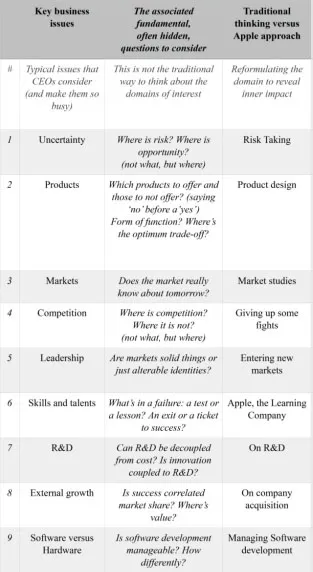
From a given domain of business relevance (e.g. “competition” in the first column), Table 1.1 establishes that line in the form of one or more questions to ask (the middle column) as a potential breaking axis. These questions are meant to trigger progress, which involves revisiting the way in which we consider a given relevance domain. Finally, from these questions we draw one core issue ready to be debated by antagonizing “the Apple way” and “the business school way”.

1.2. Nine DNA segments of rare importance

This book bases its findings on the biological metaphor of DNA that every living organism is bound to sustain life. Sustainability is both the aim and the capability that a living entity strives to ensure. Sustainability is the only core determination that underpins all others. It is a difficult subject matter, in good part not well understood and there are few methods for making it a reality, be it at a company, nation or planet level [MAS 15a, MAS 15b]. Despite a great amount of work in the sustainability domain, there is no such science of sustainability yet.
As pointed out by Diamond [DIA 05], some past civilizations followed a path which lead to their collapse (Mayan civilization, Easter Island society, etc.). This cannot be designated as a collective suicide: societies never consciously commit suicide, but they may take disastrous decisions, which produce the same effect. The same analysis can be applied at a company or individual level.
Recognizing sustainability as the primary objective, for any organization, at any level of size or complexity, is not enough: the real question is how to achieve this goal.
In this simple recognition of the living imperative, nine domains of consideration pop up together that are usually considered independently in the business spheres, taught separately by respective experts and executed in distinct branches or services. They are actually connected to each other, and express an even simpler global concept:
How can a striving firm be made sustainable?
Let us now scan each of the nine core issues in Table 1.1.
Table 1.1. In free market economies, firms face eternal issues to consider. Exploring their core subsets reveals hidden issues to bring into consideration
img

2
On Risk Taking

2.1. Where is the gap?

Risk or reward? Danger lurks not only within the business route but also within opportunities. Why do we retain such a dualistic view for a single term? After all, “venture capitalism” originates from the latin adventura(literally “toward the venture, the possibilities”). But it was then renamed as risk capital!
img

2.1.1. Business school

Beyond the official presentations trying to portray how innovative the organization is, the sad and sordid reality is that every manager is in fact, at a personal level at least, allergic to risk, for the simple reason that an elementary cost/benefit analysis quickly convinces him that risk taking does not pay off, in terms of career development.
Moreover, traditional business school teaching puts so much emphasis on risk analysis that cautiousness easily turns into risk aversion.
Even in cases where the innovative forces of the company manage to come up with a promising new product, it is frequently rejected, based on the idea that a new product could sabotage the existing products, which characterize an organization perceiving its own innovation (and innovators) as a threat.
In traditional sectors, characterized by slow innovation, managers may never, or very seldom in an entire career, forced to decide on a major disruptive innovation. The bulk of innovation happens through small, incremental, low risk and low cost improvements.
However, even in those sectors, there always comes a time when the digital era is about to overthrow everything:
  • – ...

Table of contents

  1. Cover
  2. Table of Contents
  3. Title
  4. Copyright
  5. Acknowledgments
  6. Preface
  7. Introduction
  8. PART 1: From Insanely Successful Episodes
  9. PART 2: Emergence of a Brand: From Failures to Everyday Situations (In Search of Exclusive Value)
  10. PART 3: Importing Apple’s Genes into Transferable Knowledge (In Evidence of Deeper Gaps)
  11. Conclusion
  12. APPENDICES
  13. Bibliography
  14. Index
  15. End User License Agreement