This book offers a comprehensive introduction to urban design, from a historical overview and basic principles to practical design concepts and strategies. It discusses the demographic, environmental, economic, and social issues that influence the decision-making and implementation processes of urban design. The Second Edition has been fully revised to include thorough coverage of sustainability issues and to integrate new case studies into the core concepts discussed.
eBook - ePub
Urban Design for an Urban Century
Shaping More Livable, Equitable, and Resilient Cities
- English
- ePUB (mobile friendly)
- Available on iOS & Android
eBook - ePub
Urban Design for an Urban Century
Shaping More Livable, Equitable, and Resilient Cities
About this book
Information
Chapter 1
Roots of Western Urban Form: Centralization
This chapter focuses on key points in the evolution of human settlements that, while reflecting very specific times, cultures, and conditions, also serve as the roots of America’s planning and urban design traditions.
First Cities
Early organized societies: Organic cities
Whenever archeologists think they have identified the oldest human settlement, it seems that a dig somewhere else unearths an even older one. Each new find adds to a rich human tradition: Cities exist because humans are social beings, variously tribal, communal, and mutually supportive. From nomadic beginnings—first hunter-gatherers, then tribal herdsmen—came agricultural settlements that eventually clustered for religious, administrative, defensive, or economic reasons. With the emergence of surplus economies, hierarchical societies appeared and supported the growth of villages, then towns, and, finally, cities.
In simplified terms, two basic city forms emerged early in Western civilization: the organic and the geometric.1 Organic cities arose by chance and accretion; they grew willy-nilly. Geometric cities were typically planned, functional, and rational. Geography, climate, and land apportionment shaped both forms, whether in an administrative center in a Mesopotamian kingdom, a trading settlement on the Silk Road, a Mexican colonial outpost, or a farming community on the Canadian plains.
Likely the more ancient of the two, organic settlements developed around regional crossroads, safe harbors, river crossings, and access to mountain passes or other geographic features crucial to trade or defense. Sometimes an expanse of arable land, reliable access to water, and a good defensive position encouraged settlement. From these beginnings, streets and public ways arose from the paths people and animals traveled, guided by topography. Original settlement patterns, allotment by rulers, negotiation, and trade likely governed land distribution. Often the result was a radial-concentric plan, as small villages merged and, eventually, formed into a town and then a city. Venice and Siena in Italy fall into this category, as do some newer cities, like Boston.
Stronger political, social, and religious organization: Geometric cities
The geometric city form was intentionally designed in some fashion; it dates to at least 2600 BCE. The cities of Mohenjo Daro and Harappa in the Indus River Valley are two early communities that comprised blocks formed by streets running at right angles.2 Rectilinear patterns also appear in excavated towns in Babylon and China that date from the seventeenth to fifteenth centuries BCE. The Egyptians also knew geometric planning: Kahun (nineteenth century BCE) and Amarna (fourteenth century BCE) each follows a rigid gridiron plan, as much for religious reasons as for the speed and mechanization such a plan allowed. Lewis Mumford writes, “City building under the pharaohs was a swift, one-stage operation: A simple geometric plan was a condition for rapid building. . . . More organic plans, representing the needs and decisions of many generations, require time to achieve their more subtle and complex richness of form.”3
Such considerations indicate a more mature society—one that has outgrown purely organic roots. They also suggest authoritarian rule. Geometric settlements were often planned in advance as central places for religion and commerce, remote outposts for control of regional populations, or colonial encampments that prioritized defense and control in their design. The grid offered a practical method for allotting land in colonial settlements and for demarcating land according to use and function.4
The Greek city of Miletus in Asia Minor offers one of the best-known early examples of geometric planning. While Greek cities on the mainland tended to develop along topographic contours in an organic pattern, Greek colonies in Asia Minor and elsewhere followed a more geometric path.5 Rebuilt in the fifth century BCE after having been razed during the Persian Wars, Miletus spread out on a gridiron around a central, rectangular agora in a plan often attributed to Hippodamus. This organizing scheme proved so compelling that it took on the city’s name—Miletian.
As the Greeks spread westward along the Mediterranean’s shores, they exported the Miletian plan to their outposts in Italy, where the Romans later adopted it. From their rise to power until the demise of their empire in the fifth century CE, the Romans built numerous cities and towns on the Miletian plan throughout what is now Western Europe. These communities, often fortified outposts called castra, usually followed the same strict grid pattern around a central forum. Sometimes they were overlaid atop preexisting settlements of other cultures; cities as distinctive as Cologne, Florence, and London all grew from such beginnings. In Tuscany, behind massive sixteenth-century walls, the historical center of Lucca still preserves its original Roman street grid.
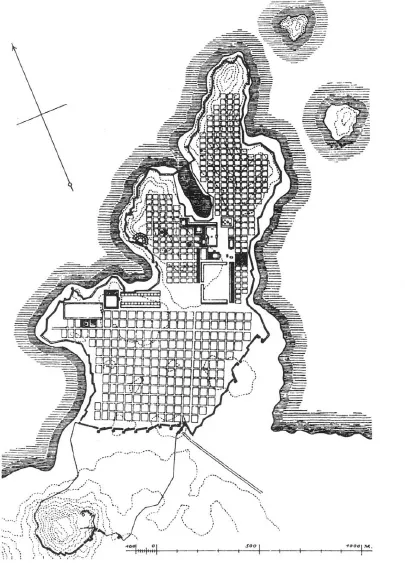
1.1 Plan of Miletus (fifth century BCE). Reconstruction of the Greek colony in Asia Minor—carried out after being sacked by the Persians—followed a gridiron plan, with square blocks radiating from a central agora. As they established subsequent colonies around the Mediterranean, the Greeks replicated the Miletian plan.
Courtesy Holger Ellgaard, via Wikimedia
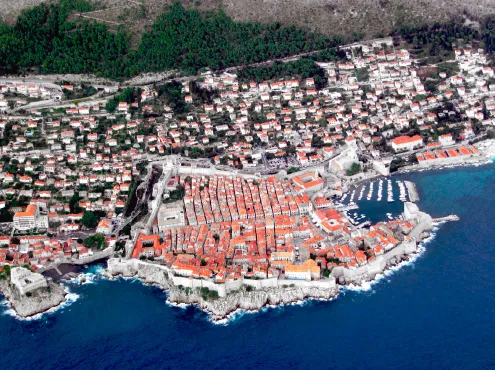
1.2 Dubrovnik, Croatia. The Byzantine empire inherited the Miletian plan from Rome and prescribed the grid that still distinguishes Dubrovnik’s historic center from development outside its walls, which were begun in the ninth century and completed during the Renaissance.
The classical cities that developed from these two beginnings evolved over hundreds and thousands of years. Rome itself combines organic origins and gridded streets, and historians have identified at least six layers of reconstruction, with the Roman grid absorbed into successive periods of growth and decay.
Rebirth of European Cities: “Organic” Cities of the Late Middle Ages
Few new European cities arose in the centuries after the fall of Rome, and military considerations strongly shaped those that did, primarily bastides in France and Zähringer towns in Germany. Inspired by Roman military outposts, these towns followed a strict Miletian pattern arrayed around a central market square. Planned from scratch, they exemplified medieval town planning and urban design.
Bastide towns dotted the Languedoc, Aquitaine, and Gascony during the thirteenth and fourteenth centuries, when the Hundred Years’ War between France and Britain raged over much of France. Bastides were typically planned and built as single units, often by a single lord; Alphonse of Poitiers for example, built several in a bid to conso...
Table of contents
- Cover
- Contents
- Title
- Copyright
- Dedication
- Acknowledgments
- Introduction
- Chapter 1: Roots of Western Urban Form: Centralization
- Chapter 2: Decentralization: The Rise and Decline of Industrial Cities
- Chapter 3: Recentralization: The Forces Shaping Twenty-First-Century Urbanism
- Chapter 4: Recentralization: Twenty-First-Century Urbanism Takes Shape
- Chapter 5: Theories of Urbanism
- Chapter 6: Urban Design for an Urban Century: Principles, Strategies, and Process
- Afterword
- Supplemental Images
- Index
- End User License Agreement
Trusted by 375,005 students
Access to over 1.5 million titles for a fair monthly price.
Study more efficiently using our study tools.
Frequently asked questions
Yes, you can cancel anytime from the Subscription tab in your account settings on the Perlego website. Your subscription will stay active until the end of your current billing period. Learn how to cancel your subscription
No, books cannot be downloaded as external files, such as PDFs, for use outside of Perlego. However, you can download books within the Perlego app for offline reading on mobile or tablet. Learn how to download books offline
Perlego offers two plans: Essential and Complete
- Essential is ideal for learners and professionals who enjoy exploring a wide range of subjects. Access the Essential Library with 800,000+ trusted titles and best-sellers across business, personal growth, and the humanities. Includes unlimited reading time and Standard Read Aloud voice.
- Complete: Perfect for advanced learners and researchers needing full, unrestricted access. Unlock 1.5M+ books across hundreds of subjects, including academic and specialized titles. The Complete Plan also includes advanced features like Premium Read Aloud and Research Assistant.
We are an online textbook subscription service, where you can get access to an entire online library for less than the price of a single book per month. With over 1.5 million books across 990+ topics, we’ve got you covered! Learn about our mission
Look out for the read-aloud symbol on your next book to see if you can listen to it. The read-aloud tool reads text aloud for you, highlighting the text as it is being read. You can pause it, speed it up and slow it down. Learn more about Read Aloud
Yes! You can use the Perlego app on both iOS and Android devices to read anytime, anywhere — even offline. Perfect for commutes or when you’re on the go.
Please note we cannot support devices running on iOS 13 and Android 7 or earlier. Learn more about using the app
Please note we cannot support devices running on iOS 13 and Android 7 or earlier. Learn more about using the app
Yes, you can access Urban Design for an Urban Century by Lance Jay Brown,David Dixon,Lance Jay Brown in PDF and/or ePUB format, as well as other popular books in Architettura & Pianificazione urbana e paesaggistica. We have over 1.5 million books available in our catalogue for you to explore.