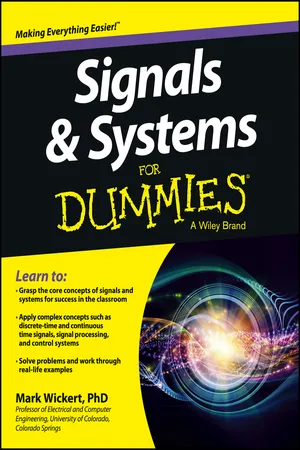
The concepts covered in a typical signals and systems course are often considered by engineering students to be some of the most difficult to master. Thankfully, Signals & Systems For Dummies is your intuitive guide to this tricky course, walking you step-by-step through some of the more complex theories and mathematical formulas in a way that is easy to understand.
From Laplace Transforms to Fourier Analyses, Signals & Systems For Dummies explains in plain English the difficult concepts that can trip you up. Perfect as a study aid or to complement your classroom texts, this friendly, hands-on guide makes it easy to figure out the fundamentals of signal and system analysis.
- Serves as a useful tool for electrical and computer engineering students looking to grasp signal and system analysis
- Provides helpful explanations of complex concepts and techniques related to signals and systems
- Includes worked-through examples of real-world applications using Python, an open-source software tool, as well as a custom function module written for the book
- Brings you up-to-speed on the concepts and formulas you need to know
Signals & Systems For Dummies is your ticket to scoring high in your introductory signals and systems course.