![]()
1
Overview of Heterogeneous Networks
Geng Wu,1 Qian (Clara) Li,1 Rose Qingyang Hu,2 and Yi Qian3
1Intel Corporation, USA
2Utah State University, USA
3University of Nebraska – Lincoln, USA
We are living in a rapidly changing world. Every two days now we create as much information as we did from the dawn of civilization up until 2003 [1]. Users want to communicate with each other at any time, anywhere and through any media, including instant messages, email, voice and video. Users want to share their personal life experience, ideas and news with friends through social networking, and use their intelligent mobile devices to produce and to consume content generated by users or by commercial media. In the meantime, mobile internet is rapidly evolving towards embedded internet, expanding its reach from people to machines [2]. In fact, the wireless industry now expects 50 billion machine-type devices connected to the global network by 2020 [3], truly forming an internet of everything.
The advancement of a number of fundamental technologies powers the rapid market growth. Moore's Law continues to provide more transistors and power budget, enabling the semiconductor industry to deliver more powerful signal processing capabilities at lower power consumption and lower cost. Application developers continue to innovate and maximize the benefits of the signal processing technology, with user interface evolving from keypad to touch to gesture, and applications from voice to video to augmented reality. As our society enters the age of ‘Big Data’ [4], our communication infrastructure also needs to evolve to meet the overwhelming demands for capacity and bandwidth. The migration from homogenous to heterogeneous network architecture is therefore essential to support a broad range of connectivity and to deliver unprecedented user experience. The future is coming today.
As one of the main pillars and the future trends of mobile communication technology, heterogeneous networks have received a lot of attention in the wireless industry and in the academic research communities. This chapter is intended to provide a technology and business overview of heterogeneous networks, the state of the art in technology development, the main challenges and tradeoffs, and the future research and development directions. However, we are still at an early stage of development of heterogeneous network technology. As you will find throughout this chapter, there are many more questions than answers at this time, and many questions may have more than one valid answer, depending on the market, the target applications and the exact deployment scenarios and competitive environment. We expect that heterogeneous network technology will continue to evolve along with the convergence of information technology and telecommunication, and increasingly intelligent mobile devices.
1.1 Motivations for Heterogeneous Networks
There are significant economic and technological reasons for the rapid development of heterogeneous networks. The outcomes of this technological development are expected to have profound impacts on the future of telecommunications.
1.1.1 Explosive Growth of Data Capacity Demands
In recent years, mobile internet has witnessed an explosive growth in demand for data capacity [5]. This is largely fuelled by the proliferation of more intelligent mobile devices. Market studies have shown that the data traffic volume is a direct function of the device's screen size, the user-friendliness of its operating system and the responsiveness of wireless network that the device is connected to. For example, a 3G smartphone on average consumes about 30 times the system capacity of a 2G voice phone, and a tablet consumes five times the system capacity of a smartphone. As the mobile devices continue to increase in screen size, image resolution and battery life, and as the network infrastructures continue to improve in peak data rate and network latency, the growth in data capacity demand will continue.
In addition to this organic growth in capacity, demand from the improved mobile devices and communication infrastructure, user-generated content and social networking add significant additional burden to the network. In fact, mobile devices are an ideal platform for social networking applications such as Facebook since they offer ubiquitous coverage with its always-on and always-connected connectivity. Social networking and other similar applications usually produce small but frequent data transmissions. A network may have to frequently set up and tear down the radio links to conserve precious radio resources in order to accommodate a large number of users. This often results in an excessive amount of control messages over the control plane. On the other hand, as watching YouTube videos on mobile devices gains popularity, the capacity demand on the data plane is also growing rapidly, and often in an asymmetric fashion between the uplink and the downlink. Finally, depending on how cloud and client partition the signal processing load, cloud-based services may further accelerate demand, as information is shipped between the mobile devices to the cloud for cloud computing and network storage. One such example is Apple's Siri voice reorganization application software. Since the popularity of mobile applications is often difficult to predict, we start to see drastically different capacity demands between the control plane and the data plane, between the uplink and the downlink. We also start to see network congestion expanding from the access network (the traditional capacity bottleneck) to the core network and even to the backbone network and connections.
Machine-type communications add yet another complexity to the future generations of wireless networks. With mobile internet evolving towards embedded internet, future networks need to scale up in size and complexity in order to accommodate an unprecedented number of connected devices with vastly different traffic characteristics, usage models and security requirements. The capacity demands from these machine-type devices range from very low traffic volume monthly meter reading to high speed real-time video surveillance. In addition, securely managing billions of such connected devices across many different types of networks and operating environments adds to the complexity of capacity planning.
The combined capacity demands from organic traffic growth, user-generated contents, social networking and machine-type connected devices require orders of magnitude capacity increase in future wireless networks. This heterogeneous data traffic growth also mandates a paradigm shift in network architecture design and provisioning.
1.1.2 From Spectral Efficiency to Network Efficiency
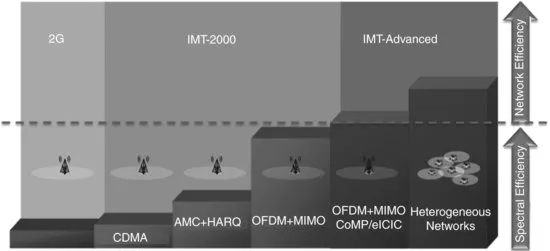
The wireless industry has several options for meeting the explosive data traffic growth. After decades of relentless air interface innovations, today we are practically reaching the theoretical limit of radio channel capacity, commonly known as the Shannon limit. Although air interface improvement will continue to maximize the benefits of advanced wireless communication research and take full advantage of advanced signal processing technologies for an even higher spectral efficiency, we need several orders of magnitude greater system capacity than what the air interface spectral efficiency improvement can offer. The future capacity increases therefore need to come from a combination of technology solutions, including, in particular, maximizing the overall network efficiency instead of solely relying on the spectral efficiency improvement at the radio link level (Figure 1.1). Heterogeneous networks are a fundamental technology behind most of these solutions.
In the near term, mobile network operators are looking at limiting the monthly data usage of each subscriber over the wireless wide areas networks (WWAN), and throttling the data rate of heavy usage users when necessary. However, limiting usage or throttling capacity demand is in general only a temporary fix to the immediate network overloading problems. We need more proactive solutions to encourage and enable future sustained data traffic growth, and to provide mobile broadband access to all users, and to enrich every person's life on earth.
One such solution that mobile network operators are looking at is the data offloading strategy. This includes (but is not limited to) facilitating and encouraging subscribers to offload their traffic from macro base stations to the alternative small-cell networks, essentially forming a basic heterogeneous network. Since the capacity bottleneck varies from market to market and from network to network, there are many flavours and technical options for offloading strategy, including macrocell network and small-cell network of the same air interface technology, between networks of different air interface technologies, or between mobile operator core network and public internet. There is no single answer to the mobile data offloading question. These options are complementary, and all of them will continue to develop to meet the ever-increasing capacity demands.
Another obvious answer to the growing demand in data capacity is to add more spectrum. The wireless industry and regulators are working together to investigate the possibility of adding more frequency bands, both licensed and unlicensed, for mobile internet applications. However, since there is a limited supply of spectrum, and there is the strong desire for globally harmonized frequency allocation to maximize the economy of scale, the progress in new frequency allocation has been slow. As many densely populated markets are already on the verge of running out of spectrum, we see increased pressure to re-farm the existing frequency bands and for the rapid deployment of small cells for high spatial frequency reuse. In addition, the wireless industry has also started to look at high frequency bands such as millimeter wave for mobile internet applications. Since these bands have very different radio propagation characteristics from the traditional lower frequency bands (usually below 3 GHz) used for high mobility cellular networks, the technology, design and operation of these networks are expected to be very different from traditional cellular networks. Therefore, heterogeneous networks consisting of layers of networks operating at different frequency bands become the main venue for achieving higher system capacity.
In addition to obtaining additional spectrum allocation and developing new technologies for the higher frequency bands, the wireless industry and the research community are also looking at innovative ways for more flexible spectrum utilization, including spectrum sharing, dynamic spectrum access and cognitive radio with opportunistic network access. One such example is the experimental use of TV white space spectrum for wireless communication in the US market. This new type of spectrum access requires additional network entities such as databases that administrate the alternative radio transmitters to operate in the broadcast television spectrum when that spectrum is not used by the licensed service. Since the network coverage and service availability are different from those of the traditional wireless mobile networks due to the dynamic nature of the spectrum availability, the industry is still investigating suitable network architecture and business models to achieve viable return on investment. From a telecommunication infrastructure viewpoint, such new types of networks are expected to become part of the global heterogeneous networks.
1.1.3 Challenges in Service Revenue and Capacity Investment
In recent years, mobile service revenue growth has shifted from circuit-switched voice and short message service (SMS) to data services. This shift adds significant pressure to mobile network operators' profitability for three main reasons. First, mobile data in general yields a lower revenue per bit compared to the traditional voice services and SMS. Secondly, the highly profitable operator walled-garden mobile applications are facing stiff competition from over-the-top mobile applications. Finally, as mobile data traffic explodes, operators need extensive capital investment in new network capacity to meet the demand. Since mobile network operators are instrumental in investing, operating and maintaining global mobile internet infrastructure, it is crucial for the wireless industry and the academic research communities to develop new networking technologies that allow operators to remain profitable and competitive so that they can continue to invest in capacity and new services. Heterogeneous networking is considered one of the most important technologies that not only deliver tens- to thousands-fold system capacity increase but also enable new generations of services to replace the revenue from traditional but diminishing voice-centric telecom services.
To summarize, while the demand for data capacity is exploding and the improvement in spectral efficiency in homogeneous networks is slowing down due to the approaching Shannon limit, it becomes essential that the future focus of wireless technology shifts from further increasing the spectral efficiency of the radio link to improving the overall network efficiency through heterogeneous network architecture and related signal processing technologies. We need heterogeneous networks to deliver a higher system capacity to meet the higher traffic density. We want to leverage heterogeneous network architectures to expand network coverage, to improve service quality and fairness throughout the network coverage areas, in particular at the cell edge. We also want to use heterogeneous networks as a platform for future technological innovations, including the integration of new types of networks, new types of connectivity and new types of connected devices and applications.
1.2 Definitions of Heterogeneous Networks
Heterogeneous networking is one of the most widely used but most loosely defined terms in today's wireless communications industry. Some people consider the overlay of macro base station network and small cell network (e.g., micro, pico and femtocells) of the same air interface technology as heterogeneous networks. Others consider cellular network plus WiFi network as a main use case. There are also those who consider the inclusion of new network topologies and connectivity as part of the heterogeneous networks vision, such as personal hotspot, relay, peer-to-peer, device-t...