![]()
Part One
The New Value Equation
In Part One, The New Value Equation, I explain the three factors that make up the New Value Equation: Current Performance, Future Potential, and Emotional Expensiveness. These factors will determine how you are measured, retained, and rewarded in the future. I show you how to rate yourself for each factor, then give you some quick ways to improve your ratings. By the end of Part One, you'll know where you stand, what you need to work on to be highly employable in any economy, and why you owe it to yourself to take responsibility for your own fulfillment and development. You own your future. This is where it all starts: your empowerment, your reconnection to your own results, your own value, your own reality, your own truth.
![]()
Chapter 1
Your Current Performance
Performance review time brings excitement and dread in the workplace. Most of you are rated at least once a year. You feel invested in your performance numbers to the extent that they may be tied to incentives like raises and promotions, and who wouldn't want the praise and recognition that you hope to accrue in what could be a rare one-on-one meeting with the boss? The dread comes in because, for many employees, the yearly review is the only time you receive meaningful feedback on your performance, good or bad. You may be nervous about it, and you may sense that your boss is not looking forward to it any more than you are. Performance reviews can be emotionally fraught, and they take up a lot of time and energy that contributes very little to the bottom line, so managers are often tempted to put them off. What's more, they are subject to a lot of common errors, on both sides of the desk, that could be avoided.
In this chapter, I explain what performance reviews—which have been the metric of choice in most businesses for years, and at times your only indication of your value—are meant to do, and why the system isn't working and has in fact become a major point of contention between many employees and their bosses. You'll learn how to answer the question, “How am I doing?” for yourself in a way that is truly meaningful, and boost not only your value and productivity but also your contentment at work. You will find your equanimity, not only at performance review time, but all year long.
Performance Reviews in Theory
Your performance review is meant to show you how you have measured up to expectations at work in the past year and focus your mind on your role in delivering on the organization's goals. It is a chance for you and your supervisor to document and discuss how well you've performed your daily activities and conformed to the behaviors that help the company run smoothly; your success or failure to deliver on goals for the previous year, ideally based on the larger goals of the organization so you know how your work fits into the big picture; your performance rating, your score or “grade” for the year; and your plans for the year ahead.
Each year, you promise your employer a set of deliverables and agree to areas of accountability. Your organization agrees to a price for your services. In order to keep your job, and qualify for raises or other benefits, you need to meet or exceed expectations. Once a year, your work is held up for inspection by your leader, who reviews what you committed to and helps you account for your results. You identify goals you delivered on and any gaps between what you promised and what you achieved. You discuss behaviors that helped or hindered your performance, and at the end of the meeting it should all boil down to a single rating of your work that provides a clear message for you and helps the organization take an inventory of its talent and their performance. The annual review process is meant to provide an objective, nonpersonal, transparent, and up-front view of the value you added over the past twelve months, along with suggestions for growth and behavior changes that would increase your chances of adding value in the future.
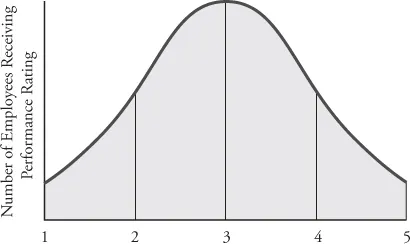
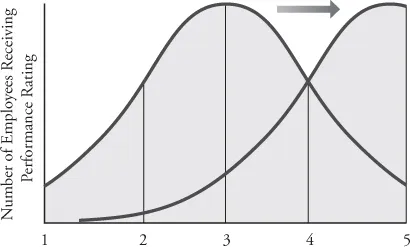
In a company where this system is working well, employee performance numbers should be represented by a bell-shaped curve (see Figure 1.1). The majority of employees would be rated as “average” and fall in the middle of the curve. The left-hand tail of the curve would represent those who lagged behind and were rated “below average.” The right-hand tail would represent the highest performers, the curve-breakers whose practices should be rewarded and replicated throughout the organization so that, next year, results would improve—in effect, picking that curve up and moving the whole thing to the right. The hope is that, through clear differentiation of performance levels, happiness and satisfaction will increase because everyone will be clear on what is expected of them, get good feedback on any shortfall, and be rewarded according to his or her contribution (see Figure 1.2).
Wouldn't it be great if that was what actually happened?
Performance Reviews in Reality
Anyone who has ever been through a performance review knows that it is far from the clean and straightforward process it is meant to be. But in order to understand what is going wrong at the individual level, we have to start by looking at the organizational level. The main reason I believe performance reviews as they are used in most companies are an inadequate measure of true value is that they seem to create an alternate reality that is divorced from companies' actual results. In other words, in most organizations there is no correlation between employees' yearly performance ratings and the results that the company is experiencing.
Many times as a leader, and later as a consultant, I have had the experience of hearing, on the same day, two opposing messages within the same organization. From Human Resources, I'd hear that many hardworking and effective employees had delivered results that merited high “exceeds expectations” performance ratings and therefore would receive pay raises. Then the chief executive officer CFO would describe the company's challenging financial outlook and explain how results had fallen far below expectations. I often sat wondering, “How can that be? Top performance by the majority of employees at the same time that results are coming in far below projections? Should we be rewarding this? How will we remain competitive?” There seemed to be a disconnect in many organizations—not just a few. Shouldn't the contributions employees have made add up to results for the company? I went out to study the reality of it, to try to solve the mystery of why this simple math had become so complicated.
I wanted to know how tightly correlated (and therefore how accurate, honest, and true to intent) performance ratings were to organizational results. So I gathered statistics from thirty-seven companies over the course of five years, involving more than 275,000 employees in total. I conducted an audit comparing each company's yearly results with that year's overall performance rating distribution. How were employees' results stacking up by comparison to the company as a whole? In companies where the average employee is assessed as “exceeding expectations,” I expected to see great results overall. In companies where the most performance scores were “average” or “below average,” I'd have expected to see results that conformed to a lower standard.
What I found was that, in companies where the majority of employees had been rated as “above average” for performance, actual results were 10 percent below industry standards in a variety of categories, including profitability, market share, employee retention, and customer satisfaction. Those companies whose overall performance ratings mapped most closely to a bell-shaped curve over five years, meaning that the majority of employees were rated as “average,” and just a few rated as “above” and “below average,” achieved far better outcomes year after year.
I found that, in less successful businesses, employees were more likely to be highly rated for performance. In other words, there was a lot of “grade inflation” going on. Within many companies I studied, the performance numbers skewed so high it would appear that they were all claiming to have all the best performers in their industry, which would be impossible. Meanwhile, successful companies were far more likely to rate the employees responsible for their success as “average,” that is, delivering as expected, as promised, and as needed to stay competitive.
Sorry to be the one to break the news to you, but in many companies, individual performance reviews have become totally disconnected from results. That's why you can't trust a top rating in your performance review. It tells you very little about where you stand and how much you are contributing to the bottom line, and it doesn't say anything about your Future Potential. One thing is for sure: your performance number is no longer a trustworthy measure of your value or a predictor of results in your organization.
How Performance Reviews Go Wrong
Although my research proves that performance reviews aren't working well for many employees as a measure of value, there are other reasons to take them with a grain of salt.
First, performance reviews are static and retrospective, and they are of a world long past. They only measure how you have performed to the minimum standards of your job. They encourage an unhelpful focus on the past at the expense of the future.
Second, performance reviews compare you to other employees within your company, when in fact your and your company's competition is across your industry as a whole. If you're not being rated against the highest level of professionalism and competence in your field, you're not getting the true measure of your value, either in terms of your career prospects or what it takes for your company to compete in the marketplace.
Third, we tend to confuse effort with results. Your organization gets no return on investment for effort. It is hard for managers to give an employee an average or below-average rating when they know he or she has worked hard, but in reality it is outcomes—not effort—that count, and that is what we all should be measured on. In order to avoid conflict, they have lowered their standards and stopped differentiating, which is the very thing the best employees would like to see more of. In a survey I ran in 2011, 75 percent of employees said the most important motivator for them was to be paid and rewarded according to their actual contribution. So lack of differentiation backfires in both directions. Those of you who are lagging behind are lulled into a false sense of security, and those who are truly stepping up are robbed of the recognition and rewards you deserve.
Both managers and employees tend to personalize Performance Ratings in a way that is unprofessional. These numbers are not—and never have been—a referendum on you and your worthiness as a human being. We must put that aside if we want to have an accurate accounting. But we don't. We seem to have forgotten that a realistic performance number, with a thorough accounting for the gap between expectations and actual results, is a great reality check. Discomfort is a fabulous motivation to change and improve. Instead, what we have is institutionalized complacency and mediocrity based on fear.
Managers are afraid of the emotion involved when they give negative feedback. They are worried about your reaction, and so they sugar-coat the message or inflate their ratings. This has corrupted the system by changing its goals. Performance reviews are supposed to spur you on to turn your talent to great productivity and even better results, not just raise your morale or reassure and appease you.
You play your role in this corruption. Your inability to receive feedback with equanimity and your anxiety about accounting for your results leads you to blame others, or your circumstances, instead of taking responsibility. Guilt and emotional blackmail ensue when you fear your number may drop. You resist any change in your rating from year to year. You may resort to having a conversation about what your organization needs to give you in order to get the gift of your work.
Performance numbers have become ego numbers—a source of frustration and disappointment for most people. We tend to inflate not only our own performance but the performance of those around us. We want to feel we are giving our best. It's hard for your manager to be honest with you and hard for you to be honest with yourself. It's easy to look back over the previous year and overstate your accomplishments, especially when a promotion or a raise is at stake. But if you don't take account of your shortfalls and missed opportunities, you won't get the chance to learn from them.
Few people walk out of a performance review feeling thrilled about their feedback or clear on what they need to do to succeed. The most typical outcome is that your employer feels as though you are neither grateful enough for the inflated score nor committed enough to the organization, and that you're more focused on what you want to get than what you can give. And, even with an inflated score, you end up feeling undervalued, misunderstood, and under-rewarded for your hard work. Too often performance reviews become a source of confusion when you are told you are doing well at the same time the company is struggling. Or worse (as is happening today), the organization begins to align and recalibrate its performance ratings with its results, your numbers get real, and you are devastated to find that they were inflated in the first place. You get the false impression that the company's results have nothing to do with you—that the economy, poor leadership, your colleagues' lack of skill, or some other cause is to blame, and you as an employee are an innocent victim. After all, if you are the one working hard, as evidenced by your outstanding performance ratings, it must be other things, or people, effacing the success of the company.
While being let off the hook might feel okay, not being recognized for your contribution is a hollow experience. Feeling that your work has little real impact on the bottom line decreases your happiness, increases fear, and breeds resentment as reality continues to provide you with evidence you've been lied to. Many of you are playing defense, trying to establish minimal standards for which you can be rated as “meets expectations,” focusing on what you have already given rather than what the organization needs to be competitive and how you can deliver it in the future.
How You Can Rise Above the Confusion
Regardless of what is wrong with reviews today, the b...