- English
- ePUB (mobile friendly)
- Available on iOS & Android
eBook - ePub
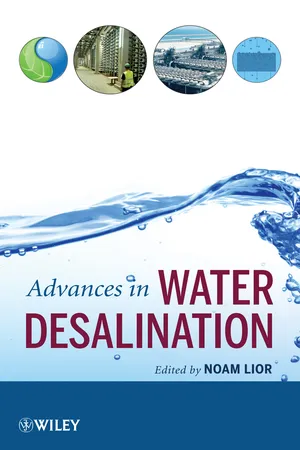
Advances in Water Desalination
About this book
Desalination is a dynamically growing field with more research, more engineering, more applications, more countries, more people, and with more training programs. This book provides high quality invited reviews on progress in various aspects of the desalination field. It features comprehensive coverage of desalination science, technology, economics, markets, energy considerations, environmental impact, and more. It is a key guide for professionals and researchers in water desalination and related areas including chemical, mechanical, and civil engineers, chemists, materials scientists, manufacturers of desalination membranes, water reuse engineers, and water authorities, as well as students in these fields.
Information
Chapter 1: Water Desalination Revisited in Changing Physical and Economic Environments
1.1 Introduction
1.1.1 Past and Present Desalination
1.1.2 The Emerged Concern
1.1.3 The Emerged Energy Analysis Methodologies
1.2 The Methodology Used in this Study
1.2.1 Improved Thermodynamic Analysis
1.2.1.1 The Exergy Function
1.2.2 Improved Costing Analysis
1.2.2.1 The Quantification of the Manufacturing and Operation Resources for a Device
1.2.2.2 Correlating the Manufacturing Resources of a Device in Terms of Thermodynamic Variables
1.2.3 Enhanced Optimization
1.2.3.1 Two Simplifying Assumptions
1.2.3.2 The Conditions of Device-by-Device Optimization
1.2.3.3 The Form of Aimin and Di of a Device
1.2.3.4 Convergence to System Optimum
1.2.3.5 Optimization of System Devices by One Average Exergy Destruction Price
1.2.3.6 Global Decision Variables
1.3 The Scope of Analysis
1.3.1 Desalination Related to Physical and Economic Environments
1.3.2 The Systems Considered
1.4 The Analyzed Systems in Detail
1.4.1 Gas Turbine/Multistage Flash Distillation Cogeneration Systems
1.4.1.1 Flow Diagram
1.4.1.2 Major Features of the Results
1.4.2 The Simple Combined Cycle Systems
1.4.2.1 Flow Diagram
1.4.2.2 Major Features of the Results
1.4.3 Vapor Compression Systems Driven by the Figure 1.2 Simple Combined Cycle
1.4.3.1 Flow Diagrams
1.4.3.2 Major Features of the Results
1.4.4 Reverse Osmosis Desalination Systems Driven by the Figure 1.2 Simple Combined Cycle
1.4.4.1 Flow Diagrams
1.4.4.2 Major Features of the Results
1.4.5 Photovoltaic/Reverse-Osmosis (PV/RO) Solar Systems
1.4.5.1 Flow Diagram
1.4.5.2 Major Features of Results
1.4.6 Photovoltaic/Electrodialysis Solar System
1.4.6.1 Major Features of the Results
1.4.7 Osmosis Power Systems
1.4.7.1 Flow Diagram
1.4.7.2 Major Features of the Results
1.4.8 Future Competitiveness of Combined Desalination Systems
1.4.8.1 Prediction Criteria
1.4.8.2 Predicted Competitiveness
1.5 Recommended Research Directions
1.5.1 Avoiding CO2 Emissions
1.5.2 Reducing CO2 Emissions
1.5.3 Desalination of Zero Liquid Discharge
1.6 Conclusions
1.7 The Software Programs Developed by the Author for System Analysis
1.7.1 Four Programs Developed and Their Entries
1.7.2 Major Ingredients of Each Program
1.7.3 The Software
Appendix
1.A.1 Brief Description of the Thermodynamic Model of a System and the Design Models of Its Main Components
1.A.2 The Capital and Fuel Costing Equations of some common Devices (Tables Table 1.A.1 and Table 1.A.2)
1.A.1.1 Thermodynamic Model
1.A.1.2 Sample Design Models
1.A.3 Some Useful Forms of Flow Exergy Expressions
1.A.3.1 Equations
1.A.3.2 Balances
1.A.4 Theoretical Separation Work Extended to Zero Liquid Discharge
1.1 Introduction
The topic of water desalination is revisited because of the negative impact of the rising oil price index on the economic environment and the adverse effects of the increasing carbon footprint on the physical environment. In this introductory chapter, these negative factors are discussed with respect to their impact on past and present desalination methods. The impact of these factors on the design and operation practices of desalination and energy-intensive systems in general is highlighted. The energy analysis methodologies developed during the last two decades, including the methodology discussed in the present study, are summarized. General references on the subject matter are listed in the Further Reading section at the end of this chapter.
The software mentioned in this chapter may be downloaded at http://booksupport.wiley.com.
1.1.1 Past and Present Desalination
Interest in water desalination began in the late 1950s and early 1960s when the price of oil was only $3 per barrel (bl). A number of desalting processes and systems were considered that sought to minimize the cost of water production. For seawater, the leading methods were multistage flash distillation, vapor compression and freezing. Other processes, such as electrodialysis and reverse osmosis, lagged somewhat behind. Balancing the cost of the resources utilized in fueling a system and the resources utilized in making its devices favored moderate efficiency devices. For example, multistage flash distillation (MSF) in a cogeneration system used a maximum temperature of around 190°F (∼80°C) in 8–12 stages. Cost allocated to water was as low as $0.3/m3. Environmental constraints were virtually absent.
As the oil price index increased to $25/bl, the number of the stages of conventional MSF increased to about 20 and the cost allocated to water rose to about $1/m3. At the same time, the awareness and concern regarding increased CO2 emissions also increased.
Present desalination methods are facing a continuing increase in oil prices and a conti...
Table of contents
- Cover
- bseries
- Title Page
- Copyright
- Preface
- Introduction to the Book Series Advances in Water Desalination
- About the Authors
- Chapter 1: Water Desalination Revisited in Changing Physical and Economic Environments
- Chapter 2: Environmental and Performance Aspects of Pretreatment and Desalination Technologies
- Chapter 3: Economic Aspects of Water Desalination
- Chapter 4: Advances in Hollow-Fiber Reverse-Osmosis Membrane Modules in Seawater Desalination
- Chapter 5: Adsorption–Desalination Cycle
- Chapter 6: Advanced Instrumentation, Measurement, Control, and Automation (IMCA) in Multistage Flash (MSF) and Reverse-Osmosis (RO) Water Desalination
- Index
Trusted by 375,005 students
Access to over 1.5 million titles for a fair monthly price.
Study more efficiently using our study tools.
Frequently asked questions
Yes, you can cancel anytime from the Subscription tab in your account settings on the Perlego website. Your subscription will stay active until the end of your current billing period. Learn how to cancel your subscription
No, books cannot be downloaded as external files, such as PDFs, for use outside of Perlego. However, you can download books within the Perlego app for offline reading on mobile or tablet. Learn how to download books offline
Perlego offers two plans: Essential and Complete
- Essential is ideal for learners and professionals who enjoy exploring a wide range of subjects. Access the Essential Library with 800,000+ trusted titles and best-sellers across business, personal growth, and the humanities. Includes unlimited reading time and Standard Read Aloud voice.
- Complete: Perfect for advanced learners and researchers needing full, unrestricted access. Unlock 1.5M+ books across hundreds of subjects, including academic and specialized titles. The Complete Plan also includes advanced features like Premium Read Aloud and Research Assistant.
We are an online textbook subscription service, where you can get access to an entire online library for less than the price of a single book per month. With over 1.5 million books across 990+ topics, we’ve got you covered! Learn about our mission
Look out for the read-aloud symbol on your next book to see if you can listen to it. The read-aloud tool reads text aloud for you, highlighting the text as it is being read. You can pause it, speed it up and slow it down. Learn more about Read Aloud
Yes! You can use the Perlego app on both iOS and Android devices to read anytime, anywhere — even offline. Perfect for commutes or when you’re on the go.
Please note we cannot support devices running on iOS 13 and Android 7 or earlier. Learn more about using the app
Please note we cannot support devices running on iOS 13 and Android 7 or earlier. Learn more about using the app
Yes, you can access Advances in Water Desalination by Noam Lior in PDF and/or ePUB format, as well as other popular books in Physical Sciences & Organic Chemistry. We have over 1.5 million books available in our catalogue for you to explore.