![]()
GREAT LEADERSHIP CREATES GREAT WORKPLACES
Whether you are an eighty-year-old corporate icon, a high-tech start-up with the ink still wet on the incorporation papers, a government department, or a nonprofit agency, nothing is certain today. Trust in corporations, government, and institutions in general keeps eroding, and there’s no indication that this trend is going to change its direction anytime soon. Besides that, employee commitment and engagement have taken a dip, and those who are still employed are indicating that they’d jump ship when things improve. There’s no doubt about it. We live in challenging times.
As surprising as it may sound, in these challenging and difficult times we’re likely to see some of the most extraordinary leadership we’ve seen in decades. Leaders, it turns out, don’t do their best when they’re maintaining the status quo or when they feel comfortable. They do their best when faced with adversity, crisis, setbacks, and great difficulty. Challenge is the opportunity for greatness.
Great results in the marketplace can only come about from making extraordinary things happen within your organization. The key is great leadership. Indeed, there is overwhelming evidence that great leadership creates great workplaces; and, in turn, great workplaces create great marketplace results. The late management guru Peter Drucker said, “Only three things happen naturally in organizations: friction, confusion, and underperformance. Everything else requires leadership.” So if you want better results in your marketplace, ensure that you are working on fostering great leadership within your organization.
In making the case that great leadership is the key to creating great workplaces, we will present evidence that leadership makes a meaningful difference in people’s engagement at work and in the performance of the organization. We’ll do this by exploring what the difference looks like in terms of The Five Practices of Exemplary Leadership®—the practices that we’ve found in our research lead to extraordinary results. And within this framework, we will provide you with practical ideas and actions you can take to become a better leader and foster a great workplace.
One additional note: developing leadership competency isn’t just an issue for any one function, industry, or nation. It’s a global issue. Studies show that over three-quarters of executives around the world indicate that the most critical people issue related to their organization’s success is leadership development, especially as it relates to developing their future pipeline of leaders.1 These executives are even more concerned because the baby boomer generation is quickly approaching retirement, a consequence of which is that vast numbers of experienced leaders are expected to retire or to step down from full-time employment by 2020, creating a leadership vacuum. A lack of leadership bench strength is of great concern to organizations worldwide.
Leaders Make a Difference
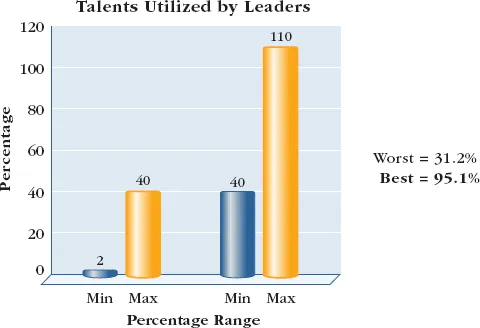
Consider what people report when we ask them to think about either the worst or the best leader they have ever worked for and the percentage of their talents that each leader utilized. In recent years, we’ve asked this question to a wide variety of people, including U.S. Coast Guard commanders, senior HR executives, graduate students in higher education administration, marketing executives with a global cosmetics firm, palliative medicine physicians, and community organizers. Their answers have been the same. Generally what we’ve found is that when people think about their worst leaders—when we just simply asked, “Give me a number from 1 to 100”—we get a range of anywhere between around 2 to 40 percent, with an average of about 31 percent. In other words, our research shows that people report that in their experience, their worst leaders tapped less than a third of their available energy and talents. Many continued to work hard, but few said that they put into their work all that they were capable of delivering. Those few who reported a higher percentage clearly noted and voiced their resentment about how they had to do so much more than was really necessary because of their boss’s ineptitude and lack of leadership.
This percentage is in sharp contrast to what people report when they think about their most admired leader. The best leaders bring out anywhere from 40 percent of our talents (this bottom was the top of the range for the worst leaders!) to 110 percent. We know that it’s mathematically impossible to get more than 100 percent of one’s talents, yet people shake their heads and say, “No, they really did get me to do more than I thought I was capable of doing or that it was possible to do.”
There’s clearly a difference between our best and our worst leaders. As illustrated in Figure 1, the best leaders get more than three times the amount of talent, energy, commitment, and motivation from us compared to their counterparts at the other end of the spectrum.
Our data on employee engagement reinforce the experience that all of us have when we think about our best and worst leaders. In analyzing responses from nearly two million people around the world, we’ve found that those leaders who more frequently exhibit The Five Practices of Exemplary Leadership have employees who are more committed, proud, motivated, loyal, and productive than those whose leaders exhibit these practices less frequently. Overall engagement scores are 25 to 50 percent higher among the groups with leaders who exhibit exemplary leadership.
When people reflect on their own experience, it becomes crystal clear that leaders make a difference. They make a significant and meaningful difference in people’s willingness to put forward more discretionary effort, and they make a difference in organizational performance.
Are Leaders Born or Made?
If leaders make a difference, is it really possible to develop leaders who can make a difference? Isn’t talent fixed, and people either have it or they don’t? We hear this all the time. In nearly every class we teach or speech we give, someone invariably asks, “Are leaders born or made?”
Whenever we’re asked this question, our answer, always offered with a smile, is this: “We’ve never met a leader who wasn’t born. We’ve also never met an accountant, artist, athlete, engineer, lawyer, physician, writer, or zoologist who wasn’t born. We’re all born. That’s a given. It’s wha...