- First collection in twenty years dedicated to examining Herzog's expansive career
- Features essays by international scholars and Herzog specialists
- Addresses a broad spectrum of the director's films, from his earliest works such as Signs of Life and Fata Morgana to such recent films as The Bad Lieutenant and Encounters at the End of the World
- Offers creative, innovative approaches guided by film history, art history, and philosophy
- Includes a comprehensive filmography that also features a list of the director's acting appearances and opera productions
- Explores the director's engagement with music and the arts, his self-stylization as a global filmmaker, his Bavarian origins, and even his love-hate relationship with the actor Klaus Kinski
- English
- ePUB (mobile friendly)
- Available on iOS & Android
eBook - ePub
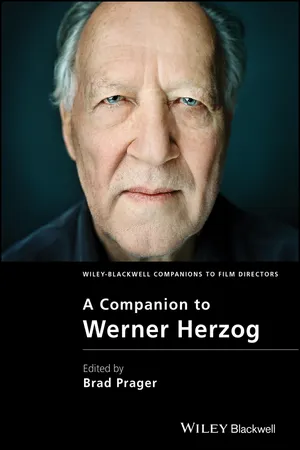
A Companion to Werner Herzog
About this book
A Companion to Werner Herzog showcases over two dozen original scholarly essays examining nearly five decades of filmmaking by one of the most acclaimed and innovative figures in world cinema.
Information
Part I
Critical Approaches and Contexts
1
Herzog and Auteurism
Performing Authenticity
Michel Ichat’s Victoire sur l’Annapurna (1953) is incomplete, André Bazin tells the reader of “Cinema and Exploration,” because an avalanche “snatched the camera out of the hands of [Maurice] Herzog” (1967: 162). Bazin’s description conjures up a film camera immersed in snow, its lens obscured. No act of photographic registration can take place here: there is no distance between the hapless camera and its object. Struggling to delineate cinematic realism, Bazin evokes a limit case in bringing the real into the film frame, one in which the camera seized by an avalanche figures the collapse of world with filmic apparatus. Its existential weight intensified by its unrepresentability, Maurice Herzog’s peak experience is sublime. It’s the explorer’s brush with death that evokes Bazin’s central metaphor for the indexical image: the Veil of Veronica “pressed to the face of human suffering” (1967: 163). I have long suspected that Bazin’s account is what inspired Werner Stipetić to change his name to Werner Herzog, perhaps also to assume his particular aesthetic stance, since Bazin’s story contains all the lineaments of the portrait Herzog draws of himself as auteur. It’s the portrait of someone for whom the conquering of a mountain is co-extensive with filming it, for whom filmmaking demands a physical investment, and landscapes produce essential images because death lurks in the natural world. Most centrally, it’s the portrait of a filmmaker for whom authenticity is at stake. But what is the nature of this “authenticity”? It doesn’t reside in Bazinian realism in a strict sense, although it’s connected to its more metaphorical, expanded expression. Herzog’s relation to reality is evident in his images: more than one of Herzog’s films document the water droplets that splash up onto the camera lens as it almost merges with the watery scene it seeks to capture. Such moments span the trajectory of Herzog’s filmmaking: we find them in films that stretch from Aguirre, the Wrath of God (1972) to Fitzcarraldo (1982), to his joint effort with Zak Penn, Incident at Loch Ness (2004), even to Rescue Dawn (2006). More is involved than simply the indexical relation that all film images bear to reality: moments such as these trump indexicality by figuratively eliminating the gap between sign and referent.
Authenticity: Ecstatic Truth and Physical Investment
What is meant by authenticity, then? Can it be conferred? How is it expressed? It is certainly not the “accountant’s truth,” a conventional realism that Herzog disparages in his Minnesota Declaration of 1999. The governing idea of Herzog’s manifesto—that “there is such a thing as a poetic, ecstatic truth”—has been so often cited by the director and his critics that it’s become a cliché (Cronin 2002: 301). Herzog asserts that there are “deeper strata of truth” in cinema, strata that can only be reached “through fabrication and imagination and stylization” (Cronin 2002: 301). And while the Minnesota Declaration may very well have originated in the uproar at the Berlin Film Festival surrounding the screening of Lessons in Darkness (1992)—an aestheticizing film essay about Kuwait after the Iraqi invasion—Herzog claims that his manifesto was the product of a sleepless night spent watching TV. Everything he watched, he tells Paul Cronin, was banal and inauthentic until, at 4 a.m., hardcore porn was on the screen. Its images suddenly conveyed “something real,” a “real naked truth” (2002: 239). Herzog’s investment in the “real naked truth” lies in its zero degree realism, grounded in the assumption that the sex act simply is what it is, the real. But in addition to the value placed on the real as beyond signification, the privileging of the pornographic image points to Herzog’s assertions concerning the physicality of filmmaking, as well as to a mystical belief that its corporeality will somehow be taken up into the image to reside there as “truth” or “authenticity.” The most notorious instance of this belief involves the full-size ship in Fitzcarraldo that—at Herzog’s insistence—was hauled over a mountain with pulleys and ropes: it is the extraordinary human effort required to perform this act, when registered by the camera, that renders the image authentic. It’s not the blood, sweat, and tears of the actors alone that is taken up into the images of a film, it is centrally the physical investment of the director, who treks through jungles, contracts fevers, and makes the difficult ascent himself. This is the point at which Herzog’s assertions betray their mystical dimension. For Herzog the physicality demanded by cinema involves a subjective effort not only to merge with the material world, but also to merge with the image itself.
How, then, is the privileging of physical investment, of the real, related to the Minnesota Declaration’s emphasis on the production of an “ecstatic truth?” This question calls to mind the troubled image of Herzog as a maker of so-called documentaries whose artifice is criticized for undermining the objectives of the genre. Somewhat idiosyncratically, Herzog makes no distinction between films with a documentary focus and fiction films; he asserts that documentaries are “just films” (Cronin 2002: 95 and 240). When it emerged that Herzog had invented the purported line from Pascal that is the epigraph of Lessons in Darkness, he justified his fabrication as a routine aspect of the fiction-making process. The ends justify the means: the fictional line ascribed to Pascal—“the collapse of the universe will occur like creation—in grandiose splendor”—invests the film’s images with apocalyptic, sublime import.1 For Herzog, this false citation is no different from the other devices that inflate the film’s meaning. As in Fata Morgana (1969) and The Great Ecstasy of Woodcarver Steiner (1973), Lessons in Darkness features frontal shots of war victims delivering scripted poetic monologues, one of which voices the recurrent Herzog theme of the insufficiency of language. Is it a paradox, then, that like so many of Herzog’s films, documentary or otherwise, Lessons in Darkness has recourse to voice-over narration. Here, too, it is Herzog’s own voice, awe-filled and somber, that sets the tone. “I am a storyteller,” says Herzog, “and I used the voice-over to place the film—and the audience—in a darkened planet somewhere in our solar system” (Cronin 2002: 249). It’s not the referential dimension of language that’s at stake, but rather its affective, lyrical function. Herzog is present in this text as a voice that haunts it, that produces affect. Herein language and voice are aided by music: as in earlier films such as La Soufrière (1977) and Nosferatu—The Vampyre (1979), Lessons of Darkness draws on musical passages from Wagner operas (specifically Das Rheingold, Parsifal, and Götterdämmerung) to evoke an atmosphere of foreboding and death.
Not surprisingly, Lessons also exhibits its constructedness by citing other films in the Herzog canon: self-citation serves as a means of constructing both self and text, further blurring the difference between the two. The footage of abandoned vehicles rusting in the sand is lifted from Fata Morgana, for example, a film with which it has a great deal in common. As in Fata Morgana, images in Lessons have the look of a mirage: the real landscape becomes surreal as the color, composition, rhythm, and sound of the film are synchronized with fine arts precedents in mind—evocative of Christo and Jeanne-Claude, for instance, or of the earth sculptor Michael Heizer. For the sake of effects such as these the film’s images are sometimes deliberately duplicitous, as when—Herzog admits in an interview—“little heaps of dust and oil” (Cronin 2002: 243) stand in for desert dunes. In seeming contradistinction to his insistence on physical investment and photographic registration, then, Herzog’s film practice welcomes all manner of artifice, provided that it promotes an “ecstatic inner truth,” that it lends the film image the poetic qualities he admires. No matter—it would seem—that the filmic means that confer this “ecstatic truth” upon the image produce another type of authenticity, different in kind from the authenticity conferred by physical investment. Both ideas of authenticity have their origins in a subject who affirms its mystical apprehension of the world.
Brad Prager has pointed to the relevance of Adorno’s The Jargon of Authenticity to Herzog’s filmmaking (2007: 3–5), but it may be profitable to elaborate on the points of connection between German existentialist discourse of the early twentieth century and the underlying concerns of most Herzog films. When, for example, Adorno accuses “the authentic ones” (1973: 27)—naturally Heidegger is pre-eminent among them—of “existential adventurism” (1973: 32), this is a term easily applied to Herzog. Pertinent, too, is what Adorno calls a “pose of existential seriousness” (1973: 34), perhaps most easily located in the earnest, hushed voice-overs of so many Herzog films. It goes without saying that a “pathos of uniqueness” (1973: 35) attaches to his work as well: witness the documentary La Soufrière, a film shot on the evacuated island of Guadeloupe while the volcano of that name was threatening to erupt, or Heart of Glass (1976), the fiction film in which Herzog hypnotized his actors to enable them to speak more poetically. In fact, there is even a certain overlap between “the authentic ones” and Herzog in the matter of language since, for Adorno, existential “babble” actually reaches for something behind language, something that evades its grasp (1973: 48). And insofar as existentialism does privilege language, qua Adorno, behind this privileging there lurks the premise that it’s “the whole man” who speaks (1973: 14), not simply the intellect. As Adorno is at pains to point out, many of the ideas espoused by “the authentic ones” were adopted by the National Socialists: among these are the “gesture of rooted genuineness,” and a “penchant for primitivism that privileges the indigenous and the mute,” which Adorno exposes as “belonging to the historical conquerors” (1973: 48). The rhetoric of the genuine and the privileging of muteness are at home in Herzog’s films—the latter literally, in Land of Silence and Darkness (1971). Like Adorno’s “authentic ones,” Herzog values inwardness. But, more importantly, Herzog seems to share their belief that death is the sublime counterpart of life, that it is the guarantor of authenticity, perhaps even the authentic itself. An existential belief in authenticity, writes Adorno, is located in the cast of mind for which death is the substratum of the self.
In its investment in authenticity, The Enigma of Kaspar Hauser (1974) is the fiction film that has pride of place in the Herzog canon. Kaspar is a character who—like “the authentic ones”—is identical with himself, at one with the world until the fall into language introduces the difference that culminates in his death. In one episode after another, Herzog’s film emphasizes Kaspar’s uniqueness, illustrating this quality by way of visions of landscapes. The aura of the genuine—enhanced by music—carries over into other images of the film, many of them set pieces from Romantic lyric. As for the relation of authenticity to the physical engagement of the auteur, it’s telling that Herzog claims to have planted the beans and flowers in Daumer’s garden himself (Cronin 2002: 103). Kaspar Hauser’s stunningly beautiful images—Kaspar’s name spelled out in watercress and the flickering dream of the Caucasus—seemed at the time of the film’s release in the United States to be wholly new images, although even then Herzog’s posture of creating ex nihilo, was discernible as a pose.2 Is the film “genuinely unique”—or does its investment in uniqueness serve an end? In The Jargon of Authenticity, Adorno reads the rhetoric of uniqueness as a feature of the marketplace; while such rhetoric may appear to attack modernity, in actuality, Adorno asserts, it is modernity’s waste product (1973: 45).
The discourse of authenticity surrounding Herzog’s films was read as a marketing strategy by Jan-Christopher Horak as early as the mid-1980s. Premised on the notion that Herzog creates a public persona that resonates with that of the visionary characters in his films, Horak’s indictment of Herzog is in many ways convincing. As Horak argues, a consistent authorial persona emerges from Herzog’s films, books, scripts, interviews, and from the films about him. At issue specifically is a Herzog text called Of Walking in Ice (1980), purportedly a journal of a walking trip from Bavaria to Paris. This written text shares with Herzog’s films a concern with the insufficiency of language, suggesting that even poetic language can merely gesture in the right direction. The text promotes Herzog’s walking tour as a sort of pilgrimage undertaken to “prevent” the death of Lotte Eisner, doyenne of the New German Cinema. Emphasizing Herzog’s physical investment in the pilgrimage—he purportedly carried a reel of his film Kaspar Hauser, dedicated to Eisner, all the while—walking itself functions as a guarantor of the genuine and authentic. In this instance it was Herzog’s belief that the effort expended by the pilgrim would buy off the Fates and keep the ailing Eisner alive. (She did, in fact, survive.) But, like Herzog’s documentaries, Of Walking in Ice is fictionalized in a number of ways: Herzog presents himself as passing through forbidding landscapes in which he encounters few people, although—as Horak points out—the regions he describes are among the most thickly settled areas of western Europe (1986: 32). Further, in this text Herzog as self-proclaimed vagabond claims to have resorted to thievery in order to survive—another way of living on the edge. This rhetoric recalls Herzog’s claim to have stolen his first 35 mm camera, and it gives one pause—even if pointing out the artifice in Herzog’s self-stylizations is tantamount to subscribing to an “accountant’s truth.”
Today, of course, we can include Herzog’s DVD commentaries on his own films among the proliferation of texts in which Herzog’s authorial persona also resides. (There is also his Web site, www.wernerherzog.com.) Especially enlightening is Herzog’s commentary on the DVD of Les Blank’s Burden of Dreams (1982), the film made about the filming of Fitzcarraldo. This commentary enables Herzog to amplify and correct Blank’s view of Herzog’s shoot. (Not that one can really blame Herzog for doing so, since the press raged about human rights violations of which Herzog was later exonerated by Amnesty International.) And then there is the recently translated Conquest of the Useless (2009), a transcription, as Herzog would have it, of the diaries he kept while shooting that same film, diaries which he wrote in a miniaturized script, presumably in order to conserve paper while in the jungle. Interestingly, what one notices when—in fairly quick succession—one reads Conquest of the Useless, watches Herzog’s My Best Fiend (1999), his film about Klaus Kinski with Herzog’s voice-over, and reads the interviews by Paul Cronin is that many formulations, even longish passages in all...
Table of contents
- Cover
- Series page
- Title page
- Copyright page
- Notes on Contributors
- Acknowledgments
- Werner Herzog’s Companions: The Consolation of Images
- Part I: Critical Approaches and Contexts
- Part II: Herzog and the Inter-arts
- Part III: Herzog’s German Encounters
- Part IV: Herzog’s Far-Flung Cinema Africa, Australia, the Americas, and Beyond
- Part V: Toward the Limits of Experience Philosophical Approaches
- Filmography
- Index
Trusted by 375,005 students
Access to over 1.5 million titles for a fair monthly price.
Study more efficiently using our study tools.
Frequently asked questions
Yes, you can cancel anytime from the Subscription tab in your account settings on the Perlego website. Your subscription will stay active until the end of your current billing period. Learn how to cancel your subscription
No, books cannot be downloaded as external files, such as PDFs, for use outside of Perlego. However, you can download books within the Perlego app for offline reading on mobile or tablet. Learn how to download books offline
Perlego offers two plans: Essential and Complete
- Essential is ideal for learners and professionals who enjoy exploring a wide range of subjects. Access the Essential Library with 800,000+ trusted titles and best-sellers across business, personal growth, and the humanities. Includes unlimited reading time and Standard Read Aloud voice.
- Complete: Perfect for advanced learners and researchers needing full, unrestricted access. Unlock 1.5M+ books across hundreds of subjects, including academic and specialized titles. The Complete Plan also includes advanced features like Premium Read Aloud and Research Assistant.
We are an online textbook subscription service, where you can get access to an entire online library for less than the price of a single book per month. With over 1.5 million books across 990+ topics, we’ve got you covered! Learn about our mission
Look out for the read-aloud symbol on your next book to see if you can listen to it. The read-aloud tool reads text aloud for you, highlighting the text as it is being read. You can pause it, speed it up and slow it down. Learn more about Read Aloud
Yes! You can use the Perlego app on both iOS and Android devices to read anytime, anywhere — even offline. Perfect for commutes or when you’re on the go.
Please note we cannot support devices running on iOS 13 and Android 7 or earlier. Learn more about using the app
Please note we cannot support devices running on iOS 13 and Android 7 or earlier. Learn more about using the app
Yes, you can access A Companion to Werner Herzog by Brad Prager in PDF and/or ePUB format, as well as other popular books in Media & Performing Arts & Film History & Criticism. We have over 1.5 million books available in our catalogue for you to explore.