Direct Eigen Control for Induction Machines and Synchronous Motors
eBook - ePub

Direct Eigen Control for Induction Machines and Synchronous Motors

  1. English
  2. ePUB (mobile friendly)
  3. Available on iOS & Android
eBook - ePub

Direct Eigen Control for Induction Machines and Synchronous Motors

About this book

Clear presentation of a new control process applied to induction machine (IM), surface mounted permanent magnet synchronous motor (SMPM-SM) and interior permanent magnet synchronous motor (IPM-SM)

Direct Eigen Control for Induction Machines and Synchronous Motors provides a clear and consise explanation of a new method in alternating current (AC) motor control. Unlike similar books on the market, it does not present various control algorithms for each type of AC motor but explains one method designed to control all AC motor types: Induction Machine (IM), Surface Mounted Permanent Magnet Synchronous Motor (SMPM-SM) (i.e. Brushless) and Interior Permanent Magnet Synchronous Motor (IPM-SM). This totally new control method can be used not only for AC motor control but also to control input filter current and voltage of an inverter feeding an AC motor.

  • Accessible and clear, describes a new fast type of motor control applied to induction machine (IM), surface mounted permanent magnet synchronous motor (SM-PMSM) and interior permanent magnet synchronous motor (I-PMSM) with various examples
  • Summarizes a method that supersedes the two known direct control solutions – Direct Self Control and Direct Torque Control – to be used for AC motor control and to control input filter current and voltage of an inverter feeding an AC motor
  • Presents comprehensive simulations that are easy for the reader to reproduce on a computer. A control program is hosted on a companion website

This book is straight-forward with clear mathematical description. It presents simulations in a way that is easy to understand and to reproduce on a computer, whilst omitting details of practical hardware implementation of control, in order for the main theory to take focus. The book remains concise by leaving out description of sensorless controls for all motor types. The sections on "Control Process", "Real Time Implementation" and "Kalman Filter Observer and Prediction" in the introductory chapters explain how to practically implement, in real time, the discretized control with all three types of AC motors. In order, this book describes induction machine, SMPM-SM, IPM-SM, and, application to LC filter limitations. The appendixes present: PWM vector calculations; transfer matrix calculation; transfer matrix inversion; Eigen state space vector calculation; and, transition and command matrix calculation.

Essential reading for Researchers in the field of drive control; graduate and post-graduate students studying electric machines; electric engineers in the field of railways, electric cars, plane surface control, military applications. The approach is also valuable for Engineers in the field of machine tools, robots and rolling mills.

Frequently asked questions

Yes, you can cancel anytime from the Subscription tab in your account settings on the Perlego website. Your subscription will stay active until the end of your current billing period. Learn how to cancel your subscription.
At the moment all of our mobile-responsive ePub books are available to download via the app. Most of our PDFs are also available to download and we're working on making the final remaining ones downloadable now. Learn more here.
Perlego offers two plans: Essential and Complete
  • Essential is ideal for learners and professionals who enjoy exploring a wide range of subjects. Access the Essential Library with 800,000+ trusted titles and best-sellers across business, personal growth, and the humanities. Includes unlimited reading time and Standard Read Aloud voice.
  • Complete: Perfect for advanced learners and researchers needing full, unrestricted access. Unlock 1.4M+ books across hundreds of subjects, including academic and specialized titles. The Complete Plan also includes advanced features like Premium Read Aloud and Research Assistant.
Both plans are available with monthly, semester, or annual billing cycles.
We are an online textbook subscription service, where you can get access to an entire online library for less than the price of a single book per month. With over 1 million books across 1000+ topics, we’ve got you covered! Learn more here.
Look out for the read-aloud symbol on your next book to see if you can listen to it. The read-aloud tool reads text aloud for you, highlighting the text as it is being read. You can pause it, speed it up and slow it down. Learn more here.
Yes! You can use the Perlego app on both iOS or Android devices to read anytime, anywhere — even offline. Perfect for commutes or when you’re on the go.
Please note we cannot support devices running on iOS 13 and Android 7 or earlier. Learn more about using the app.
Yes, you can access Direct Eigen Control for Induction Machines and Synchronous Motors by Jean Claude Alacoque in PDF and/or ePUB format, as well as other popular books in Technology & Engineering & Power Resources. We have over one million books available in our catalogue for you to explore.

1

Induction Machine

The three-phase induction machine with non-salient poles is the most widespread electric motor because of its simple and robust construction; it is perhaps the electrical machine that has the least intuitive operation (Caron and Hautier, 1995). It has been the subject of very many technical publications.

1.1 Electrical Equations and Equivalent Circuits

Starting from the equivalent three-phase electrical circuit of the induction machine without neutral current, let us establish initially the relations between the various electrical variables.

1.1.1 Definitions and Notation

Definitions and notation of motor parameters:
  • stator resistance
Rs
  • rotor resistance
Rr
  • stator leakage inductance
ls
  • rotor leakage inductance
lr
  • mutual inductance
Lm
  • stator inductance
Ls = Lm + ls
  • rotor inductance
Lr = Lm + lr
  • stator time constant
image
  • rotor time constant
image
  • pole pair number
Np
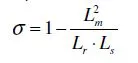
  • dispersion coefficient
image
Definitions and notations of mechanical and electrical angular frequencies:
  • mechanical angular frequency of the rotor Ω
  • polar mechanical angular frequency1 ω = Np ⋅ Ω
  • stator electrical angular frequency ωs
  • rotor electrical angular frequency ωr
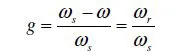
  • relative slip
    image

1.1.2 Equivalent Electrical Circuits

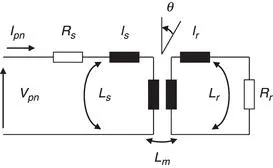
The reduced equivalent electrical circuit for each phase of the balanced three-phase induction machine is that of Figure 1.1.
The directed angular symbol of Figure 1.1 recalls that the coupling between stator and rotor windings is modified with the rotation of the rotor.
This circuit does not show the equivalent resistance of iron losses, in parallel with the mutual inductance; it would represent ohmic losses due to the hysteresis of the magnetic material and to eddy currents in magnetic steel sheets. These losses are in general minimized when designing an electric motor. Resistance values do not take into account the skin effect due to high frequency harmonic currents. Inductances are considered here to be unsaturated. It is nevertheless possible to modify the values of these elements according to the mode of motor feeding, the operation mode and the harmonic content of the voltage inverter output.
The electrical variables defined for this equivalent circuit are variables directly accessible by electrical measurement:
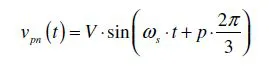
  • the phase–neutral instantaneous voltage, per phase:
(1.1)
image
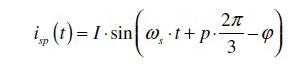
  • the instantaneous current in each phase:
(1.2)
image
with three phases p ∈ {0 ; 1 ; 2}, and
image
is the phase lagging of the current compared to the phase voltage, under traction operation.
Figure 1.1 Equivalent circuit of one phase of the three-phase induction machine
image
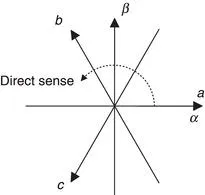
Figure 1.2 Three-phase (a, b, c) and two-phase (α, β) fixed frames
image
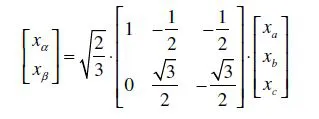
The Concordia transformation (Owen, 1999) makes it possible to reduce the three-phase scalar representation in the phase plane, by introducing a vector representation into the ­orthonormal frame plane of Figure 1.2. The transfer matrix, from the balanced three-phase ­representation to the two-phase one, which preserves the instantaneous power, is the 2 × 3 matrix of the Concordia transformation (1.3).
(1.3)
image
The chosen positive sense for measuring angles, as well as for rotation sense and angular velocity, will be always counterclockwise.
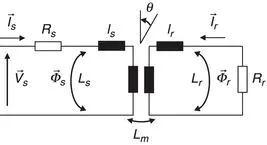
After this transformation, the equivalent circuit of the induction machine takes the reduced vector form of Figure 1.3.
The circuits of Figures 1.1 and 1.3 seem identical, but they represent, respectively, just one phase in a three-phase fixed frame, and three phases in a two-phase fixed frame. Represented electrical variables are different and are linked by the Concordia transformation.
Figure 1.3 Two-phase equivalent circuit of the induction machine
image
Equations of the system (1.4), are relations between the magnitudes of vectorial variables and maximum values of electrical phase variables, in this transformation.
(1.4)
image
Phase parameter values of the motor remain unchanged.

1.1.3 Differential Equation System

The two meshes of the equi...

Table of contents

  1. Cover
  2. Title page
  3. Copyright page
  4. Dedication
  5. Foreword by Prof. Dr Ing. Jean-Luc Thomas
  6. Foreword by Dr Abdelkrim Benchaïb
  7. Acknowledgements
  8. Introduction
  9. 1 Induction Machine
  10. 2 Surface-Mounted Permanent-Magnet Synchronous Motor
  11. 3 Interior Permanent Magnet Synchronous Motor
  12. 4 Inverter Supply – LC Filter
  13. 5 Conclusion
  14. Appendix A: Calculation of Vector PWM
  15. Appendix B: Transfer Matrix Calculation
  16. Appendix C: Transfer Matrix Inversion
  17. Appendix D: State-Space Eigenvector Calculation
  18. Appendix E: F and G Matrix Calculations
  19. References
  20. Index