Presenting Data: How to Communicate Your Message Effectively
eBook - ePub

Presenting Data: How to Communicate Your Message Effectively

  1. English
  2. ePUB (mobile friendly)
  3. Available on iOS & Android
eBook - ePub

Presenting Data: How to Communicate Your Message Effectively

About this book

A clear easy-to-read guide to presenting your message using statistical data

Poor presentation of data is everywhere; basic principles are forgotten or ignored. As a result, audiences are presented with confusing tables and charts that do not make immediate sense. This book is intended to be read by all who present data in any form.

The author, a chartered statistician who has run many courses on the subject of data presentation, presents numerous examples alongside an explanation of how improvements can be made and basic principles to adopt. He advocates following four key 'C' words in all messages: Clear, Concise, Correct and Consistent. Following the principles in the book will lead to clearer, simpler and easier to understand messages which can then be assimilated faster. Anyone from student to researcher, journalist to policy adviser, charity worker to government statistician, will benefit from reading this book. More importantly, it will also benefit the recipients of the presented data.

'Ed Swires-Hennessy, a recognised expert in the presentation of statistics, explains and clearly describes a set of "principles" of clear and objective statistical communication. This book should be required reading for all those who present statistics.'
Richard Laux, UK Statistics Authority

'I think this is a fantastic book and hope everyone who presents data or statistics makes time to read it first.'
David Marder, Chief Media Adviser, Office for National Statistics, UK

'Ed's book makes his tried-and-tested material widely available to anyone concerned with understanding and presenting data. It is full of interesting insights, is highly practical and packed with sensible suggestions and nice ideas that you immediately want to try out.'
Dr Shirley Coleman, Principal Statistician, Industrial Statistics Research Unit, School of Mathematics and Statistics, Newcastle University, UK
Frequently asked questions

Yes, you can cancel anytime from the Subscription tab in your account settings on the Perlego website. Your subscription will stay active until the end of your current billing period. Learn how to cancel your subscription.
No, books cannot be downloaded as external files, such as PDFs, for use outside of Perlego. However, you can download books within the Perlego app for offline reading on mobile or tablet. Learn more here.
Perlego offers two plans: Essential and Complete
  • Essential is ideal for learners and professionals who enjoy exploring a wide range of subjects. Access the Essential Library with 800,000+ trusted titles and best-sellers across business, personal growth, and the humanities. Includes unlimited reading time and Standard Read Aloud voice.
  • Complete: Perfect for advanced learners and researchers needing full, unrestricted access. Unlock 1.4M+ books across hundreds of subjects, including academic and specialized titles. The Complete Plan also includes advanced features like Premium Read Aloud and Research Assistant.
Both plans are available with monthly, semester, or annual billing cycles.
We are an online textbook subscription service, where you can get access to an entire online library for less than the price of a single book per month. With over 1 million books across 1000+ topics, we’ve got you covered! Learn more here.
Look out for the read-aloud symbol on your next book to see if you can listen to it. The read-aloud tool reads text aloud for you, highlighting the text as it is being read. You can pause it, speed it up and slow it down. Learn more here.
Yes! You can use the Perlego app on both iOS or Android devices to read anytime, anywhere — even offline. Perfect for commutes or when you’re on the go.
Please note we cannot support devices running on iOS 13 and Android 7 or earlier. Learn more about using the app.
Yes, you can access Presenting Data: How to Communicate Your Message Effectively by Ed Swires-Hennessy in PDF and/or ePUB format, as well as other popular books in Matematica & Probabilità e statistica. We have over one million books available in our catalogue for you to explore.

Information

Publisher
Wiley
Year
2014
Print ISBN
9781118489598
eBook ISBN
9781118901847

Chapter 1
Understanding number

This chapter deals with the basics of how users perceive numbers and how they should be presented to allow maximum uptake of the meaning of the data.
A false assumption of many who seek to communicate numerical information is that their audience is as able to handle the information as they are. The available data in for the majority of OECD countries is that numeracy skills are significantly below those for literacy.
Numeracy skills in the general population in England are poor – and are not improving. Information from a skills survey in England in 20111 noted that Numeracy skills had declined slightly since the last survey in 2003. Seventeen million adults in England in 2011 (just under half the working-age population) were at ‘Entry Levels’ in numeracy – roughly equivalent to the standards expected in primary school. Further, the survey showed that 78% of the working-age population were at or below level 2 numeracy. These people may not be able to compare products and services for the best buy, or work out a household budget; essentially they would not achieve a good mark in a mathematics examination at age 16.
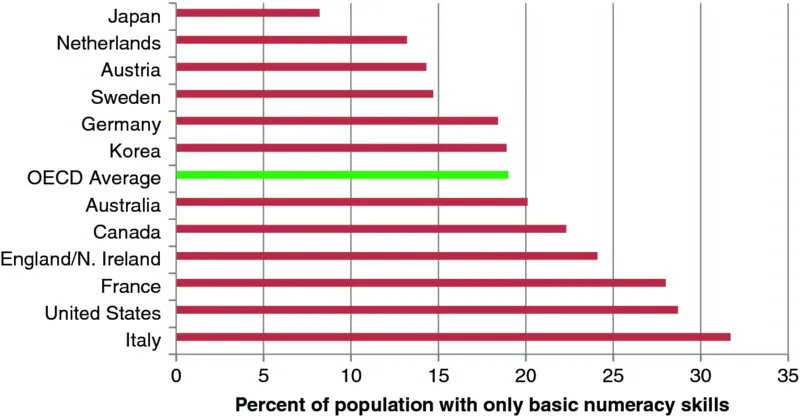
More generally, the OECD published the results of a survey in October 20132 showing that 19% of adults in 21 countries had mathematics skills at the level of a 10-year-old. These adults could only manage one-step tasks with sums, sorting numbers or reading graphs: many could only perform sums with money or whole numbers. For individual countries, the percentage at this level of numeracy ranged from 8% in Japan to 32% in Italy. A selection of the results is shown in Figure 1.1. For England and Northern Ireland, the estimate is that around 8.5 million adults are at this level.
images
Figure 1.1 Adult population with only basic numeracy skills.

1.1 Thousands separator

When considering a number with more than three digits, most of us will not take in the whole number but will try to understand it. If the number is just a set of digits together without any separators, most will try to find the place for thousands separators to form the basis of understanding the number. Then, depending on the size of the number, will try to do some rounding to understand the number and put it into our mental understanding range.
Example 1.1 ............
Let us consider a number which represents the population of a country.
numbered Display Equation
How do we try to understand the number? None could honestly say they could read the digits as given and fully understand it without any other process going on in our brains.
So what do we do?
First our brains need a little help. We can introduce separator characters to split the digits into groups of three, starting from the right-hand side. These separators are known as ‘thousands separators’. In some countries (United States and United Kingdom), the separator is a comma; for much of Europe, the separator is a space but in some European countries a full stop is used. I visited one country's statistical office website and found three different practices: comma, space and nothing used for the separator! Whichever is chosen, it must be consistently used throughout an organisation's output.
The number, with these separators would then appear as either
numbered Display Equation
This process here helps us to identify that we have 12 million, 573 thousands and 981 units.
But how does our brain handle all this information? It doesn't. The brain will not retain all of the information but introduce some abbreviation of the data. This could either be by truncating the number (i.e. throwing some digits away): for example, after the millions – giving 12 million. Many will argue that a lot of information has been thrown away: but, does it matter? Only, one could argue, if it affects the understanding....

Table of contents

  1. Cover
  2. Title Page
  3. Copyright
  4. Introduction
  5. Preface
  6. Acknowledgements
  7. Chapter 1: Understanding number
  8. Chapter 2: Tables
  9. Chapter 3: Charts (bar charts, histograms, pie charts, graphs)
  10. Chapter 4: Numbers in text
  11. Chapter 5: Data presentation on the Internet
  12. End User License Agreement
