Part I
Understanding Verbs and Sentences
Glenn Lumsden
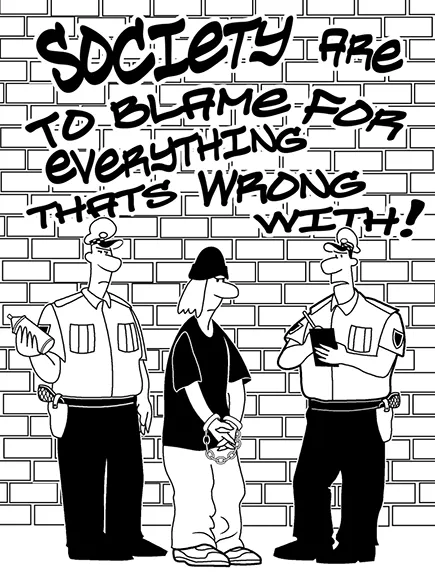
‘You’re charged with illegal use of a verb, omission of an apostrophe and — something the magistrate is unlikely to hand down — an incomplete sentence.’
In this part . . .
So it’s, like, communication, y’know?
Can you make a statement like that without risking arrest by the grammar police? Maybe. Read Chapter 1 for a discussion of the levels of English and a guide to when each is appropriate. The rest of this part of the book explains the building blocks of the sentence and why verbs are so important to sentences. Chapter 2 shows you how to find the verb, and Chapter 3 tells you what to do with it once you’ve found it. Chapter 4 provides a road map to the subject of the sentence and explains the basics of matching subjects and verbs properly. Chapter 5 is all about completeness — why a grammatically sound sentence needs it and how to make sure that each sentence has it. In Chapter 6, we explore the last building block of a sentence — the object or complement.
Chapter 1
Who Cares about Grammar?
In This Chapter
Understanding when following the rules is necessary
Identifying accepted patterns of speech and writing in Australia
Recognising friendly, conversational and formal English
Knowing when to use the various levels of English
You may be reading this book for a number of reasons. Perhaps you’re hoping to impress your English teacher or tertiary tutor (if so, it’s a good idea to be caught casually reading it). Or maybe you’re one of the many people who didn’t learn much English grammar at school and felt you didn’t really understand what you did learn. If English was your first language, you probably learnt English grammar by osmosis, by hearing what others say, which, all too often, means absorbing a fair chunk of incorrect grammar along with the correct bits. Or perhaps you want to improve your writing at work so your boss will give you a promotion.
Whatever your ultimate goal is, you seem to have decided that learning better grammar is a valuable strategy. Good for you! In this chapter, we look a little more closely at why good grammar is so important. We also look at how the definition of better grammar changes according to your situation, purpose and audience.
Functioning with Good Grammar
Back when you were stuck in English class, you probably thought that grammar was invented just to give teachers something to test. But grammar — or, to be more precise, formal grammar teaching — exists to help you express yourself clearly. Good communication and good grammar go hand in hand. Without a thorough knowledge of grammar, you can get by just fine chatting with your friends and family. But you may find yourself at a disadvantage when you’re interviewed for a job or a place at university, or when you’re trying to convince someone to publish your novel. And heaven help you if your boss turns out to be a stickler — one of those people who knows every grammar rule that was ever invented (and thinks you should know them too) and insists that the English language must never be allowed to change.
Rightly or wrongly, your audience or readers judge you by the words you use and the way you string them together. Ten minutes at the movies will show you the truth of this statement. Listen to the speech of the people on the screen. An uneducated character sounds different from someone with five diplomas on the wall. The dialogue reflects reality: educated people follow certain rules when they speak and write. If you want to present yourself as an educated person, you have to follow those rules too.
Following grammar rules is just a matter of deciding which type of grammar to use. We can hear the groan already. Which grammar? You mean there’s more than one? Yes, several different types of grammar do exist, including historical (how language has changed through the centuries) and comparative (comparing languages). Don’t despair. In this book, we deal with only two — the two you have to know in order to improve your speech and writing: descriptive grammar and functional grammar.
Descriptive grammar gives names to things — the parts of speech and parts of a sentence. When you learn descriptive grammar, you understand what every word is (its part of speech) and what every word does (its function in the sentence). Learning some grammar terms has a couple of important advantages — to understand why a particular word or phrase is correct or incorrect (and sometimes to be able to explain to someone else why it’s wrong), and to understand the explanations and advice given when you check something in a dictionary or style guide.
Functional grammar makes up the bulk of English Grammar For Dummies. Functi...