![]()
1
Animal Manure – From Waste to Raw Materials and Goods
Sven G. Sommer
Institute of Chemical Engineering, Biotechnology and Environmental Technology, University of Southern Denmark, Denmark
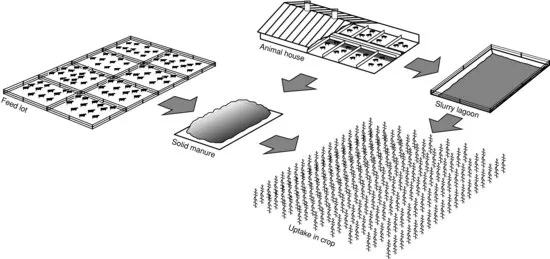
Societies will inevitably have to recognise that animal excreta are not just a waste material requiring disposal, but a crucial raw material needed to boost plant production to feed a growing world population. If used appropriately, animal excreta can replace significant amounts of mineral fertilisers in areas with livestock production. Manure comprises animal excreta dissolved in water or mixed with straw, a substance made up of organic matter and used as an organic fertiliser in agriculture, where it contributes to the fertility of the soil by adding plant nutrients and organic matter (Figure 1.1). In the management chain before it is applied to soil, manure can also be used for energy production.
The increasing focus on developing and using new technologies and management methods for manure handling is the consequence of both a huge increase in livestock production worldwide and specialisation in agriculture. Thus, in new production systems, traditional farms with a mixture of livestock and crop production are often replaced with landless livestock production units. These new livestock production systems may not have the capacity to recycle manure on-farm, which was a feature of many farming system in the past.
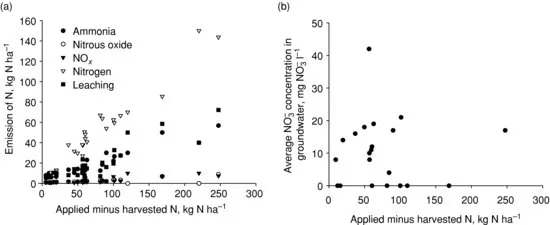
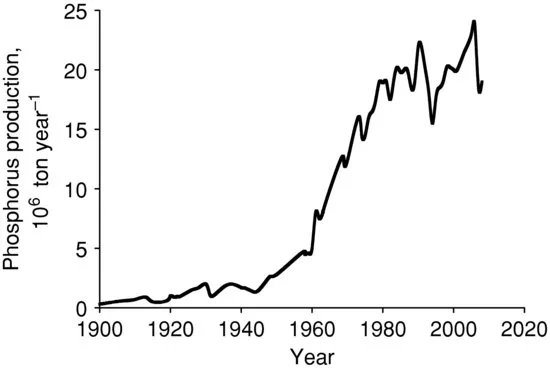
The plant nutrients in manure can, if used appropriately, replace significant amounts of mineral fertilisers, and the organic matter can boost soil fertility (Text Box – Basic 1.1) and can be used for energy production. On the other hand, improper management and utilisation of manure results in loss of plant nutrients (Bouwman et al., 2012)(Figure 1.2), which are a limited resource, and this can be a risk to the global feed and food supply. For example, phosphorus (P) is a limited resource, with the mineable phosphate-rich rocks used for P fertiliser production projected to become exhausted within the next 60–130 years (Figure 1.3). In a 14-month period during 2007–2008, the global food crisis led to phosphate rock and fertiliser demand exceeding supply and prices increased by 700% (Cordell et al., 2009). This increase in cost may be mitigated by reducing P losses. It is estimated that close to 25% of the 1 billion tonnes of P mined since 1950 has ended up in water bodies or is buried in landfill (Rosmarin, 2004).
Text Box – Basic 1.1 Soil and environmental terminologies
Soil fertility: The ability of soil to provide plants with sufficient, balanced and non-toxic amounts of nutrients and water, and to act as a suitable medium for root development, in order to assure proper plant growth and maturity. Soil fertility is basically controlled by the inherent mineralogy and soil texture as determined by location and geology, and by the dynamic parameters of soil organic matter content, acidity, nutrient concentration, porosity and water availability, all of which can be influenced by human activity and management.
Soil organic matter (SOM): The total organic matter in soil, except for materials identifiable as undecomposed or partially decomposed biomass, is called humus and is the solid, dark-coloured component of soil. It plays a significant role in soil fertility and is formed by microbial decay of added organic matter (e.g. plant residues and manur) and polymerisation of the cycled organic compounds. Carbon content in soil organic matter ranges from 48% to 57%.
Eutrophication: An increase in the concentration of chemical nutrients in terrestrial and aquatic ecosystems to the extent that it increases the primary productivity of the ecosystem. Subsequent negative environmental effects in watercourses, such as anoxia and severe reductions in water quality, fish stocks and other animal populations, may occur. On land, the negative effect is seen as a change in the existing plant community composition, which becomes dominated by species that prefer a high plant nutrient level. As a consequence, the enrichment in plant nutrient content is associated with a decline in biodiversity.
In the development of new technologies and management practices for improving the quality of the livestock product and for reducing production costs, the management of externalities, which in this case is manure, is often unchanged. This tendency is because the producers and experts who develop the new livestock production system often overlook the fact that the existing management of manure needs to be adapted to new livestock production systems. In livestock production this is reflected in a surplus of plant nutrients in regions where livestock production has increased. Thus, plant nutrient surpluses have been documented in regions in America, Europe and Asia. In Asia, such surpluses are commonly centred around cities (Gerber et al., 2005), because of consumer demand for meat to be slaughtered immediately before sale, and in these countries living animals are not transported long distances. Increasing livestock densities (livestock units ha−1) will lead to surplus plant nutrients as documented for nitrogen (N) on livestock farms in Europe (Olesen et al., 2006) and these surpluses may end up polluting the environment (i.e. eutrophication of ecosystems) (Figure 1.2).
In livestock farming, manure management consists of a chain of management stages or technologies (Figure 1.1). The handling systems differ between farms, regions and countries. For example, in parts of Europe recycling on the farm effectively reduces the need for mineral fertilisers, whereas in other parts of the world, livestock farms handle the manure as a dilute slurry that is stored in lagoons and eventually sprayed on fields or discharged to rivers (i.e. with no recycling of nutrients in the waste). In all countries, recycling and pollution control inevitably represent a necessary investment for the farmer who wants to maintain a given production level under stricter environmental regulations or wants to expand production without aggravating the environmental impact. This development is supported by lower costs for establishing and maintaining environmental technologies associated with intensification and industrialisation of livestock production.
Through optimising new environmentally friendly technologies in a “chain approach” (Figure 1.1), livestock waste management can become economically sustainable by taking advantage of the valuable resources in manure. To achieve this outcome, the individual technologies have to be optimised by assessment of their efficiency when introduced into the chain of technologies (Petersen et al., 2007). This assessment must include the effect on the performance of the other technologies in the whole system. The tool for doing this is system analysis, which is much used in engineering, but not widely in agriculture.
This leads us back in time to the late nineteenth century, when researchers at experimental stations at Rothamsted in England and Askov in Denmark carried out field studies comparing manure and fertiliser efficiency to convince farmers that mineral fertiliser was useful and could increase plant production at a low cost. Today, mineral fertilisers are costly, because it takes much energy to produce them and because the sources are approaching exhaustion. As a consequence, there is a burgeoning need for technologies and management practices to use animal manure as a valuable nutrient source for the production of crops and food, as well as for energy production. Collaboration between different types of professionals (e.g. engineers, agronomists and natural scientists) on the development of manure management and utilisation technologies is therefore necessary and requires a mutual insight and understanding of processes, technologies and management. This book is written to facilitate such collaboration.
References
Bouwman, L., Goldewijk, K.K., Van Der Hoek, K.W., Beusen, A.H.W., Van Vuuren, D.P., Willems, J., Rufino, M.C. and Stehfest, E. (2012) Exploring global changes in nitrogen and phosphorus cycles in agriculture induced by livestock production over the 1900–2050 period. Proc. Natl. Acad. Sci. USA, Early Edition, doi: 10.1073/pnas.1012878108.
Cordell, D., Drangert, J.-O. and White, S. (2009) The story of phosphorus: global food security and food for thought. Global Environ. Change, 19, 292–305.
Gerber, P., Chilonda, P., Franceschini, G. and Menzi, H. (2005) Geographical determinants and environmental implications of livestock production intensification in Asia. Bioresour. Technol., 96, 263–276.
Olesen, J.E., Schelde, K., Weiske, A., Weisbjerg, M.R., Asman, W.A.H. and Djurhuus, J. (2006) Modelling greenhouse gas emissions from European conventional and organic dairy farms. Agric. Ecosyst. Environ., 112, 207–220.
Oenema, O., Oudendag, D. and Velthof, G.L. (2007) Nutrient losses from manure management in the European Union. Livest. Sci., 112, 261–272.
Petersen, S.O., Sommer, S.G., Béline, F., Burton, C., Dach, J., Dourmad, J.Y., Leip, A., Misselbrook, T., Nicholson, F., Poulsen, H.D., Provolo, G., Sørensen, P., Vinnerås, B., Weiske, A., Bernal, M.-P., Böhm, R., Juhász, C. and Mihelic, R. (2007) Recycling of livestock manure in a whole-farm perspective – preface. Livest. Sci., 112, 180–191.
Rosmarin, A. (2004) The precarious geopolitics of phosphorous. Down to Earth, 2004, 27–31; http://www.downtoearth.org.in/node/11390.
![]()
2
Animal Production and Animal Manure Management
Sven G. Sommer1 and Morten L. Christensen2
1Institute of Chemical Engineering, Biotechnology and Environmental Technology, University of Southern Denmark, Denmark
2Department of Biotechnology, Chemistry and Environmental Engineering, Aalborg University, Denmark
2.1 Introduction
Globally, livestock production varies from systems where the animals move freely to find their feed to systems where the animals ar...