Aerospace Propulsion
  1. English
  2. ePUB (mobile friendly)
  3. Available on iOS & Android
eBook - ePub

About this book

Aerospace propulsion devices embody some of the most advanced technologies, ranging from materials, fluid control, and heat transfer and combustion. In order to maximize the performance, sophisticated testing and computer simulation tools are developed and used.

Aerospace Propulsion comprehensively covers the mechanics and thermal-fluid aspects of aerospace propulsion, starting from the fundamental principles, and covering applications to gas-turbine and space propulsion (rocket) systems. It presents modern analytical methods using MATLAB and other advanced software and includes essential elements of both gas-turbine and rocket propulsion systems. Gas turbine coverage includes thermodynamic analysis, turbine components, diffusers, compressors, turbines, nozzles, compressor-turbine matching, combustors and afterburners. Rocket coverage includes chemical rockets, electrical rockets, nuclear and solar sail.

Key features:

  • Both gas-turbine and rocket propulsion covered in a single volume
  • Presents modern analytical methods and examples
  • Combines fundamentals and applications, including space applications
  • Accompanied by a website containing MATLAB examples, problem sets and solutions

Aerospace Propulsion is a comprehensive textbook for senior undergraduate graduate and aerospace propulsion courses, and is also an excellent reference for researchers and practicing engineers working in this area.
Frequently asked questions

Yes, you can cancel anytime from the Subscription tab in your account settings on the Perlego website. Your subscription will stay active until the end of your current billing period. Learn how to cancel your subscription.
At the moment all of our mobile-responsive ePub books are available to download via the app. Most of our PDFs are also available to download and we're working on making the final remaining ones downloadable now. Learn more here.
Perlego offers two plans: Essential and Complete
  • Essential is ideal for learners and professionals who enjoy exploring a wide range of subjects. Access the Essential Library with 800,000+ trusted titles and best-sellers across business, personal growth, and the humanities. Includes unlimited reading time and Standard Read Aloud voice.
  • Complete: Perfect for advanced learners and researchers needing full, unrestricted access. Unlock 1.4M+ books across hundreds of subjects, including academic and specialized titles. The Complete Plan also includes advanced features like Premium Read Aloud and Research Assistant.
Both plans are available with monthly, semester, or annual billing cycles.
We are an online textbook subscription service, where you can get access to an entire online library for less than the price of a single book per month. With over 1 million books across 1000+ topics, we’ve got you covered! Learn more here.
Look out for the read-aloud symbol on your next book to see if you can listen to it. The read-aloud tool reads text aloud for you, highlighting the text as it is being read. You can pause it, speed it up and slow it down. Learn more here.
Yes! You can use the Perlego app on both iOS or Android devices to read anytime, anywhere — even offline. Perfect for commutes or when you’re on the go.
Please note we cannot support devices running on iOS 13 and Android 7 or earlier. Learn more about using the app.
Yes, you can access Aerospace Propulsion by T. W. Lee, Peter Belobaba, Jonathan Cooper, Allan Seabridge, Peter Belobaba,Jonathan Cooper,Allan Seabridge in PDF and/or ePUB format, as well as other popular books in Technology & Engineering & Aeronautic & Astronautic Engineering. We have over one million books available in our catalogue for you to explore.
1
Introduction to Propulsion Systems
Propulsion systems include some of the most advanced technologies. The high performance requirements, at low system weight, necessitate advanced thermal-fluid design, materials and system integration. The thrust, generated through a simple-looking principle of conservation of momentum (or Newton's second law), enables many human capabilities, such as high-speed civil transport (approximately 12 hours for trans-Pacific flights), affordable personal aircraft, advanced military aircrafts (e.g. F-22 Raptor, Sukhoi), Earth orbital operations (Space Shuttle) and numerous satellites, planetary probes and possible missions. The propulsion technology can also lead to potentially destructive uses, as in cruise missiles, intercontinental ballistic missiles and many other weapons propelled at high speeds.
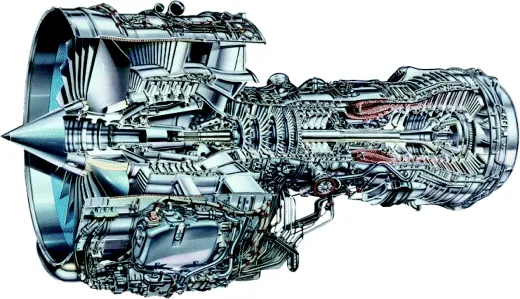
A typical gas-engine shown in Figure 1.1 achieves the high exit momentum through a sequence of devices that include compressor, combustor, turbine and nozzle. The ambient air is ingested in gas-turbine engines. The compressor consists of a series of rotating blades, which aerodynamically is a set of airfoils using rotary motion to generate a pressure differential as the air traverses the blade elements. The air pressure is increased in the compressor, and sent into the combustor where the fuel is injected, mixed with the air, and burned. The air energy (enthalpy) increase is now used in the turbines to convert some of the thermal energy (enthalpy) into shaft power. This shaft power is used to power the compressor, by simply having a common axis between the turbine and the compressor in turbojet engines. However, in turbofan engines, the turbine power is used to run both the compressor and the fan. The fan adds enthalpy to the air stream in the fan section. The energy available at the end of the turbine section is converted to air kinetic energy in the nozzle. The high kinetic energy of the exhaust stream also has high momentum, which is useful in generating thrust. Ramjets are a much simpler form of turbojet engines, where “ram compression” of incoming stream at supersonic speeds is sufficient to elevate the pressure of the air. Fuel then needs to be injected into this high-pressure air stream and the resulting flame stabilized in the ramjet combustor, for sustained thrust.
Figure 1.1 A typical gas-turbine engine. Copyright United Technologies Corporation.
img
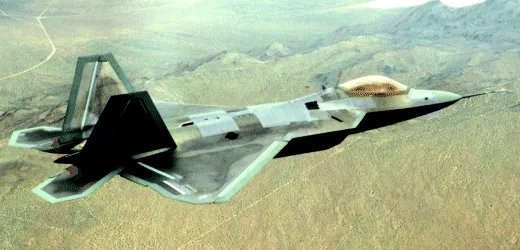
Advances in practically all aspect of engineering, including propulsion technology, can be found in the Lockheed Martin F-22 Raptor (Figure 1.2) that entered service in 2005. New materials such as advanced alloys and composite materials are used in the Raptor airframe, aerodynamic surfaces and engine components. The power plant in the F-22 consists of Pratt-Whitney afterburning turbofans (F119-PW-100) with a high efficiency, which provide supersonic cruise speeds with long range and unmatched agility with pitch-vectoring thrust nozzles. But these technological advances came with a high price tag. Many of the new technologies were researched and developed specifically as part of the F-22 project. If all the development costs are added in, the F-22 carries a price tag of over $300 million per aircraft. Table 1.1 shows some of the main specifications of the F-22, including some of the propulsion characteristics.
Figure 1.2 F-22 Raptor, with advanced embedded technologies, including the power plant (F119-PW-100). Courtesy of US Department of Defence.
img
Table 1.1 F-22 specifications.
...
Length 62.1 ft (18.9 m)
Wingspan 44.5 ft (13.56 m)
Height 16.8 ft (5.08 m)
Maximum take-off weight 80 000 lb (36 288 kg)
Power plant Two Pratt-Whitney F119-PW-100 pitch-vectoring turbofans with afterburners
Total thrust 70 000 lb
Maximum speed High altitude: Mach 2.42 or 1600 mph (2570 km/h)
Low altitude: Mach 1.72 or 1140 mph (1826 km/h)

Table of contents

  1. Cover
  2. Series Page
  3. Title Page
  4. Copyright
  5. Series Preface
  6. Preface
  7. Chapter 1: Introduction to Propulsion Systems
  8. Chapter 2: Principle of Thrust
  9. Chapter 3: Basic Analyses of Gas-Turbine Engines
  10. Chapter 4: Gas-Turbine Components: Inlets and Nozzles
  11. Chapter 5: Compressors and Turbines
  12. Chapter 6: Combustors and Afterburners
  13. Chapter 7: Gas-Turbine Analysis with Efficiency Terms
  14. Chapter 8: Basics of Rocket Propulsion
  15. Chapter 9: Rocket Propulsion and Mission Analysis
  16. Chapter 10: Chemical Rockets
  17. Chapter 11: Non-Chemical Rockets
  18. Appendices
  19. Index