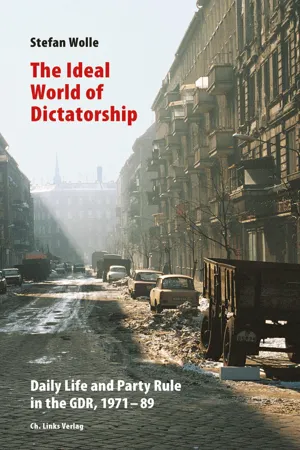
Life in the German Democratic Republic was a permanent balancing act between conformity and revolt. Political pressure and an economy of scarcity coexisted alongside the more pleasant and seemingly idyllic aspects of everyday life. Stefan Wolle takes these contradictory images of a now defunct world and weaves them into a coherent picture. He shows that the meticulously kept death strip at the border and lovingly tended allotment gardens were two sides of the same coin, that dictatorship and daily life necessarily went hand in hand.
Wolle tells the history of the last two decades of the GDR from the inside out, as the collective biography of its inhabitants. The result is a thoroughly researched and ambitious scholarly work that doesn't shy away from radical subjectivity. He describes the attempts of East German citizens to create a modicum of intellectual and spiritual freedom, takes stock of the shattered dream of a human, democratic socialism, and reclaims the multifaceted lives of those who lived under Communist Party rule.
Originally published in 1998, this seminal history of everyday life in East Germany is now available for the first time in English.
eBook - ePub
The Ideal World of Dictatorship
Daily Life and Party Rule in the GDR, 1971-89
- 464 Seiten
- German
- ePUB (handyfreundlich)
- Über iOS und Android verfügbar
eBook - ePub
The Ideal World of Dictatorship
Daily Life and Party Rule in the GDR, 1971-89
Über dieses Buch
Information
Part I
Change and Continuity
Chapter One: The Sixties and Seventies in the History of the GDR
The end of the Ulbricht era
East Germans were neither overjoyed nor stricken with grief when on May 3, 1971 Walter Ulbricht was relieved of his duties as first secretary of the Central Committee of the SED and Erich Honecker took over. Loyal SED followers greeted this change in the Party leadership and the new man soon managed to gain a certain, positive image, among his own people as well as Western observers. He was at least considered the lesser of two evils. Besides, most people had come to expect little more from a Party leader anyway. The image of Ulbricht increasingly faded in the ensuing years, eventually disappearing almost entirely. Not until the agonizing phase of 1988–89 did functionary circles begin once again to praise the attempted reforms of the 1960s. In comparison to the stagnation of the late Honecker era, the Ulbricht period seemed like an economically flourishing and intellectually lively period. Party members, in search of points of identification with their own party history, became more and more nostalgic about the reform efforts under Ulbricht.
It is clear in retrospect that the decade between the construction of the Berlin Wall and Ulbricht’s removal from power was a curiously contradictory period of East German history. After the erection of the Berlin Wall on August 13, 1961, many East German citizens—especially those in Berlin—presumed that the system was nearing its end. The economic, political and moral bankruptcy of the regime was all too obvious. What kind of a state is forced to put up barbed wire and to gun down its own citizens just to keep them from running off? Added to this was the fact that forced collectivization, the so-called “socialist spring in the countryside,” had critically worsened the food supply. When the borders were finally sealed off for good and things should have taken a turn for the better, meat and butter became scarce, a situation that could only be ameliorated by the massive import of foodstuffs from the Soviet Union. In domestic policy there were indications of more stormy weather to come rather than skies clearing. The SED regime suppressed every opposition with draconian punishments or the threat of punishment. In the second half-year of 1961, a total of 18,297 political convictions were meted out, in comparison to only 4,442 in the first half-year.1 A kind of law of the jungle even emerged for a short period of time. East German newspapers proudly reported that alleged workers had beaten “agitators and saboteurs” bloody. Under the slogan “Campaign Lightning—Contra NATO stations,” patrol groups of the Free German Youth (FDJ), the official youth organization of the GDR, climbed onto housetops in order to redirect TV antennas—so that those set-up to receive Western stations would receive East German ones instead—or even to tear them down completely.
“Soon it will be different,” was one of the idioms of the era. Yet nothing seemed to change at all. The influence of Soviet power and foreign policy and, with this, the power of the Party and the division of Germany seemed more entrenched than ever. The bulwark structure was becoming more and more impenetrable. In spite of much talk in the West, it was clear that the Americans would not do anything to tear down the Wall. On the other hand, to constantly live in a state of inner strife and moral indignation is rather difficult, if not impossible. East Germans figured—quite correctly—that they only had one life to live, and came to accept the fact that they would live their lives in the GDR. Most were preoccupied with their careers and their children’s futures. Day-to-day concerns took center stage: registering for a car, finding an apartment, and above all the permanent pursuit of scarce goods and services. This required making arrangements. Although the economy of scarcity still seemed to set the tone of daily life, it was somehow not as bad as it used to be. The waiting lists for televisions, refrigerators, washing machines and other much sought-after consumer goods had abated to a certain extent. In 1958 the system of ration cards was finally done away with, so that the “potato stamps,” “butter numbers,” “apple certificates” and other relics of the rationing economy eventually disappeared along with it.
Slowly but surely the economy had begun to improve since the mid-1960s. Official GDR statistics recorded a continual rise in retail sales of 10% per annum for the years 1964–67, 13% for 1968, and even 17% in 1969. Although such numbers should be viewed with caution, it is apparent nonetheless that a modest degree of prosperity had spread throughout society. TV-sets, electric refrigerators and washing machines made their way into many households during this period and more and more families could afford a car. The 1960s also saw the introduction of a five-day workweek. Whereas the six-day week with an eight-hour workday had been the norm up until then, in 1966 the first step was taken to shorten work times, reducing the workweek to 45 hours with every other Saturday off. In 1967 Saturdays were declared work-free. It is therefore hardly surprising that many East Germans look back at the 1960s perhaps not as a “golden age” but at least as a time of change and a new beginning, and also as a time of hope. Just like in West Germany, a new generation stepped to the fore, a generation which had learned about the war and postwar years only through books and films, or from the stories of their parents and teachers. As children they had been nourished with a steady stream of lofty ideals, and had learned in school that they would one day live under Communism. In the December 1958 issue of Mosaik, the comic book heroes “Dig and Dag” traveled on a spaceship from antiquity directly into the future, where they witnessed the blessings of progress.2 Indeed, the belief in the ability to influence the course of history and in the omnipotence of science and technology was common at that time all across the globe.
On October 4, 1957 the world’s first artificial satellite, Sputnik, was launched by the Soviets, marking the start of the space age. The elementary-school-aged Young Pioneers sang the following tribute: “Hejo, Sputnik, hoch am Himmelszelt, sag, was siehst du bei der Reise um die Welt?” (Hey, Sputnik, high up in the firmament, tell us what you see on your travels round the world). The satellite answered in a kind of antiphonal song: “Ich seh vom Gelben Meer herüber bis zum Elbestrand die Schar der befreiten Völker, mittendrin mein Heimatland. Die Fahnen leuchten rot und die Gesänge klingen froh!” (From the Yellow Sea to the banks of the Elbe I see the flock of liberated peoples, in their midst my homeland. The flags glow red and the songs sound joyful!). This was then followed by the chorus, in Russian: “Hey, Sputnik, ochen’ khorosho!”3 Popular figures of those years were the Siberian husky “Laika,” the passenger of “Sputnik 1,” which incinerated in the stratosphere in November 1957, and the ever-smiling and affable Yuri Gagarin, who—we know today—just barely escaped the same fate in April 1961. The Soviet empire had become much less terrifying. The second wave of de-Stalinization had reached the Soviet satellite states by November 1961. The portraits of Stalin vanished for good into the junk room and the collected works of the dictator were removed from reading rooms and relegated to the stacks. In the dead of night, a construction crew set to work on the sly, soundlessly dethroning the monument across from the pseudo-classical sports hall on Stalinallee. Stalinallee was renamed Karl-Marx-Allee, and Stalinstadt (Stalin City) became Eisenhüttenstadt (Iron Works City). Nikita Khrushchev was now at the helm in Moscow, the merry man with the bald head who became the butt of countless jokes, the best of which were the ones he told himself. The stages on the path towards the envisioned goal of a Communist society had been outlined in detail by the Twenty-Second Party Congress of the CPSU in October 1961. Communism was to be firmly established within the next twenty years. “Industrial production will have grown sixfold by 1980, agricultural production threefold,” the Party Congress proclaimed.
The U.S.S.R. will have achieved the highest levels of industrial and agricultural production in the world, and will have thereby surpassed the most advanced capitalist countries … The principle will apply: from each according to his abilities, to each according to his needs.4
At first, basic food stuffs would be made available for free. Then rent, utility costs, and ultimately even money would be done away with altogether. Everyone could take as much as they needed from the overabundance of supplies in stores. Thus, crime, criminal courts and prisons would become relics of the past. The distinction between physical and mental labor would gradually melt away and work would merely serve to provide a sense of fulfillment and happiness in life. “The dream of ‘living a hundred years without aging’ would become reality” was what the baffled reader could learn from the title page of the SED’s official daily newspaper, Neues Deutschland.5 All of this was supposed to become reality by the year 1980. The dawn of utopia was marked on the calendar.
While some may have simply sniggered at such promises—the gap between propaganda and reality was all too obvious—others accepted the proclamation of a coming age of paradise as a kind of offer. They were keen to do away with socialism in their own way—by overcoming it dialectically in a Hegelian sense and progressing towards Communism. A line was often quoted from Peter Hacks’s play Problems and Power, which debuted in 1962. The character Emma Holdefleiss puts it like this:
In my empty bag I carry the fullness of the world, Communism, which we will be entering in a not too distant year. Official decisions have been made about it. Colleagues, if you want to imagine Communism, then set your eyes on what exists now and take the opposite. Because the way hardly resembles the goal.6
Remarks like these obviously antagonized the authorities, which promptly banned the play after only a few performances.7 For all its critique of existing conditions, Hacks’s comedy, like other plays from this period, ultimately dealt with the theme of individuals deriving their creative energy from the very contradiction between a blueprint of utopia and the oppressiveness of reality. The comedy Problems and Power, which takes place in a proletarian milieu, was in its rather stilted folksiness itself just another manifestation of utopia. It is safe to say that the author himself did not really expect workers in the brown-coal industry to talk or think that way. But the feelings it describes really did exist—if not among blue-collar workers, then among intellectuals and students. And these feelings initially coincided with a favorable political climate.
The leading circles of the SED had been discussing a fundamental economic reform since 1962. It was becoming apparent that without increasing the efficiency of its economic system, the GDR would fall further and further behind the West and the so-called “scientific-technical revolution” would eventually peter out. The proponents of a policy of reform were greatly encouraged by similar discussions among Soviet economists at the end of 1962. Ulbricht summed up the planned reforms in January 1963 with the term New Economic System of Planning and Management (NES). Its goals were to give enterprises more autonomy, to allow more flexibility in the planning process, to make use of market mechanisms, and to rapidly put the latest scientific developments into practice. In spite of its many inconsistencies and half-measures, the reform program of the NES was based on a genuine desire to promote economic innovation. This led to an increased emphasis on research and development, which in turn meant that Party leaders promptly focused their attention on universities and research institutes. A paper entitled “Principles for the Further Development of Teaching and Research at Institutes of Higher Learning in the German Democratic Republic” prepared by the State Secretary for Universities and Technical Colleges was presented at the Eleventh Plenary of the Central Committee of the SED in December 1965, and was later published and put up for discussion. The document was adopted by the Fourth SED Conference on Institutes of Higher Learning, which took place on February 12–13, 1967 in East Berlin. In line with these developments, the Seventh Party Congress of the SED decided on April 22, 1967 that its new program would continue the rather forced policy of university reform.
What applied to the development of GDR society in general also applied to university reforms. An appropriate diagnosis of the existing weaknesses in the system led to rational approaches for change. This was true, for instance, of the call for practice-oriented research and training or the attempt to adapt university education to the needs of industry. All of this took place, however, under the condition that political structures remain untouched, with the result that the SED leadership promoted very contradictory policies in the second half of the 1960s, a phase inaugurated by the legendary Eleventh Plenary of the Central Committee of the SED and the ensuing cultural-policy clampdown and culminating with the Seventh Party Congress of the SED in April 1967. The end was marked by Ulbricht’s ouster, an action which began with the “corrective decision” of the Politbüro on September 9, 1970 and concluded with the Fourteenth Plenary of the Central Committee of the SED in December 1970. The period was characterized by an unparalleled intervention of the state in the arts, literature and sciences, the Party laying down an ideological framework and demanding slavish obedience. Yet at the same time there were lively theoretical discussions, some of which entailed a brazenly critical examination of the foundations of state ideology. The most visible symbol of the will for change was the large-scale reconstruction of city centers, which pushed the capacities of the GDR’s economic system to its limits.8 Room was made in a rigorous fashion for the erection of monumental buildings, the showpieces of communist architecture, and city planners were not afraid of razing notable historical buildings in the pr...
Inhaltsverzeichnis
- Cover
- Titel
- Impressum
- Contents
- Prologue to the English Edition. A Brief Word on Long Goodbyes
- Prologue to the Original German Edition (1998). In the Labyrinth of the Past
- Part I Change and Continuity
- Part II The GDR and Europe
- Part III The Structures of Power
- Part IV Control and Submission
- Part V Society and Economy
- Part VI Elements of Crisis
- Part VII The Road to Collapse
- Epilogue: The Dialectic of Decline
- Publisher’s Afterword to the English Edition
- Appendix Notes
375,005 Studierende vertrauen auf uns
Zugang zu über 1,5 Millionen Titeln zu einem fairen monatlichen Preis.
Mit unseren Lerntools kannst du noch effizienter lernen.
Häufig gestellte Fragen
Ja, du kannst dein Abo jederzeit über den Tab Abo in deinen Kontoeinstellungen auf der Perlego-Website kündigen. Dein Abo bleibt bis zum Ende deines aktuellen Abrechnungszeitraums aktiv. Erfahre, wie du dein Abo kündigen kannst
Nein, Bücher können nicht als externe Dateien, z. B. PDFs, zur Verwendung außerhalb von Perlego heruntergeladen werden. Du kannst jedoch Bücher in der Perlego-App herunterladen, um sie offline auf deinem Smartphone oder Tablet zu lesen. Erfahre, wie du Bücher herunterladen kannst, um sie offline zu lesen
Wir sind ein Online-Lehrbuch-Abonnement-Service, bei dem du für weniger als den Preis eines einzelnen Buchs pro Monat Zugriff auf eine gesamte Online-Bibliothek erhältst. Bei über 1,5 Millionen Büchern zu mehr als 990 Themen bist du bestens versorgt! Erfahre mehr über unsere Mission
Achte auf das Symbol zum Vorlesen bei deinem nächsten Buch, um zu sehen, ob du es dir auch anhören kannst. Bei diesem Tool wird dir Text laut vorgelesen, wobei der Text beim Vorlesen auch grafisch hervorgehoben wird. Du kannst das Vorlesen jederzeit anhalten, beschleunigen und verlangsamen. Erfahre mehr über die Funktion „Vorlesen“
Ja! Du kannst die Perlego-App sowohl auf iOS- als auch auf Android-Geräten nutzen, damit du jederzeit und überall lesen kannst – sogar offline. Perfekt für den Weg zur Arbeit oder wenn du unterwegs bist.
Bitte beachte, dass wir Geräte, auf denen die Betriebssysteme iOS 13 und Android 7 oder noch ältere Versionen ausgeführt werden, nicht unterstützen können. Mehr über die Verwendung der App erfahren
Bitte beachte, dass wir Geräte, auf denen die Betriebssysteme iOS 13 und Android 7 oder noch ältere Versionen ausgeführt werden, nicht unterstützen können. Mehr über die Verwendung der App erfahren
Ja, du kannst auf The Ideal World of Dictatorship von Stefan Wolle, David Burnett im PDF- und/oder ePUB-Format sowie auf andere beliebte Bücher in Politik & Internationale Beziehungen & Kunstgeschichte der zeitgenössischen Kunst zugreifen. In unserem Katalog stehen über 1,5 Millionen Bücher zur Verfügung.