- 251 Seiten
- German
- PDF
- Über iOS und Android verfügbar
eBook - PDF
Electronic dissipation processes during chemical reactions on surfaces
Über dieses Buch
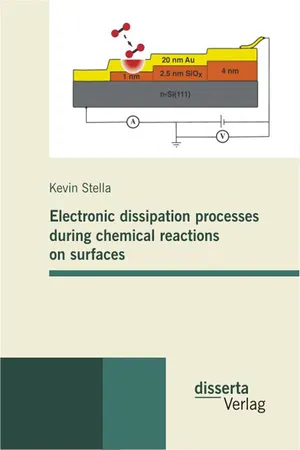
Every day in our life is larded with a huge number of chemical reactions on surfaces. Some reactions occur immediately, for others an activation energy has to be supplied. Thus it happens that though a reaction should thermodynamically run off, it is kinetically hindered. Meaning the partners react only to the thermodynamically more stable product state within a mentionable time if the activation energy of the reaction is supplied. With the help of catalysts the activation energy of a reaction can be lowered. Such catalytic processes on surfaces are widely used in industry. Around 90% of chemicals are produced via a heterogeneously catalyzed process where a reaction occurs on the surface of a catalyst. However, why is it generally possible that such reactions run off with the help of heterogeneous catalysis, meaning with lower activation energy than without presence of a catalyst? What happens with the energy which is released during a reaction of gas particles on surfaces? How is this energy released, when some part of the energy is transferred to the reactant and some to the chemically active surface? Which physical mechanisms play a key role in the energy transfer? These questions are summarized in the concept of the energy dissipation. To observe this energy dissipation phenomenon, we use a new method, the chemoelectronics. With this method we try to detect the released energy, induced by reactions on surfaces, via thin-layered electronic device elements. An aim of this work is to build up very sensitive chemoelectronic sensors to measure electronic excitations released during such simple reactions of molecules as adsorption and desorption and more complicated reactions as the water formation reaction. Therefore a new line of chemoelectronic sensors is developed and characterized in terms of internal photoemission and stability. Meaning the previously used aluminum (Al–AlOx–Ag) and tantalum based (Ta–TaOx–Au) metal–insulator–metal sensors (MIM) are tested and new titanium based (Ti–TiOx–Au) MIMs are developed. Additionally silicon based stepped–metal–insulator–semiconductor sensors (stepped-MIS, Si–SiOx–Au, Si–SiOx–Pt) are set up and characterized. For the characterization of the chemoelectronic sensors the process of internal photoemission is used. Both, chemical- and photoexcitation release hot charge carriers (electrons and holes). Due to the existence of excited carriers in the sensor, a current can be measured without applying a bias voltage. It will be shown that the chemo- and the photosensitivity are strongly related to each other. As a first experiment for the chemical selectivity of the detectors, a stream of excited hydrogen molecules and hydrogen atoms is used. The excitation and radical formation is produced by the interaction of ground state molecules with a hot tungsten surface according to the pioneering experiments of Irving Langmuir. Additionally, excited oxygen beams are studied in this work.
Information
Thema
NaturwissenschaftenThema
ChemieInhaltsverzeichnis
- Electronic dissipation processes during chemical reactionson surfaces
375,005 Studierende vertrauen auf uns
Zugang zu über 1,5 Millionen Titeln zu einem fairen monatlichen Preis.
Mit unseren Lerntools kannst du noch effizienter lernen.
Häufig gestellte Fragen
Ja, du kannst dein Abo jederzeit über den Tab Abo in deinen Kontoeinstellungen auf der Perlego-Website kündigen. Dein Abo bleibt bis zum Ende deines aktuellen Abrechnungszeitraums aktiv. Erfahre, wie du dein Abo kündigen kannst
Nein, Bücher können nicht als externe Dateien, z. B. PDFs, zur Verwendung außerhalb von Perlego heruntergeladen werden. Du kannst jedoch Bücher in der Perlego-App herunterladen, um sie offline auf deinem Smartphone oder Tablet zu lesen. Erfahre, wie du Bücher herunterladen kannst, um sie offline zu lesen
Perlego bietet zwei Pläne an: Essential und Complete
- Essential ist ideal für Lernende und Fachkräfte, die es genießen, eine Vielzahl von Themen zu erkunden. Greife auf die Essential Library mit über 800.000 vertrauenswürdigen Titeln und Bestsellern in den Bereichen Wirtschaft, persönliche Weiterentwicklung und Geisteswissenschaften zu. Enthält unbegrenzte Lesezeit und Standard-Vorlesestimme.
- Complete: Perfekt für fortgeschrittene Lernende und Forschende, die vollen, uneingeschränkten Zugriff benötigen. Entsperre über 1,5 Millionen Bücher zu Hunderten von Themen, einschließlich akademischen und spezialisierten Titeln. Der Complete-Plan enthält außerdem fortschrittliche Funktionen wie Premium Vorlesen und Forschungsassistent.
Wir sind ein Online-Lehrbuch-Abonnement-Service, bei dem du für weniger als den Preis eines einzelnen Buchs pro Monat Zugriff auf eine gesamte Online-Bibliothek erhältst. Bei über 1,5 Millionen Büchern zu mehr als 990 Themen bist du bestens versorgt! Erfahre mehr über unsere Mission
Achte auf das Symbol zum Vorlesen bei deinem nächsten Buch, um zu sehen, ob du es dir auch anhören kannst. Bei diesem Tool wird dir Text laut vorgelesen, wobei der Text beim Vorlesen auch grafisch hervorgehoben wird. Du kannst das Vorlesen jederzeit anhalten, beschleunigen und verlangsamen. Erfahre mehr über die Funktion „Vorlesen“
Ja! Du kannst die Perlego-App sowohl auf iOS- als auch auf Android-Geräten nutzen, damit du jederzeit und überall lesen kannst – sogar offline. Perfekt für den Weg zur Arbeit oder wenn du unterwegs bist.
Bitte beachte, dass wir Geräte, auf denen die Betriebssysteme iOS 13 und Android 7 oder noch ältere Versionen ausgeführt werden, nicht unterstützen können. Mehr über die Verwendung der App erfahren
Bitte beachte, dass wir Geräte, auf denen die Betriebssysteme iOS 13 und Android 7 oder noch ältere Versionen ausgeführt werden, nicht unterstützen können. Mehr über die Verwendung der App erfahren
Ja, du kannst auf Electronic dissipation processes during chemical reactions on surfaces von Kevin Stella im PDF- und/oder ePUB-Format sowie auf andere beliebte Bücher in Naturwissenschaften & Chemie zugreifen. In unserem Katalog stehen über 1,5 Millionen Bücher zur Verfügung.