If, at the moment of the Eucharistic consecration, solely the accidents remain – as our senses testify – the question inevitably arises: Is it possible for an accident to exist and at the same time not inhere in a subject? This study addresses that question and traces the development of the discussions surrounding the status of Eucharistic accidents that exist without a subject. It covers the period in the Middle Ages up to Thomas Aquinas and examines selected reactions from the first generation of thinkers after Aquinas. It identifies the fundamental philosophical concerns of these authors, their principal insights and conclusions, partly based on hitherto unpublished texts. The entire debate centers on the need to safeguard divine omnipotence; for even God cannot make contradictories, such as accidents existing without a subject, true. On several occasions Thomas Aquinas expressed his concern that the faith, when shown to be false or impossible, would be held up to the ridicule of non-believers. The rise of 'radical Aristotelianism' urged Aquinas and his contemporaries to defend philosophically the possibility of accidents existing sine subiecto. Starting with Berengar of Tours, this study provides a detailed chronological account of the debate in the various 12th century 'schools' and in the early Summae. The most important authors prior to Thomas Aquinas are treated extensively, with a particular emphasis on the authenticity of the treatise De corpore Domini, attributed to Albertus Magnus. The analysis of Aquinas' key texts on the question is carried out in relation to the whole of his thought and its reception by Peter of Tarentasia, Hannibaldus de Hannibaldis and Adenulf of Anagnia. The final part of this study considers the criticism by the Parisian members of the Faculty of Arts: Dietrich of Freiberg, Godfrey of Fontaines, Giles of Rome, John of Paris, John of Sterngassen and HervaeusNatalis. Lengthy attention is also devoted to the famous anonymous Commentary on the Sentences, contained in Ms. 491 of the city library of Bruges (Belgium).
eBook - PDF
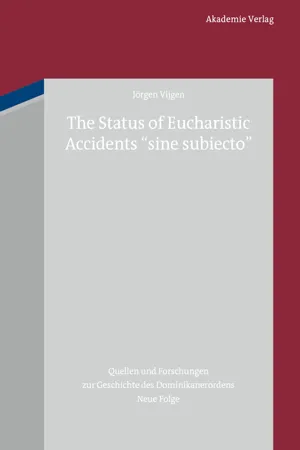
The Status of Eucharistic Accidents "sine subiecto"
An Historical Survey up to Thomas Aquinas and Selected Reactions
- 424 Seiten
- German
- PDF
- Über iOS und Android verfügbar
eBook - PDF
The Status of Eucharistic Accidents "sine subiecto"
An Historical Survey up to Thomas Aquinas and Selected Reactions
Über dieses Buch
Information
Inhaltsverzeichnis
375,005 Studierende vertrauen auf uns
Zugang zu über 1,5 Millionen Titeln zu einem fairen monatlichen Preis.
Mit unseren Lerntools kannst du noch effizienter lernen.
Häufig gestellte Fragen
Ja, du kannst dein Abo jederzeit über den Tab Abo in deinen Kontoeinstellungen auf der Perlego-Website kündigen. Dein Abo bleibt bis zum Ende deines aktuellen Abrechnungszeitraums aktiv. Erfahre, wie du dein Abo kündigen kannst
Nein, Bücher können nicht als externe Dateien, z. B. PDFs, zur Verwendung außerhalb von Perlego heruntergeladen werden. Du kannst jedoch Bücher in der Perlego-App herunterladen, um sie offline auf deinem Smartphone oder Tablet zu lesen. Erfahre, wie du Bücher herunterladen kannst, um sie offline zu lesen
Perlego bietet zwei Pläne an: Essential und Complete
- Essential ist ideal für Lernende und Fachkräfte, die es genießen, eine Vielzahl von Themen zu erkunden. Greife auf die Essential Library mit über 800.000 vertrauenswürdigen Titeln und Bestsellern in den Bereichen Wirtschaft, persönliche Weiterentwicklung und Geisteswissenschaften zu. Enthält unbegrenzte Lesezeit und Standard-Vorlesestimme.
- Complete: Perfekt für fortgeschrittene Lernende und Forschende, die vollen, uneingeschränkten Zugriff benötigen. Entsperre über 1,5 Millionen Bücher zu Hunderten von Themen, einschließlich akademischen und spezialisierten Titeln. Der Complete-Plan enthält außerdem fortschrittliche Funktionen wie Premium Vorlesen und Forschungsassistent.
Wir sind ein Online-Lehrbuch-Abonnement-Service, bei dem du für weniger als den Preis eines einzelnen Buchs pro Monat Zugriff auf eine gesamte Online-Bibliothek erhältst. Bei über 1,5 Millionen Büchern zu mehr als 990 Themen bist du bestens versorgt! Erfahre mehr über unsere Mission
Achte auf das Symbol zum Vorlesen bei deinem nächsten Buch, um zu sehen, ob du es dir auch anhören kannst. Bei diesem Tool wird dir Text laut vorgelesen, wobei der Text beim Vorlesen auch grafisch hervorgehoben wird. Du kannst das Vorlesen jederzeit anhalten, beschleunigen und verlangsamen. Erfahre mehr über die Funktion „Vorlesen“
Ja! Du kannst die Perlego-App sowohl auf iOS- als auch auf Android-Geräten nutzen, damit du jederzeit und überall lesen kannst – sogar offline. Perfekt für den Weg zur Arbeit oder wenn du unterwegs bist.
Bitte beachte, dass wir Geräte, auf denen die Betriebssysteme iOS 13 und Android 7 oder noch ältere Versionen ausgeführt werden, nicht unterstützen können. Mehr über die Verwendung der App erfahren
Bitte beachte, dass wir Geräte, auf denen die Betriebssysteme iOS 13 und Android 7 oder noch ältere Versionen ausgeführt werden, nicht unterstützen können. Mehr über die Verwendung der App erfahren
Ja, du kannst auf The Status of Eucharistic Accidents "sine subiecto" von Jörgen Vijgen im PDF- und/oder ePUB-Format sowie auf andere beliebte Bücher in Geschichte & Europäische Geschichte des Mittelalters zugreifen. In unserem Katalog stehen über 1,5 Millionen Bücher zur Verfügung.