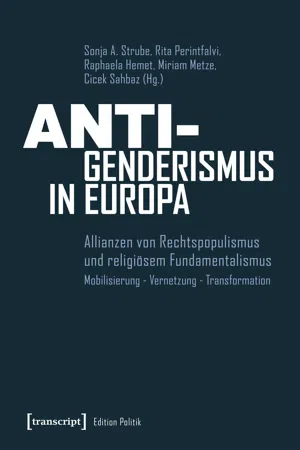
Systematische Angriffe auf die Geschlechtergerechtigkeit verschärfen sich weltweit und sind in einigen EU-Staaten bereits Teil des Regierungshandelns. Als Infragestellung basaler Menschenrechte und zumeist rechtspopulistisch bzw. fundamentalistisch motiviert gefährden sie die Demokratie. Aus internationaler und interdisziplinärer Perspektive analysieren die Beiträger*innen des Bandes Anti-Genderismus als strategisches Mittel der Emotionalisierung, Mobilisierung und Vernetzung innerhalb des rechten Spektrums und einer im Entstehen begriffenen religiösen Rechten. Mit besonderem Fokus auf die Situation einiger ostmitteleuropäischer Staaten und unter Einbezug von Erfahrungen aus dem LGBTIQ*-Aktivismus erörtern sie, wie dieser Entwicklung konstruktiv-widerständig zu begegnen ist.
eBook - ePub
Anti-Genderismus in Europa
Allianzen von Rechtspopulismus und religiösem Fundamentalismus. Mobilisierung - Vernetzung - Transformation
- 300 Seiten
- German
- ePUB (handyfreundlich)
- Über iOS und Android verfügbar
eBook - ePub
Anti-Genderismus in Europa
Allianzen von Rechtspopulismus und religiösem Fundamentalismus. Mobilisierung - Vernetzung - Transformation
Über dieses Buch
375,005 Studierende vertrauen auf uns
Zugang zu über 1,5 Millionen Titeln zu einem fairen monatlichen Preis.
Mit unseren Lerntools kannst du noch effizienter lernen.
Information
Anti-Genderismus in Ost-Mitteleuropa – Analysen und Berichte
Xenophobia and Power Politics: The Hungarian Far Right
In this chapter we aim to demonstrate how the Orbán regime occupied the far-right ideological space in Hungary. What did the leaders of the regime do to fundamentally reshape ideology and cultural politics? Between 2010 and 2019, dominant ideology, state propaganda, and cultural politics of the increasingly authoritarian regime, became indistinguishable from each other. Is it possible to have an increasingly flourishing autocratic regime in the European Union? Member states of the European Union are supposed to be liberal democracies, but Hungary, in harbouring authoritarian features under a disintegrating guise of democracy, is rightly called a competitive authoritarian regime. As such, it is the first non-democratic member state in the history of the European Union.
Hybrid regimes have the common feature that they all have competition, although the political elite in power deliberately rearranges state regulations and the political arena as to grant itself undue advantages. (Levitsky/Way 2010) For all practical purposes, they are all beneficiaries of an uneven playing field. Orbán’s Hungary fits into this model. There is a point where even broken democracy comes to an end. At a point where the line between private and public interest is swallowed up, the difference between nationalization and privatization disappears, where public interest becomes indistinguishable from the interests of politicians/economic players capturing the state, where mutatis mutandis, the system ends up defending these entrepreneurs. Corruption became centralized, legalized and systemic. »What is called corruption is in effect Fidesz’s most important political aim,« the regime’s chief ideologist stated with undisguised honesty (Lánczi 2015, translation by the authors). Corruption in Hungary is no longer seen as deviant behaviour, but as an integral part of the system itself. Breaking the law has become the new normal. What was once described as the abuse of power, today has become a defining feature of the regime. The emerging clan state, or »mafia state is a privatized form of the parasitic state« (Magyar 2016:13), where the patron-client relationship no longer refers to the patronage system also seen in democracies; essentially, it is the replacement of individual and institutional autonomies by the system of dependencies. This comes close to a definition of authoritarian regimes.
In 2016, when Hungarian citizens were prevented from submitting a referendum question by brute »civilian« force (i.e. skinheads and football hooligans) and with the government’s tacit consent, they were barred from exercising their constitutional right. With its outsourced violence the Orbán regime took another step on the road towards establishing a power monopoly. Just as the far right Jobbik party once had a paramilitary wing, there were indications that a similar team of loosely organized thugs in Fidesz colours was about to emerge whose members, while not wearing uniforms, were deployed to intimidate demonstrators and members of the opposition.
For policy reasons the regime proudly claimed that its enforcement agencies did not use direct force. The job of intimidation has been outsourced to ›civilian‹ street fighters, the ultras of some football clubs and others. This policy perfectly fits the Orbán regime’s governance strategy characterized by a deliberate effort to blur the differences between official and unofficial, responsible and unaccountable agents. Decisions are made outside the established institutions, behind their back, in an invisible and grey zone, in a world of shady organizations bearing no political responsibility or liability. Under this scheme, acts of violence that may embarrass those in power are performed by skilled skinheads that, in turn, can be easily disclaimed by Fidesz. Similarly, the budget is not necessarily drafted by the minister in charge, but by private firms with no legal ties to the government, and whose members may also have access to classified information.
We consider the centralization and personalization of power, the nationalist propaganda coupled with the discrimination and marginalization of underclass elements of the society, the forced change of elites by the predatory (or mafia) state, and the practice of power politics as the building blocks of the regime. The regime is rooted in the prime minister’s conviction that »revolutionary circumstances« mandate him to execute exceptional policies (Bozóki 2011, 2015).
In Hungary, nationalism has been of particular salience and emotional appeal, harnessing and playing off of many Hungarians’ discontent with the post-transition situation. Indeed, the cultivation of a strong nationalist discourse has been a key boon for the Orbán regime, which has manipulated Hungarians’ disillusionment, prejudices, and fears in a way that has rendered the citizenry increasingly susceptible to extreme nationalist and right-wing ideologies. In the midst of widespread dissatisfaction with Hungary’s direction in the aftermath of the Soviet communist hegemony, nationalist sentiment is particularly salient in that it gives citizens a common identity and sense of belonging within what would otherwise appear to be an alien land stripped of its rightful territory. Indeed, the power of nationalism and nationalizing discourses, has arguably been the driving force behind the far right and its popularity among its constituents (Brubaker 1996).
The right’s nationalizing discourse has attempted to create and reinforce the perception of a common national identity among Hungarians that stretches back to ancient times. The other far-right party, Jobbik, has capitalized on the idea of a founding myth to bind together Hungarians with a sense of national pride and belonging. The Jobbik cultural policy platform included a call for constitutional protection of Hungarian ›national symbols‹ such as the Holy Crown and the Turul bird, further solidifying this conception of an ancient nation with a common founding myth (ibid). In constructing such a national identity, Jobbik and Fidesz have promoted a homogeneous nation of ethnic Hungarians at the expense of ethnic minorities, and the parties’ vision of an ideal Hungary values these ›true‹ Hungarians above all others – even if not explicitly.
Earlier, Viktor Orbán attempted to distance himself from charges of extremism leveled against his political allies in Jobbik, though he has drawn ire on a number of occasions for adopting a similarly exclusionary stance. In 2013, he was accused of trying to gain favor among far-right radicals by bestowing a high honor, the Táncsics Prize, upon some figures known for their espousal of anti-Semitic conspiracies and extreme nationalist views (Hungary Hands Awards 2015). Thus, Orbán has recognized the power of national symbols and radical nationalist myths in mobilizing popular support and consolidating power, prompting the regime to pick up on Jobbik’s cues and repackage them so as to appear the originators of these ethnic nationalist ideals.
The refugee crisis of 2015 has provided a particularly powerful source for cultivating ethnic nationalist sentiment. The crisis sweeping across Europe has been met by a variety of responses – ranging from hospitable to downright hostile – from nations affected by the influx of desperate Syrian refugees. The hostile response of the Hungarian government was, in large part, a product of Fidesz’s attempts to appropriate Jobbik’s stance on the crisis and what should be done to mitigate it. The result of this political outbidding has been the development of a nationalist climate that aids Hungary’s authoritarian backsliding.
Underlying the Fidesz-Jobbik convergence on the refugee crisis was a very particular conception of »Hungarian-ness« that has been largely influenced by Jobbik’s unabashedly exclusionary version of Hungarian ethnic nationalism. A cornerstone of its ideological foundation was an intense wariness toward ›multiculturalism‹. In a post on the party’s official website, a Jobbik operative discussed the need to counter the wave of migrants crossing through Hungary, at the same time underscoring this exhortation with a condemnation of the principles of multiculturalism: »The failure of multiculturalism is obvious for everybody and even if the West is already lost, nobody can deprive Central Europe of its right to preserve the continent together with its traditional values, religion, and culture« (Editorial 2015a). Transparent through this condemnation of multiculturalism is a very particular conception of the ideal culture that needs defending. The far-right, Orbán government intimation that the West is beyond saving projects an image of Hungary as the guardians of Europe from individuals that they see as Muslim invaders, undesirables who pose a dire threat to a homogeneous, Christian Hungary (Ádám/Bozóki 2016a).
In the case of immigration, it became clear that the so-called moderating effects of power have not done anything to constrain Orbán and his Fidesz party in promoting their stances towards the refugee crisis. Indeed, Fidesz’s immigration policy very closely resembled the immigration policy started by Jobbik. Orbán has asserted that Hungary is not sufficiently equipped to handle migrants because of the country’s inexperience with ›multiculturalism‹ (Tremlett/Messing 2015). In addition to the construction of a 110-mile-long fence along the Hungarian-Serbian border to keep out migrants in transit and Fidesz’s fierce rejection of EU-imposed migrant quotas, the Orbán government channeled xenophobic attitudes toward the crisis and set in motion a nationwide anti-immigration campaign that included posters and billboards throughout Hungary admonishing migrants and reminding them that Hungary is a nation for Hungarians. Among the poster quotes were the following: »If you come to Hungary you have to respect our culture.« and »If you come to Hungary you have to respect our laws.«1 This marked a clear political ploy by Fidesz to ingratiate itself to voters who felt threatened by migrants entering the country, especially given that the migrants toward which the signs were purportedly directed were unlikely to understand Hungarian.
An additional aspect of Fidesz’s grassroots anti-migrant campaign, called the »National Consultation on Immigration,« was a questionnaire sent in July 2015 to every Hungarian household in a supposed effort to collect data on Hungarians’ feelings on immigration. Clearly imbued with an anti-immigrant slant, the survey asked such leading questions as: »There are some who think that mismanagement of the immigration question by Brussels may have something to do with increased terrorism. Do you agree with this view?« (National Consultation 2015, Transl. by the authors). Such aggressive posturing has been complemented by Orbán’s refusal to abide by mandatory EU quotas imposed on each member state to more evenly spread the financial and infrastructural burden. Additionally, the Orbán regime decided to unilaterally reject transfers of migrants to Hungary under the Dublin Regulations (Lyons 2015).
However, Orbán was just using the opportunity of the migration crisis for the purposes of manipulation: to control Hungarian citizens more strictly in order to cement his own power. The political right’s hostility towards refugees has been complemented and preceded by a long history of its hostility towards certain subgroups of Hungarians as well, namely the Roma and Jews. This hostility has only worsened since the rise of the right wing and Fidesz’s effective attempts to outbid Jobbik in its xenophobic zeal. László Trócsányi, Hungary’s Minister of Justice (2014-2019) was lambasted by the Hungarian and international press for a statement in May 2015 wherein he both criticized the EU migrant quota system and gave an interesting justification as to why Hungary cannot accept Syrian refugees: because Hungary must first focus on integrating the country’s Roma population of 800.000 (Adam 2015). Indeed, analysts have pointed out how Fidesz’s scapegoating of the Roma is strikingly reminiscent of Jobbik, warily stating that tying the immigration issue with the Roma is a ›genius‹ tactic by Fidesz to win over the growing contingent of Jobbik supporters within Hungary (Tremlett/Messing 2015).
Fidesz’s Roma-blaming tactics echo Jobbik’s previous cries of rampant ›gypsy crime‹ (cigánybűnözés in Hungarian) an offensive term that has become more widely used and accepted since the Hungarian mainstream has shifted to the right. The government officially denies that it is racist against the Roma people while also justifying their usage of the term. At the same time as the regime officially asserts that it is not anti-Roma, it categorically equates the minority ethnic group with »the predominant commission of certain types of crimes« (Editorial 2015b, Transl. by the authors). What is more, they support their claim by citing cases of increased crime rates in communities abroad that have seen large influxes of Roma migrants, saying that »when such Roma populations emigrate […] the communities they come to suddenly find themselves victims of precisely these forms of criminality« (ibid., Transl. by. the authors).
This anti-Roma rhetoric has been taken a step further with the formation of far-right paramilitary groups. In 2007, former Jobbik leader Gábor Vona founded the Magyar Gárda, (»Hungarian Guard«), with its primary goal being to »strengthen national self-defense and to maintain public order« (Alapító Nyilatkozat 2007, Transl. by the authors). The group’s members wore fascist-era boots and coats adorned with the red-and-white-striped flag used by the anti-Semitic, fascist Arrow Cross Party in the 1940s. Though Hungarian courts ordered the disbandment of the Magyar Gárda in 2008, the group utilized legal loopholes to reorganize into three separate but associated groups: the New Hungarian G...
Inhaltsverzeichnis
- Cover
- Titelseite
- Impressum
- Inhalt
- Anti-Genderismus in Europa – Zur Einführung
- Dynamiken der Vernetzung, Emotionalisierung, Mobilisierung
- Anti-Genderismus in Ost-Mitteleuropa – Analysen und Berichte
- Fokus: Anti-Genderismus im Schnittfeld von Religion und Politik
- Perspektiven für Öffnungen und Transformationsprozesse
- Autor*innenverzeichnis
Häufig gestellte Fragen
Ja, du kannst dein Abo jederzeit über den Tab Abo in deinen Kontoeinstellungen auf der Perlego-Website kündigen. Dein Abo bleibt bis zum Ende deines aktuellen Abrechnungszeitraums aktiv. Erfahre, wie du dein Abo kündigen kannst
Nein, Bücher können nicht als externe Dateien, z. B. PDFs, zur Verwendung außerhalb von Perlego heruntergeladen werden. Du kannst jedoch Bücher in der Perlego-App herunterladen, um sie offline auf deinem Smartphone oder Tablet zu lesen. Erfahre, wie du Bücher herunterladen kannst, um sie offline zu lesen
Perlego bietet zwei Pläne an: Essential und Complete
- Essential ist ideal für Lernende und Fachkräfte, die es genießen, eine Vielzahl von Themen zu erkunden. Greife auf die Essential Library mit über 800.000 vertrauenswürdigen Titeln und Bestsellern in den Bereichen Wirtschaft, persönliche Weiterentwicklung und Geisteswissenschaften zu. Enthält unbegrenzte Lesezeit und Standard-Vorlesestimme.
- Complete: Perfekt für fortgeschrittene Lernende und Forschende, die vollen, uneingeschränkten Zugriff benötigen. Entsperre über 1,5 Millionen Bücher zu Hunderten von Themen, einschließlich akademischen und spezialisierten Titeln. Der Complete-Plan enthält außerdem fortschrittliche Funktionen wie Premium Vorlesen und Forschungsassistent.
Wir sind ein Online-Lehrbuch-Abonnement-Service, bei dem du für weniger als den Preis eines einzelnen Buchs pro Monat Zugriff auf eine gesamte Online-Bibliothek erhältst. Bei über 1,5 Millionen Büchern zu mehr als 990 Themen bist du bestens versorgt! Erfahre mehr über unsere Mission
Achte auf das Symbol zum Vorlesen bei deinem nächsten Buch, um zu sehen, ob du es dir auch anhören kannst. Bei diesem Tool wird dir Text laut vorgelesen, wobei der Text beim Vorlesen auch grafisch hervorgehoben wird. Du kannst das Vorlesen jederzeit anhalten, beschleunigen und verlangsamen. Erfahre mehr über die Funktion „Vorlesen“
Ja! Du kannst die Perlego-App sowohl auf iOS- als auch auf Android-Geräten nutzen, damit du jederzeit und überall lesen kannst – sogar offline. Perfekt für den Weg zur Arbeit oder wenn du unterwegs bist.
Bitte beachte, dass wir Geräte, auf denen die Betriebssysteme iOS 13 und Android 7 oder noch ältere Versionen ausgeführt werden, nicht unterstützen können. Mehr über die Verwendung der App erfahren
Bitte beachte, dass wir Geräte, auf denen die Betriebssysteme iOS 13 und Android 7 oder noch ältere Versionen ausgeführt werden, nicht unterstützen können. Mehr über die Verwendung der App erfahren
Ja, du kannst auf Anti-Genderismus in Europa von Sonja A. Strube, Rita Perintfalvi, Raphaela Hemet, Miriam Metze, Cicek Sahbaz, Sonja A. Strube,Rita Perintfalvi,Raphaela Hemet,Miriam Metze,Cicek Sahbaz im PDF- und/oder ePUB-Format sowie auf andere beliebte Bücher in Social Sciences & Philosophy History & Theory zugreifen. In unserem Katalog stehen über 1,5 Millionen Bücher zur Verfügung.