eBook - ePub
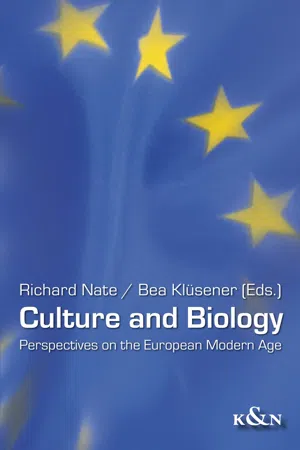
Culture and biology
Perspectives on the European Modern Age
- German
- ePUB (handyfreundlich)
- Über iOS und Android verfügbar
eBook - ePub
Culture and biology
Perspectives on the European Modern Age
Über dieses Buch
R. Nate: The 'New Man': Historical Perspectives – N. Hagen / B. Isenberg: The Manifestation of Modernity in Genetic Science – M. Schwartz: Sozialistische Eugenik im 20. Jahrhundert – A. Gerstner: A Paneurope of Supermen: Coudenhove-Kalergi's European Vision – S. Schieren: Die autokratische Versuchung: Britischer Imperialismus, Buren- Krieg, 'Effi ciency' und Staatsreform in Großbritannien zur Wende zum 20. Jahrhundert – J. S. Partington: H. G. Wells and Population Control: From a Eugenic Public Policy to the Eugenics of Personal Choice – A. Laukötter: Theoretisieren, Sammeln, Ausstellen: Techniken der Völkerkundemuseen zu Beginn des 20. Jahrhunderts – V. Gutsche: Kulturpessimismus und Geschichtstheorie: Oswald Spengler und Eduard Spranger – R. Nate: Fears of Degeneracy: Paul Rohrbach and the' 'Menace of the Under-Man' – B. Klüsener: Biological Theories of the Criminal and Their Impact on British 19th- Century Novels – S. Lampadius: The World State as a Superhuman Organism, from H. G. Wells to Aldous Huxley – V. Shamina: Eugenics in Russia and Its Refl ection in Literature
Information
Thema
SprachwissenschaftBiological Theories of the Criminal and Their Impact on British Nineteenth-Century Novels
Evil in the form of crime has always been a part of human society and there have been many attempts to both explain and fight it. The beginning of the nineteenth century brought a shift from theological explanations for the behavior of “fallen” individuals towards biological theories of crime, according to which criminality was either an illness, an atavism or a genetic defect – as reflected in the concepts of moral insanity, phrenology, criminal anthropology, and in evolutionarily inspired ideas concerning the criminal as a degenerated person.1 These ideas were developed and discussed by scientists from various national contexts.
In England, the early criminological systems were dominated by their idea of the criminal as a morally insane or imbalanced person who needed society’s help and who could – in most cases – be fully rehabilitated. While the first half of the nineteenth century was characterized by the optimistic ideas of manageable social problems in a rational world, the second half brought a change of this attitude, due to increasing troubles caused by urbanization, huge class divisions and a sense of crisis both on the national and the international level2 as “industry, capitalism and social mobility appeared to produce a feverish political and social unrest.”3 With people being anxious about the future, fighting crime became one means of managing this crisis which was supposed to threaten both the individual and the whole social body. The criminal was regarded as a danger for society which had to be protected from such elements with the help of different measures that became more and more eugenic towards the end of the century.
This essay will give an overview of a number of biological theories of crime and their implications for British society in the nineteenth century. Based on the idea of an interdependence of literature and culture, some literary examples will be discussed in order to illustrate how different ideas about the criminal made their way into nineteenth-century British literature and culture and how they were artistically implemented into the presentation of the villain in British nineteenth-century novels.
1. Concepts
1.1. Moral Insanity
The concept of moral insanity can be regarded as the starting point of a scientific treatment of criminology. In the British context, the work of the physician James Cowles Prichard (1786-1848) is probably most interesting because he was the one who established ‘moral insanity’ as a standard term in psychiatry.4 Prichard’s most influential work is A Treatise on Insanity (1835), in which he defines moral insanity in the following way: “[It is] a form of mental derangement in which the intellectual faculties appear to have sustained little or no injury, while the disorder is manifested principally or alone, in the state of the feelings, temper, or habits.”5 The morally insane were supposed to be characterized by logical thinking in combination with “irascibility and constant malicious plotting against others”.6 That Prichard equaled mental illness with an emotional disturbance was revolutionary in comparison to eighteenth-century ideas that had viewed mental disease as an intellectual deficiency. On the basis of his theory, Prichard could account for people who usually behaved normally but lost control from time to time without being intellectually inferior.7
Prichard realized that this phenomenon occurred in families with a “hereditary tendency to madness”8 or in people who suffered from fever or epilepsy, for instance, but he could not explicitly name the causes of moral insanity although he was sure that patients were not really responsible for their deeds.9 Of course, there was skepticism concerning the legal consequences of this lack of responsibility because it offered an opportunity for criminals to escape capital punishment. In addition to this, it was difficult to diagnose. In England, Daniel Hack Tuke10 and other followers of Prichard’s concept continued to collect data in order to empirically prove their theory, and Prichard’s ideas spread quickly throughout Europe and even the U.S. and thereby became part of “the international language of disease.”11
When the concept of moral insanity met with the idea of degeneration, however, it faced a transformation. In 1881, George H. Savage – influenced by the evolutionists Herbert Spencer and Charles Darwin as well as by the degeneration psychiatrist Henry Maudsley – connected the two branches and concluded that moral insanity was close to intellectual insanity and that, furthermore, it was hereditary.12 Moral insanity was regarded as a step back on the evolutionary ladder with the altruistic sentiments being on a very low level, as Tuke put it in 1884. Still, it could be either acquired or innate.13
With the ideas of moral insanity and degeneration linked to each other, the new, i.e. late version of the morally insane was close to Cesare Lombroso’s Criminal Man. The starting point of the theory of moral insanity being the idea that biology offered the key for an understanding of human behavior, and also criminal behavior, this theory brought a slightly determinist perspective as it replaced free will by biologically medicalizing criminality. This had an influence on contemporary opinions concerning the criminal. While moral insanity was – in some cases – regarded as curable, it was no longer considered to be so after its merging with degeneration theory during the second half of the nineteenth century. Still, the original hope for rehabilitation was also characteristic of another biological theory of crime: phrenology.
1.2. Phrenology
Phrenology is based on the idea that by examining the shape of a person’s head, the surface of the cranium, one can detect various character traits and come to conclusions about a subject’s intelligence.14 Again, the aim of phrenology was to give scientific explanations of any human behaviour, which, of course, included criminal behaviour as well. The Austrian physician Franz Joseph Gall and the German Johann Gaspar Spurzheim are usually seen as the founders of phrenology – the starting point of which is placed in 1800 – which caused a serious scientific discussion for about 30 years but became rather popularized and less scientific towards the middle of the nineteenth century.15 Phrenology was strongly influenced by Johann Kaspar Lavater’s (1741-1801) physiognomy, which taught the “correspondence between the external and internal man”,16 between the visible features and invisible qualities.
In his main work, On the Functions of the Brain and Each of Its Parts (1825), Gall explains that the brain consists of thirty separate organs/faculties.17 In healthy individuals, these are in balance. In criminals, they are not. Gall had already identified an organ responsible for murder.18 Spurzheim also argued that the destructive propensity was extremely intense in some individuals due to one responsible organ that did not work properly. A crucial aspect is that, although evolutionary theory had not yet developed into Darwinism, Gall anticipated it in...
Inhaltsverzeichnis
- Decke
- Half Titel
- Titel Seite
- Copyright
- Contents
- Preface
- Introduction
- Visions of a “New Man”: A Historical Survey
- The Manifestation of Modernity in Genetic Science
- Sozialistische Eugenik im 20. Jahrhundert
- Die autokratische Versuchung: Britischer Imperialismus, Buren-Krieg, „Efficiency“ und Staatsreform in Großbritannien zur Wende zum 20. Jahrhundert
- Strukturen, Strategien, Statistiken der Völkerkundemuseen zu Beginn des 20. Jahrhunderts
- A Paneurope of Supermen: Coudenhove-Kalergi’s European Vision
- Kulturpessimismus und Geschichtsauffassung: Oswald Spengler und Eduard Spranger
- H. G. Wells and Population Control: From a Eugenic Public Policy to the Eugenics of Personal Choice
- Fears of Degeneracy: Paul Rohrbach and the “Menace of the Under-Man”
- Biological Theories of the Criminal and Their Impact on British Nineteenth-Century Novels
- The World State as a Superhuman Organism, from H. G. Wells to Aldous Huxley
- Eugenics and Its Reflection in Twentieth Century Russian Literature
- Notes on Contributors
375,005 Studierende vertrauen auf uns
Zugang zu über 1,5 Millionen Titeln zu einem fairen monatlichen Preis.
Mit unseren Lerntools kannst du noch effizienter lernen.
Häufig gestellte Fragen
Ja, du kannst dein Abo jederzeit über den Tab Abo in deinen Kontoeinstellungen auf der Perlego-Website kündigen. Dein Abo bleibt bis zum Ende deines aktuellen Abrechnungszeitraums aktiv. Erfahre, wie du dein Abo kündigen kannst
Nein, Bücher können nicht als externe Dateien, z. B. PDFs, zur Verwendung außerhalb von Perlego heruntergeladen werden. Du kannst jedoch Bücher in der Perlego-App herunterladen, um sie offline auf deinem Smartphone oder Tablet zu lesen. Erfahre, wie du Bücher herunterladen kannst, um sie offline zu lesen
Perlego bietet zwei Pläne an: Essential und Complete
- Essential ist ideal für Lernende und Fachkräfte, die es genießen, eine Vielzahl von Themen zu erkunden. Greife auf die Essential Library mit über 800.000 vertrauenswürdigen Titeln und Bestsellern in den Bereichen Wirtschaft, persönliche Weiterentwicklung und Geisteswissenschaften zu. Enthält unbegrenzte Lesezeit und Standard-Vorlesestimme.
- Complete: Perfekt für fortgeschrittene Lernende und Forschende, die vollen, uneingeschränkten Zugriff benötigen. Entsperre über 1,5 Millionen Bücher zu Hunderten von Themen, einschließlich akademischen und spezialisierten Titeln. Der Complete-Plan enthält außerdem fortschrittliche Funktionen wie Premium Vorlesen und Forschungsassistent.
Wir sind ein Online-Lehrbuch-Abonnement-Service, bei dem du für weniger als den Preis eines einzelnen Buchs pro Monat Zugriff auf eine gesamte Online-Bibliothek erhältst. Bei über 1,5 Millionen Büchern zu mehr als 990 Themen bist du bestens versorgt! Erfahre mehr über unsere Mission
Achte auf das Symbol zum Vorlesen bei deinem nächsten Buch, um zu sehen, ob du es dir auch anhören kannst. Bei diesem Tool wird dir Text laut vorgelesen, wobei der Text beim Vorlesen auch grafisch hervorgehoben wird. Du kannst das Vorlesen jederzeit anhalten, beschleunigen und verlangsamen. Erfahre mehr über die Funktion „Vorlesen“
Ja! Du kannst die Perlego-App sowohl auf iOS- als auch auf Android-Geräten nutzen, damit du jederzeit und überall lesen kannst – sogar offline. Perfekt für den Weg zur Arbeit oder wenn du unterwegs bist.
Bitte beachte, dass wir Geräte, auf denen die Betriebssysteme iOS 13 und Android 7 oder noch ältere Versionen ausgeführt werden, nicht unterstützen können. Mehr über die Verwendung der App erfahren
Bitte beachte, dass wir Geräte, auf denen die Betriebssysteme iOS 13 und Android 7 oder noch ältere Versionen ausgeführt werden, nicht unterstützen können. Mehr über die Verwendung der App erfahren
Ja, du kannst auf Culture and biology von Richard Nate, Bea Klüsener, Richard Nate,Bea Klüsener im PDF- und/oder ePUB-Format sowie auf andere beliebte Bücher in Sprachen & Linguistik & Sprachwissenschaft zugreifen. In unserem Katalog stehen über 1,5 Millionen Bücher zur Verfügung.