Berlin strahlt nicht? Das Risiko für einen Atomunfall ist in der Hauptstadt wohl äußerst gering. Außer dem kleinen Forschungsreaktor des Helmholtz-Zentrums im Stadtteil Wannsee gibt es keine Atomreaktoren in oder nahe der Stadt. Eine Selbstverständlichkeit?Wäre es nach den Plänen gegangen, die der West-Berliner Senat und der Stromversorger Bewag in den 1950er bis 1970er Jahren vorantrieben, würde in Berlin jetzt mindestens ein großer Atomreaktor stehen. Die nie verwirklichten Pläne rekonstruieren die Autoren Stück für Stück und beschreiben damit eine fast unglaubliche Geschichte, die weit über den lokalen Berliner Rahmen hinausweist.
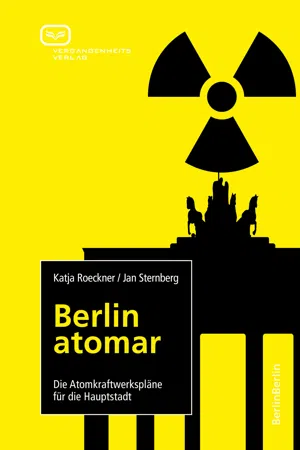
- 120 Seiten
- German
- ePUB (handyfreundlich)
- Über iOS und Android verfügbar
eBook - ePub
Über dieses Buch
Information
Thema
GeschichteThema
WeltgeschichteAnhang
Dank
Wir danken den Mitarbeitern des Bewag-Archivs bei Vattenfall Europe Berlin, Susan Hortmann und Wolfgang Broede; den Mitarbeitern des Landesarchivs Berlin; Benedikt Erenz beim Ressort Geschichte der Zeit und nicht zuletzt unserem Verleger Alexander Schug.
„Atoms for Peace“: die Eisenhower-Rede
Address by Mr. Dwight D. Eisenhower, President of the United States of America, to the 470th Plenary Meeting of the United Nations General Assembly
Tuesday, 8 December 1953, 2:45 p.m.
General Assembly President: Mrs. Vijaya Lakshmi Pandit (India)
Madam President and Members of the General Assembly;
When Secretary General Hammarskjold’s invitation to address the General Assembly reached me in Bermuda, I was just beginning a series of conferences with the Prime Ministers and Foreign Ministers of the United Kingdom and France. Our subject was some of the problems that beset our world. During the remainder of the Bermuda Conference, I had constantly in mind that ahead of me lay a great honour. That honour is mine today as I stand here, privileged to address the General Assembly of the United Nations.
At the same time that I appreciate the distinction of addressing you, I have a sense of exhilaration as I look upon this Assembly. Never before in history has so much hope for so many people been gathered together in a single organization. Your deliberations and decisions during these sombre years have already realized part of those hopes.
But the great tests and the great accomplishments still lie ahead. And in the confident expectation of those accomplishments, I would use the office which, for the time being, I hold, to assure you that the Government of the United States will remain steadfast in its support of this body. This we shall do in the conviction that you will provide a great share of the wisdom, of the courage and of the faith which can bring to this world lasting peace for all nations, and happiness and well-being for all men.
Clearly, it would not be fitting for me to take this occasion to present to you a unilateral American report on Bermuda. Nevertheless, I assure you that in our deliberations on that lovely island we sought to invoke those same great concepts of universal peace and human dignity which are so clearly etched in your Charter. Neither would it be a measure of this great opportunity to recite, however hopefully, pious platitudes. I therefore decided that this occasion warranted my saying to you some of the things that have been on the minds and hearts of my legislative and executive associates, and on mine, for a great many months: thoughts I had originally planned to say primarily to the American people.
I know that the American people share my deep belief that if a danger exists in the world, it is a danger shared by all; and equally, that if hope exists in the mind of one nation, that hope should be shared by all. Finally, if there is to be advanced any proposal designed to ease even by the smallest measure the tensions of today’s world, what more appropriate audience could there be than the members of the General Assembly of the United Nations.
I feel impelled to speak today in a language that in a sense is new, one which I, who have spent so much of my life in the military profession, would have preferred never to use. That new language is the language of atomic warfare.
The atomic age has moved forward at such a pace that every citizen of the world should have some comprehension, at least in comparative terms, of the extent of this development, of the utmost significance to every one of us. Clearly, if the peoples of the world are to conduct an intelligent search for peace, they must be armed with the significant facts of today’s existence.
My recital of atomic danger and power is necessarily stated in United States terms, for these are the only incontrovertible facts that I know, I need hardly point out to this Assembly, however, that this subject is global, not merely national in character.
On 16 July 1945, the United States set off the world’s biggest atomic explosion. Since that date in 1945, the United States of America has conducted forty-two test explosions. Atomic bombs are more than twenty-five times as powerful as the weapons with which the atomic age dawned, while hydrogen weapons are in the ranges of millions of tons of TNT equivalent.
Today, the United States stockpile of atomic weapons, which, of course, increases daily, exceeds by many times the total equivalent of the total of all bombs and all shells that came from every plane and every gun in every theatre of war in all the years of the Second World War. A single air group whether afloat or land based, can now deliver to any reachable target a destructive cargo exceeding in power all the bombs that fell on Britain in all the Second World War.
In size and variety, the development of atomic weapons has been no less remarkable. The development has been such that atomic weapons have virtually achieved conventional status within our armed services. In the United States, the Army, the Navy, the Air Force and the Marine Corps are all capable of putting this weapon to military use.
But the dread secret and the fearful engines of atomic might are not ours alone.
In the first place, the secret is possessed by our friends and allies, the United Kingdom and Canada, whose scientific genius made a tremendous contribution to our original discoveries and the designs of atomic bombs.
The secret is also known by the Soviet Union. The Soviet Union has informed us that, over recent years, it has devoted extensive resources to atomic weapons. During this period the Soviet Union has exploded a series of atomic devices, including at least one involving thermonuclear reactions.
If at one time the United States possessed what might have been called a monopoly of atomic power, that monopoly ceased to exist several years ago. Therefore, although our earlier start has permitted us to accumulate what is today a great quantitative advantage, the atomic realities of today comprehend two facts of even greater significance. First, the knowledge now possessed by several nations will eventually be shared by others, possibly all others.
Second, even a vast superiority in numbers of weapons, and a consequent capability of devastating retaliation, is no preventive, of itself, against the fearful material damage and toll of human lives that would be inflicted by surprise aggression.
The free world, at least dimly aware of these facts, has naturally embarked on a large programme of warning and defence systems. That programme will be accelerated and extended. But let no one think that the expenditure of vast sums for weapons and systems of defence can guarantee absolute safety for the cities and citizens of any nation. The awful arithmetic of the atomic bomb does not permit of any such easy solution. Even against the most powerful defence, an aggressor in possession of the effective minimum number of atomic bombs for a surprise attack could probably place a sufficient number of his bombs on the chosen targets to cause hideous damage.
Should such an atomic attack be launched against the United States, our reactions would be swift and resolute. But for me to say that the defence capabilities of the United States are such that they c...
Inhaltsverzeichnis
- Deckel
- Titelblatt
- Urheberrecht
- Inhalt
- Einleitung: Berlin und die Atomkraft – nicht nur eine Fernbeziehung
- Atombegeisterung, Programme und erste Reaktoren
- Berliner Besonderheiten
- Erste Pläne, erste Liebe, erster Wahn. Das Reaktorprojekt von 1959-62
- Strahlen an der Spree. Pläne für einen Reaktor in Ruhleben 1970-76
- „Lieber heute aktiv als morgen radioaktiv“ – der Beginn der Anti-Atom-Proteste
- Fazit
- Anhang
375,005 Studierende vertrauen auf uns
Zugang zu über 1,5 Millionen Titeln zu einem fairen monatlichen Preis.
Mit unseren Lerntools kannst du noch effizienter lernen.
Häufig gestellte Fragen
Ja, du kannst dein Abo jederzeit über den Tab Abo in deinen Kontoeinstellungen auf der Perlego-Website kündigen. Dein Abo bleibt bis zum Ende deines aktuellen Abrechnungszeitraums aktiv. Erfahre, wie du dein Abo kündigen kannst
Nein, Bücher können nicht als externe Dateien, z. B. PDFs, zur Verwendung außerhalb von Perlego heruntergeladen werden. Du kannst jedoch Bücher in der Perlego-App herunterladen, um sie offline auf deinem Smartphone oder Tablet zu lesen. Erfahre, wie du Bücher herunterladen kannst, um sie offline zu lesen
Perlego bietet zwei Pläne an: Essential und Complete
- Essential ist ideal für Lernende und Fachkräfte, die es genießen, eine Vielzahl von Themen zu erkunden. Greife auf die Essential Library mit über 800.000 vertrauenswürdigen Titeln und Bestsellern in den Bereichen Wirtschaft, persönliche Weiterentwicklung und Geisteswissenschaften zu. Enthält unbegrenzte Lesezeit und Standard-Vorlesestimme.
- Complete: Perfekt für fortgeschrittene Lernende und Forschende, die vollen, uneingeschränkten Zugriff benötigen. Entsperre über 1,5 Millionen Bücher zu Hunderten von Themen, einschließlich akademischen und spezialisierten Titeln. Der Complete-Plan enthält außerdem fortschrittliche Funktionen wie Premium Vorlesen und Forschungsassistent.
Wir sind ein Online-Lehrbuch-Abonnement-Service, bei dem du für weniger als den Preis eines einzelnen Buchs pro Monat Zugriff auf eine gesamte Online-Bibliothek erhältst. Bei über 1,5 Millionen Büchern zu mehr als 990 Themen bist du bestens versorgt! Erfahre mehr über unsere Mission
Achte auf das Symbol zum Vorlesen bei deinem nächsten Buch, um zu sehen, ob du es dir auch anhören kannst. Bei diesem Tool wird dir Text laut vorgelesen, wobei der Text beim Vorlesen auch grafisch hervorgehoben wird. Du kannst das Vorlesen jederzeit anhalten, beschleunigen und verlangsamen. Erfahre mehr über die Funktion „Vorlesen“
Ja! Du kannst die Perlego-App sowohl auf iOS- als auch auf Android-Geräten nutzen, damit du jederzeit und überall lesen kannst – sogar offline. Perfekt für den Weg zur Arbeit oder wenn du unterwegs bist.
Bitte beachte, dass wir Geräte, auf denen die Betriebssysteme iOS 13 und Android 7 oder noch ältere Versionen ausgeführt werden, nicht unterstützen können. Mehr über die Verwendung der App erfahren
Bitte beachte, dass wir Geräte, auf denen die Betriebssysteme iOS 13 und Android 7 oder noch ältere Versionen ausgeführt werden, nicht unterstützen können. Mehr über die Verwendung der App erfahren
Ja, du kannst auf Berlin atomar von Katja Roeckner im PDF- und/oder ePUB-Format sowie auf andere beliebte Bücher in Geschichte & Weltgeschichte zugreifen. In unserem Katalog stehen über 1,5 Millionen Bücher zur Verfügung.