- 212 Seiten
- German
- PDF
- Über iOS und Android verfügbar
eBook - PDF
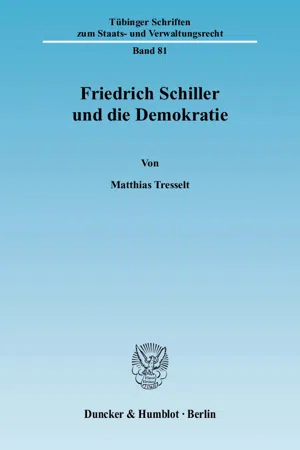
Friedrich Schiller und die Demokratie.
Über dieses Buch
The subject of this study is democratic political thought in the dramatic and historiographic opus of Friedrich Schiller (1759–1805). The study situates the references to democracy in Schiller's work against the historical backgrounds of German territorial absolutism and the French Revolution, and evaluates them on the basis of a »modern concept of democracy«. The study is divided into three main chapters. In chapter one, the author shows that Schiller understood, illustrated and called for the »substance« of democracy, i.e. security, self-determination and citizens' rights of individual liberty. Similarly to Humboldt, the author argues, Schiller considered citizens' self-determination to be the origin of individual and cultural progress. The author discusses in detail the significance of individual liberty rights and human rights in Schiller's work, examining in particular the principles of communication and justice in Don Karlos and Maria Stuart. In addition, the author points out parallels to Kant's concept of human dignity. In chapter two, the author asks whether Schiller was familiar with the »structure« of democracy, i.e. with the political equality of citizens. The author advances the opinion that democratic structures are latent in Schiller's work, but are not realised in the modern sense. Schiller, it is argued, considered political equality possible and wished it to materialise as a form of governance for future generations. However, democracy for Schiller was possible only under certain prerequisites. In demonstrating this, the author distinguishes between legal prerequisites (representation, independence of the citizens and members of parliament) and ethical prerequisites (political maturity). In chapter three, the author highlights the »universality« of democracy, i.e. the references to European and international law in Schiller's work. The author concludes that Schiller was a European thinker who apprehended the protection of civic liberty, particularly freedom of religion, as the core of a European identity. Moreover, Schiller spoke in support of peace in Europe and a balance of power between the European states. The author argues that ultimately, Schiller followed Hugo Grotius in advocating a humanitarian form of international law.
Information
Inhaltsverzeichnis
- Vorwort
- Inhaltsverzeichnis
- Einleitung
- 1. Kapitel: Die Substanz der Demokratie: Sicherheit, Selbstbestimmung und Menschenrechte
- 2. Kapitel: Die Struktur der Demokratie: Möglichkeiten, Voraussetzungen und Durchsetzung
- 3. Kapitel: Die Universalität der Demokratie: Europäertum und Völkerrechtsdenken
- Schluss: Zusammenfassung, Würdigung und Ausblick
- Literaturverzeichnis
- Sachverzeichnis
375,005 Studierende vertrauen auf uns
Zugang zu über 1,5 Millionen Titeln zu einem fairen monatlichen Preis.
Mit unseren Lerntools kannst du noch effizienter lernen.
Häufig gestellte Fragen
Ja, du kannst dein Abo jederzeit über den Tab Abo in deinen Kontoeinstellungen auf der Perlego-Website kündigen. Dein Abo bleibt bis zum Ende deines aktuellen Abrechnungszeitraums aktiv. Erfahre, wie du dein Abo kündigen kannst
Nein, Bücher können nicht als externe Dateien, z. B. PDFs, zur Verwendung außerhalb von Perlego heruntergeladen werden. Du kannst jedoch Bücher in der Perlego-App herunterladen, um sie offline auf deinem Smartphone oder Tablet zu lesen. Erfahre, wie du Bücher herunterladen kannst, um sie offline zu lesen
Perlego bietet zwei Pläne an: Essential und Complete
- Essential ist ideal für Lernende und Fachkräfte, die es genießen, eine Vielzahl von Themen zu erkunden. Greife auf die Essential Library mit über 800.000 vertrauenswürdigen Titeln und Bestsellern in den Bereichen Wirtschaft, persönliche Weiterentwicklung und Geisteswissenschaften zu. Enthält unbegrenzte Lesezeit und Standard-Vorlesestimme.
- Complete: Perfekt für fortgeschrittene Lernende und Forschende, die vollen, uneingeschränkten Zugriff benötigen. Entsperre über 1,5 Millionen Bücher zu Hunderten von Themen, einschließlich akademischen und spezialisierten Titeln. Der Complete-Plan enthält außerdem fortschrittliche Funktionen wie Premium Vorlesen und Forschungsassistent.
Wir sind ein Online-Lehrbuch-Abonnement-Service, bei dem du für weniger als den Preis eines einzelnen Buchs pro Monat Zugriff auf eine gesamte Online-Bibliothek erhältst. Bei über 1,5 Millionen Büchern zu mehr als 990 Themen bist du bestens versorgt! Erfahre mehr über unsere Mission
Achte auf das Symbol zum Vorlesen bei deinem nächsten Buch, um zu sehen, ob du es dir auch anhören kannst. Bei diesem Tool wird dir Text laut vorgelesen, wobei der Text beim Vorlesen auch grafisch hervorgehoben wird. Du kannst das Vorlesen jederzeit anhalten, beschleunigen und verlangsamen. Erfahre mehr über die Funktion „Vorlesen“
Ja! Du kannst die Perlego-App sowohl auf iOS- als auch auf Android-Geräten nutzen, damit du jederzeit und überall lesen kannst – sogar offline. Perfekt für den Weg zur Arbeit oder wenn du unterwegs bist.
Bitte beachte, dass wir Geräte, auf denen die Betriebssysteme iOS 13 und Android 7 oder noch ältere Versionen ausgeführt werden, nicht unterstützen können. Mehr über die Verwendung der App erfahren
Bitte beachte, dass wir Geräte, auf denen die Betriebssysteme iOS 13 und Android 7 oder noch ältere Versionen ausgeführt werden, nicht unterstützen können. Mehr über die Verwendung der App erfahren
Ja, du kannst auf Friedrich Schiller und die Demokratie. von Matthias Tresselt im PDF- und/oder ePUB-Format sowie auf andere beliebte Bücher in Politik & Internationale Beziehungen & Politischer Prozess zugreifen. In unserem Katalog stehen über 1,5 Millionen Bücher zur Verfügung.