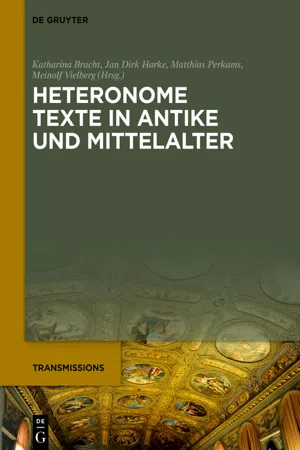
Heteronome Texte
eBook - ePub

Heteronome Texte

Kommentierende und tradierende Literatur in Antike und Mittelalter

  1. 277 Seiten
  2. German
  3. ePUB (handyfreundlich)
  4. Über iOS und Android verfügbar
eBook - ePub

Heteronome Texte

Kommentierende und tradierende Literatur in Antike und Mittelalter

Über dieses Buch

The peer-reviewed series Transmissions aims to constitute a space for documentation, theoretical and methodological reflection and critical discussion on the transmission of texts. The focus is on textual production in Greek and Latin, while remaining open to comparisons with the dynamics of transmission in the graphic and textual production of other cultures and languages, especially in the cases where the latter function as vehicles for the transmission of Greek and Latin texts. The series hosts studies on the various aspects of conservation and transformation, in all their manifold processes, from antiquity to the modern period. Its concern is above all with the material factors and practices of use and reception of texts and their physical supports, with the aim of reconstructing the cultural and social history that serves as a foundation for their transmission. The scope of reflection is thus the itineraries of texts, books and book collections, with particular attention to the role of the actors and institutions that participate in these dynamics, leading towards a phenomenology and theory of the processes of transmission.

The series responds to an increasing critical awareness, and to the search for theoretical systematisation in the field of the transmission of ancient texts. In the most recent research, alongside the philological approach to the text, an attention to the technical-material aspects of transmission has become widespread, and so also to the editorial and historical-cultural fortunes of the textual product right from antiquity itself, in the eastern and western Middle Ages and the whole of European humanism, up to the modern period. The philological approach to the book, with the observation of the physical signs of the material support, is ever more central to the investigation of texts, to the reconstruction of the paths taken by books and to a historical contextualisation of their use, in the need to tie the text to the fortunes of its vehicle. Increasingly conscious attention is being given to the transitions and arrivals of texts and books in different cultural and cultural-linguistic contexts, with their dynamics of confrontation and adaptation, resulting in new material outcomes of textual production, for example translations and commentaries, paraphrases, abbreviations and anthologisations.

In general, there is a strong need to trace the social and cultural environments and scenarios in which the journeys of books and texts occur, by observing morphological shifts and ways of use both in textual products and in their material witnesses, and so also in the role of the actors in the practices of writing and reading – scribes, readers, scholars, humanists – and of institutions – schools, universities, public and private libraries – in the production, circulation and conservation processes of written culture. These are Transmissions, thus, not only of texts, but also of praxeis, of books and of collections of books, in the encounter between cultures.

Transmissions publishes monographs, edited volumes and critical editions with commentary of texts which are particularly relevant for the study of the dynamics of textual transmission. The preferred language of publication is English, but German, Italian, and French are also accepted.

Series Editor:

Rosa Maria Piccione (Università di Torino)

Advisory Board:

Rodney Ast (Universität Heidelberg); Daniele Bianconi (Sapienza Università di Roma); Caterina Carpinato (Università Ca' Foscari Venezia); Paolo Eleuteri (Università Ca' Foscari Venezia); Gerlinde Huber-Rebenich (Universität Bern); Juan Pedro Monferrer (Universidad de Cordoba); Raphaële Mouren (Warburg Institute-University of London); Matthias Perkams (Universität Jena); Elisabetta Sciarra (Biblioteca Nazionale Marciana); Sofia Torallas Tovar (University of Chicago)

375,005 Studierende vertrauen auf uns

Zugang zu über 1 Million Titeln zu einem fairen monatlichen Preis.

Mit unseren Lerntools kannst du noch effizienter lernen.

Information

Jahr
2021
eBook-ISBN:
9783110733778

Inhaltsverzeichnis

  1. Title Page
  2. Copyright
  3. Contents
  4. Vorwort
  5. Heteronome Texte: Kommentierende und tradierende Literatur in Antike und Mittelalter.Einleitung
  6. Die Geburt einer Gattung: Die Pescharim von Qumran
  7. Juristische Kommentare in der Prinzipatszeit: Zu Begriff und Funktion einer Literaturgattung anhand des Beispiels furtum (Diebstahl)
  8. Ein Liebesdrama als Allegorie: Origenes als Bibelkommentator am Beispiel seines Kommentars zum Hohelied
  9. Ein römisches Schulbuch und der Wissenshorizont römischer Eliten: Der Horazkommentar des Porphyrio
  10. Die methodischen Grundlagen neuplatonischer Literaturinterpretation: Proklos’ Theorie der Dichtungsarten
  11. Alchemie, Astrologie und Divination: Die Vielfalt antiker Wissensformen in der medizinischen Literatur der Syrer
  12. Philosophie nach Format: Vermittlung aus dem Griechischen und Aneignung im Arabischen
  13. Das Recht als „Schatzhaus“: Traditionslinien des juristischen Kommentars im Mittelalter
  14. Kommentieren als Philosophieren: Die Aristoteles-Kommentare von Albertus Magnus
  15. Rettung einer Apokalypse: Die apokryphe Leiter Jakobs im Kontext der kirchenslavischen Kommentierten Paleja
  16. Verzeichnis der Abbildungen
  17. Sachregister
  18. Register antiker und moderner Personen und ihrer Werke
  19. Stellenregister

Häufig gestellte Fragen

Ja, du kannst dein Abo jederzeit über den Tab Abo in deinen Kontoeinstellungen auf der Perlego-Website kündigen. Dein Abo bleibt bis zum Ende deines aktuellen Abrechnungszeitraums aktiv. Erfahre, wie du dein Abo kündigen kannst
Nein, Bücher können nicht als externe Dateien, z. B. PDFs, zur Verwendung außerhalb von Perlego heruntergeladen werden. Du kannst jedoch Bücher in der Perlego-App herunterladen, um sie offline auf deinem Smartphone oder Tablet zu lesen. Erfahre, wie du Bücher herunterladen kannst, um sie offline zu lesen
Perlego bietet zwei Abopläne an: Elementar und Erweitert
  • Elementar ist ideal für Lernende und Profis, die sich mit einer Vielzahl von Themen beschäftigen möchten. Erhalte Zugang zur Basic-Bibliothek mit über 800.000 vertrauenswürdigen Titeln und Bestsellern in den Bereichen Wirtschaft, persönliche Weiterentwicklung und Geisteswissenschaften. Enthält unbegrenzte Lesezeit und die Standardstimme für die Funktion „Vorlesen“.
  • Pro: Perfekt für fortgeschrittene Lernende und Forscher, die einen vollständigen, uneingeschränkten Zugang benötigen. Schalte über 1,4 Millionen Bücher zu Hunderten von Themen frei, darunter akademische und hochspezialisierte Titel. Das Pro-Abo umfasst auch erweiterte Funktionen wie Premium-Vorlesen und den Recherche-Assistenten.
Beide Abopläne sind mit monatlichen, halbjährlichen oder jährlichen Abrechnungszyklen verfügbar.
Wir sind ein Online-Lehrbuch-Abo, bei dem du für weniger als den Preis eines einzelnen Buches pro Monat Zugang zu einer ganzen Online-Bibliothek erhältst. Mit über 1 Million Büchern zu über 990 verschiedenen Themen haben wir bestimmt alles, was du brauchst! Erfahre mehr über unsere Mission
Achte auf das Symbol zum Vorlesen bei deinem nächsten Buch, um zu sehen, ob du es dir auch anhören kannst. Bei diesem Tool wird dir Text laut vorgelesen, wobei der Text beim Vorlesen auch grafisch hervorgehoben wird. Du kannst das Vorlesen jederzeit anhalten, beschleunigen und verlangsamen. Erfahre mehr über die Funktion „Vorlesen“
Ja! Du kannst die Perlego-App sowohl auf iOS- als auch auf Android-Geräten nutzen, damit du jederzeit und überall lesen kannst – sogar offline. Perfekt für den Weg zur Arbeit oder wenn du unterwegs bist.
Bitte beachte, dass wir Geräte, auf denen die Betriebssysteme iOS 13 und Android 7 oder noch ältere Versionen ausgeführt werden, nicht unterstützen können. Mehr über die Verwendung der App erfahren
Ja, du hast Zugang zu Heteronome Texte von Katharina Bracht, Jan Dirk Harke, Matthias Perkams, Meinolf Vielberg, Katharina Bracht,Jan Dirk Harke,Matthias Perkams,Meinolf Vielberg im PDF- und/oder ePub-Format sowie zu anderen beliebten Büchern aus Literature & Ancient & Classical Literary Criticism. Aus unserem Katalog stehen dir über 1 Million Bücher zur Verfügung.