The series European-Jewish Studies reflects the international network and competence of the Moses Mendelssohn Center for European Jewish studies (MMZ). Thanks to the highly interdisciplinary character of the series, which is edited in collaboration with the Selma Stern Center for Jewish Studies Berlin-Brandenburg, particular emphasis is placed on the way in which history, the humanities and cultural sciences approach the subject, as well as on fundamental intellectual, political and religious questions that inspire Jewish life and thinking today, and have influenced it in the past.
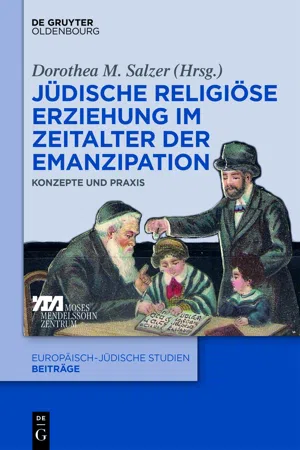
eBook - ePub
Jüdische religiöse Erziehung im Zeitalter der Emanzipation
Konzepte und Praxis
- 291 Seiten
- German
- ePUB (handyfreundlich)
- Über iOS und Android verfügbar
eBook - ePub
Über dieses Buch
Information
Thema
HistoryThema
History of EducationUnterhaltende Kinder- und Jugendliteratur als Mittel der religiösen Unterweisung
Robinson der Jüngere in the Service of the Haskalah: Joachim Heinrich Campe, the Haskalah and the “Bildung” Project in Jewish Society
Zohar Shavit
Note: This article was written in the framework of a DFG funded research project: “Innovation durch Tradition? Jüdische Bildungsmedien als Zugang zum Wandel kultureller Ordnungen während der ‘Sattelzeit’” run together with Prof. Simone Lässig of the German Historical Institute, Washington D.C. I would like to thank Prof. Lässig for her cooperation and advice and I would like to deeply thank M. Engel, Irit Halavy, Irad ben Isaak, Ido Peled, and Ran Kalderon for their precious and indispensable help in the intricate work of writing this essay.
What does a Jewish Maskil, unhappy about the poor state of Jewish education and residing in a province relatively far from the cultural center of Berlin, do to remedy the situation? A typical answer can be found in Haskalah literature of the early nineteenth century, in David Samosc’s (1789 – 1864) 1824 Hebrew translation of Joachim Heinrich Campe’s Robinson der Jüngere titled Robinson der Jüngere. Ein Lesebuch für Kinder (the book cover and title appeared in German transliterated into Hebrew letters; the language of the text itself was entirely Hebrew).1 This translation demonstrates both the familiarity of members of the Haskalah movement – even those in the provinces – with contemporary German literature, and their use of translations as a tool to disseminate their ideas and ideals within the Jewish community. The ideas in this case were the Philanthropinist movement’s approaches to education; David Samosc’s translation was designed to provide teachers and parents (primarily fathers) with a text they could use to impart a new set of values to children, thereby generating change in Jewish society and its culture in the German-speaking parts of Europe.
This article will examine the circumstances that led to Samosc’s translation of Robinson der Jüngere, an internationally renowned bestseller. Its author, Joachim Heinrich Campe (1746−1818), was among the most prominent writers of the Philanthropinist movement and had personal contacts among the Maskilim; his Robinson was considered the text that most clearly expressed the values of Philanthropinism. My study of Samosc’s translation will focus on how he utilized Campe’s status among the Maskilim to embed Philanthropinist approaches to education in Jewish literature; how he used his translation as a platform for imparting the values of “Bildung” to the Jewish communities of German-speaking areas of Europe; and how he leveraged his translation to introduce civil society, the values of “Bildung”, and the bourgeois family model to Jews – all this in the context of the relationship between the Haskalah and Philanthropinism in general and with Joachim Heinrich Campe in particular. This article will also compare later translations of Robinson that were based on a different worldview than Samosc’s, in order to better illustrate the objectives of his own work.
In previous articles I have demonstrated how Maskilim used translated texts to present Jewish society with an alternative habitus;2 by embedding in those overt or implied instructions regarding everyday practices. This article will describe how Maskilim employed translation to put forth their ideal model for Jewish society – one which deviated from tradition and was based on the values of the German bourgeoisie, particularly in terms of familial relations, “Bildung”, vocational training and relations with non-Jews.
David Samosc’s translation was part of a major Maskilic project that emerged toward the late eighteenth century of publishing books for Jewish children and young adults. These books voiced the change that the Haskalah movement was trying to engender in Jewish communities, among other things by establishing a network of schools whose pedagogical approach embraced Philanthropinist values – albeit filtered through their own Maskilic interpretation. The Maskilim sought to become part of bourgeois civil society and to reform Jewish society via the dissemination of “Bildung” values, in the spirit of Christian Wilhelm von Dohm’s3 recommendation that Jews be granted equal civil rights provided that they adopt “Bildung” values and the behavioral codes of civil society’s bourgeoisie (Bürgertum). The Maskilim understood that adopting such values would open up new horizons for Jews’ integration into non-Jewish bourgeois society, where one was judged by his ability to acquire independent status by attaining a profession, a broad education, and financial and cultural capital. The line separating the bourgeoisie from other socioeconomic strata was shaped by a unique bourgeois self-consciousness, cultural model, and ways of life.4 This Bürgerlichkeit was manifested in “individuelle Leistung, Arbeit und Arbeitsethos, Neigung zu rationaler Lebensführung, Selbständigkeit, Selbstorganisation, Bildung, ästhetisches Verhältnis zur Hochkultur, ein Familienideal, symbolische Alltagsformen (Tischsitten, Kleidung, Konventionen) etc. – und ‘vielleicht’ auch politische Werte wie ein ‘Minimum an liberalen Tugenden’”.5
Embracing bourgeois values eased – and in fact made possible – Jews’ integration into German speaking society. Their emancipation, as opposed, for example, to that of the Jews in France, was conditional. Whereas French Jews could decide for themselves what to make of their emancipation, the Edict of Tolerance, passed in 1782 in the Habsburg empire, demanded a prolonged preliminary process for Jews if they wished to earn emancipation.6 Jews could enjoy equal (albeit limited) rights if they proved they had acquired “Bildung”. In other words, emancipation meant adopting the German bourgeoisie’s Enlightenment ideals: its unique social ethos, its rules of “Sittlichkeit”, and its customs and etiquette.
Scholars have provided different answers to the question of how Jews adopted bourgeois values. Some, like Shulamit Volkov,7 believe it involved a two-stage process that relied on Jews having first achieved economic prosperity. Others, like Simone Lässig,8 argue the opposite: that Jews began acquiring a secular education and adopting the daily practices of the German bourgeoisie at an earlier rather than later stage of the process of entering that stratum; in other words, the “Bildung” that they acquired then enabled them to improve th...
Inhaltsverzeichnis
- Title Page
- Copyright
- Contents
- Wie aus Kindern Juden werden. Religiöse Erziehung im Judentum vor dem Hintergrund von Aufklärung und Emanzipation
- Christliche Konzepte der religiösen Unterweisung
- Jüdische Konzepte der religiösen Unterweisung
- Jüdische Lehrbücher
- Unterhaltende Kinder- und Jugendliteratur als Mittel der religiösen Unterweisung
- Über die Autorinnen und Autoren
- Personenregister
375,005 Studierende vertrauen auf uns
Zugang zu über 1,5 Millionen Titeln zu einem fairen monatlichen Preis.
Mit unseren Lerntools kannst du noch effizienter lernen.
Häufig gestellte Fragen
Ja, du kannst dein Abo jederzeit über den Tab Abo in deinen Kontoeinstellungen auf der Perlego-Website kündigen. Dein Abo bleibt bis zum Ende deines aktuellen Abrechnungszeitraums aktiv. Erfahre, wie du dein Abo kündigen kannst
Nein, Bücher können nicht als externe Dateien, z. B. PDFs, zur Verwendung außerhalb von Perlego heruntergeladen werden. Du kannst jedoch Bücher in der Perlego-App herunterladen, um sie offline auf deinem Smartphone oder Tablet zu lesen. Erfahre, wie du Bücher herunterladen kannst, um sie offline zu lesen
Perlego bietet zwei Pläne an: Essential und Complete
- Essential ist ideal für Lernende und Fachkräfte, die es genießen, eine Vielzahl von Themen zu erkunden. Greife auf die Essential Library mit über 800.000 vertrauenswürdigen Titeln und Bestsellern in den Bereichen Wirtschaft, persönliche Weiterentwicklung und Geisteswissenschaften zu. Enthält unbegrenzte Lesezeit und Standard-Vorlesestimme.
- Complete: Perfekt für fortgeschrittene Lernende und Forschende, die vollen, uneingeschränkten Zugriff benötigen. Entsperre über 1,5 Millionen Bücher zu Hunderten von Themen, einschließlich akademischen und spezialisierten Titeln. Der Complete-Plan enthält außerdem fortschrittliche Funktionen wie Premium Vorlesen und Forschungsassistent.
Wir sind ein Online-Lehrbuch-Abonnement-Service, bei dem du für weniger als den Preis eines einzelnen Buchs pro Monat Zugriff auf eine gesamte Online-Bibliothek erhältst. Bei über 1,5 Millionen Büchern zu mehr als 990 Themen bist du bestens versorgt! Erfahre mehr über unsere Mission
Achte auf das Symbol zum Vorlesen bei deinem nächsten Buch, um zu sehen, ob du es dir auch anhören kannst. Bei diesem Tool wird dir Text laut vorgelesen, wobei der Text beim Vorlesen auch grafisch hervorgehoben wird. Du kannst das Vorlesen jederzeit anhalten, beschleunigen und verlangsamen. Erfahre mehr über die Funktion „Vorlesen“
Ja! Du kannst die Perlego-App sowohl auf iOS- als auch auf Android-Geräten nutzen, damit du jederzeit und überall lesen kannst – sogar offline. Perfekt für den Weg zur Arbeit oder wenn du unterwegs bist.
Bitte beachte, dass wir Geräte, auf denen die Betriebssysteme iOS 13 und Android 7 oder noch ältere Versionen ausgeführt werden, nicht unterstützen können. Mehr über die Verwendung der App erfahren
Bitte beachte, dass wir Geräte, auf denen die Betriebssysteme iOS 13 und Android 7 oder noch ältere Versionen ausgeführt werden, nicht unterstützen können. Mehr über die Verwendung der App erfahren
Ja, du kannst auf Jüdische religiöse Erziehung im Zeitalter der Emanzipation von Dorothea M. Salzer im PDF- und/oder ePUB-Format sowie auf andere beliebte Bücher in History & History of Education zugreifen. In unserem Katalog stehen über 1,5 Millionen Bücher zur Verfügung.