eBook - PDF
Staatssicherheit und KSZE-Prozess
MfS zwischen SED und KGB (1972–1989)
- 765 Seiten
- German
- PDF
- Über iOS und Android verfügbar
eBook - PDF
Über dieses Buch
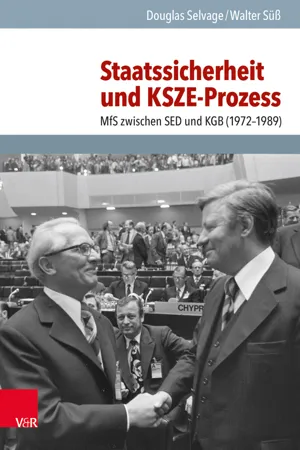
The book analyzes the role, activities and influence of the East German Ministry of State Security (MfS or Stasi) not only in connection with the Conference for Security and Cooperation in Europe (CSCE) and its follow-up conferences (i. e., the "CSCE Process"), but also in terms of limiting its influence upon East German society in terms of improved human rights and increased human contacts between East and West. On the one hand, the MfS supported the hard line of the East German party and state leadership in the CSCE process – also, when necessary, in opposition to the Soviet Union. On the other hand, the MfS supported Moscow's demands – also communicated by its "fraternal organ", the KGB – that the East German leadership should conduct a policy of strict "delimitation" (Abgrenzung) with regard to West Germany in order to seal Germany's division. In general, Minister of State Security Erich Mielke supported the hardest possible line toward West Germany, whether as a representative of the East German Party leadership with regard to Moscow or as a supporter of Moscow's hard line for the GDR towards West Germany within the SED regime. However, the economic weakness of the GDR and the Soviet Union, further exacerbated by the arms race with NATO and especially the U.S. in the 1980's, led to concessions by both regimes to the West both within and outside of the CSCE process that further limited the possibilities of the MfS in terms of repressing East German dissidents. More importantly, this was also the case with regard to the growing movement to emigrate from the GDR to West Germany that had developed in response to the GDR's signing of the CSCE Final Act in Helsinki in August 1975. In the end, the Stasi, which had always been a "servant of two masters" – i. e. the East German Party and the Soviet Union, represented by the KGB – could no longer keep the domestic effects arising from the CSCE process and détente under control because of the concessions of its two erstwhile "masters" to the West.
Information
Inhaltsverzeichnis
- Cover
- Title Page
- Copyright
- Table of Contents
- Body
- 1. Einleitung [DS]
- 2. Der KGB, das MfS und die Entspannungspolitik, 1969–1975 [DS/WS]
- 3. Die Sowjetunion, die DDR und der Kampf um die Auslegung der KSZE-Schlussakte [DS]
- 4. Die DDR, die deutsche Frage und der KSZE-Prozess [DS]
- 5. Das Belgrader Treffen (1977–1978): Menschenrechte, Korb III, Friedensoffensive [DS]
- 6. Madrider Folgetreffen (1980–1983): Korb III, Friedensoffensive und Menschenrechte [DS]
- 7. Das Madrider Abschlussdokument, die Ausreisebewegung und die Milliardenkredite 1983 bis 1985 [DS]
- 8. Fehlgeschlagene Friedensoffensive: Euromissiles, die Stockholmer Konferenz und westliche Friedensbewegungen, 1983 bis 1985 [DS] L
- 9. Expertentreffen zu Menschenrechtsfragen [WS]
- 10. Vorbereitungen und Beginn der Wiener Folgekonferenz [WS]
- 11. Sowjetischer Positionswandel, Beginn politischer Reformen und die Taktik der Warschauer-Pakt-Staaten in der KSZE [WS]
- 12. Abschlussverhandlungen in Wien [WS]
- 13. Nach Wien [WS]
- 14. Schlussbetrachtung [DS]
- Anhang
- Danksagung
- Angaben zu den Autoren
375,005 Studierende vertrauen auf uns
Zugang zu über 1,5 Millionen Titeln zu einem fairen monatlichen Preis.
Mit unseren Lerntools kannst du noch effizienter lernen.
Häufig gestellte Fragen
Ja, du kannst dein Abo jederzeit über den Tab Abo in deinen Kontoeinstellungen auf der Perlego-Website kündigen. Dein Abo bleibt bis zum Ende deines aktuellen Abrechnungszeitraums aktiv. Erfahre, wie du dein Abo kündigen kannst
Nein, Bücher können nicht als externe Dateien, z. B. PDFs, zur Verwendung außerhalb von Perlego heruntergeladen werden. Du kannst jedoch Bücher in der Perlego-App herunterladen, um sie offline auf deinem Smartphone oder Tablet zu lesen. Erfahre, wie du Bücher herunterladen kannst, um sie offline zu lesen
Perlego bietet zwei Pläne an: Essential und Complete
- Essential ist ideal für Lernende und Fachkräfte, die es genießen, eine Vielzahl von Themen zu erkunden. Greife auf die Essential Library mit über 800.000 vertrauenswürdigen Titeln und Bestsellern in den Bereichen Wirtschaft, persönliche Weiterentwicklung und Geisteswissenschaften zu. Enthält unbegrenzte Lesezeit und Standard-Vorlesestimme.
- Complete: Perfekt für fortgeschrittene Lernende und Forschende, die vollen, uneingeschränkten Zugriff benötigen. Entsperre über 1,5 Millionen Bücher zu Hunderten von Themen, einschließlich akademischen und spezialisierten Titeln. Der Complete-Plan enthält außerdem fortschrittliche Funktionen wie Premium Vorlesen und Forschungsassistent.
Wir sind ein Online-Lehrbuch-Abonnement-Service, bei dem du für weniger als den Preis eines einzelnen Buchs pro Monat Zugriff auf eine gesamte Online-Bibliothek erhältst. Bei über 1,5 Millionen Büchern zu mehr als 990 Themen bist du bestens versorgt! Erfahre mehr über unsere Mission
Achte auf das Symbol zum Vorlesen bei deinem nächsten Buch, um zu sehen, ob du es dir auch anhören kannst. Bei diesem Tool wird dir Text laut vorgelesen, wobei der Text beim Vorlesen auch grafisch hervorgehoben wird. Du kannst das Vorlesen jederzeit anhalten, beschleunigen und verlangsamen. Erfahre mehr über die Funktion „Vorlesen“
Ja! Du kannst die Perlego-App sowohl auf iOS- als auch auf Android-Geräten nutzen, damit du jederzeit und überall lesen kannst – sogar offline. Perfekt für den Weg zur Arbeit oder wenn du unterwegs bist.
Bitte beachte, dass wir Geräte, auf denen die Betriebssysteme iOS 13 und Android 7 oder noch ältere Versionen ausgeführt werden, nicht unterstützen können. Mehr über die Verwendung der App erfahren
Bitte beachte, dass wir Geräte, auf denen die Betriebssysteme iOS 13 und Android 7 oder noch ältere Versionen ausgeführt werden, nicht unterstützen können. Mehr über die Verwendung der App erfahren
Ja, du kannst auf Staatssicherheit und KSZE-Prozess von Douglas Selvage,Walter Süß im PDF- und/oder ePUB-Format sowie auf andere beliebte Bücher in Geschichte & Geschichte des 20. Jahrhunderts zugreifen. In unserem Katalog stehen über 1,5 Millionen Bücher zur Verfügung.