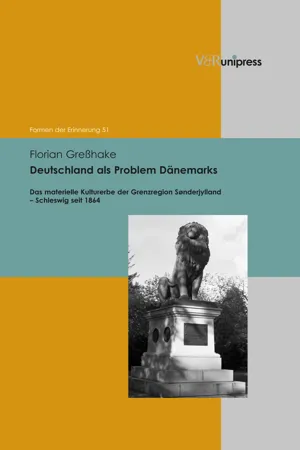
eBook - PDF
Deutschland als Problem Dänemarks
Das materielle Kulturerbe der Grenzregion Sønderjylland – Schleswig seit 1864
- 491 Seiten
- German
- PDF
- Über iOS und Android verfügbar
eBook - PDF
Deutschland als Problem Dänemarks
Das materielle Kulturerbe der Grenzregion Sønderjylland – Schleswig seit 1864
Über dieses Buch
As a result of the concept of nation state the border area Sønderjylland/Schleswig became a central place of conflict between the German and the Danish claims for power national movements in the mid- 19th century, because of that the border area received a central role for the establishment und transmission of collective and identities both north and south of the border.In the context of this problematical history, my thesis asks for the the function of the material cultural heritage in the border conflict. In view of the variable Schleswigean history it is in particular the question of continuity and change in the discussions and practices on the cultural heritage which I am interested in. Furthermore I ask for the protagonists in the field of memory policy and the role of memorial frameworks as they are defined by French sociologist Maurice Halbwachs. This study is hereby structured by the significant turning points and occasions of the border area history. Beginning with the German-Danish War in 1864 the analysed period extends to the present, so that the narratives considering the material cultural heritage can be contextualised within the central historical occasions. In the view of the political changes self-perceptions and images of the "other" were negotiated and modified again and again. In the context of the cultural heritage there are obviously long lasting processes of national in- and exclusion as well as the production of a cultural autonomous Schleswig-Holstein. Because of that the border area Sønderjylland/Schleswig is today a hybrid space between German and Danish cultural influences. The example of the German-Danish border region prove hereby the central significance of the role of supposedly peripheral border areas – the inner peripheries – for the establishment and transmission of national identities and memorial frameworks.
Information
Inhaltsverzeichnis
- Title Page
- Copyright
- Table of Contents
- Body
- Vorwort
- I. Einleitung
- II. Grenzverschiebung I: Das materielle Kulturerbe zwischen regionaler Identität und nationaler Abgrenzung (1864–1920)
- III. Grenzverschiebung II: Das materielle Kulturerbe im kulturellen Grenzkampf (1920–1933)
- IV. Der »nordische Gedanke« und die Grenzfrage (1933–1945)
- V. Das materielle Kulturerbe im Grenzkampf der Nachkriegszeit (1945–1960)
- VI. Das materielle Kulturerbe zwischen nationaler Abgrenzung und europäischer Annäherung (1960–1990)
- VII. Europa und das Kulturerbe der Grenzregionen: Das Beispiel der Region Sønderjylland/Schleswig (1990–…)
- VIII. Fazit
- IX. Quellen- und Literaturverzeichnis
- X. Abbildungsverzeichnis
375,005 Studierende vertrauen auf uns
Zugang zu über 1,5 Millionen Titeln zu einem fairen monatlichen Preis.
Mit unseren Lerntools kannst du noch effizienter lernen.
Häufig gestellte Fragen
Ja, du kannst dein Abo jederzeit über den Tab Abo in deinen Kontoeinstellungen auf der Perlego-Website kündigen. Dein Abo bleibt bis zum Ende deines aktuellen Abrechnungszeitraums aktiv. Erfahre, wie du dein Abo kündigen kannst
Nein, Bücher können nicht als externe Dateien, z. B. PDFs, zur Verwendung außerhalb von Perlego heruntergeladen werden. Du kannst jedoch Bücher in der Perlego-App herunterladen, um sie offline auf deinem Smartphone oder Tablet zu lesen. Erfahre, wie du Bücher herunterladen kannst, um sie offline zu lesen
Perlego bietet zwei Pläne an: Essential und Complete
- Essential ist ideal für Lernende und Fachkräfte, die es genießen, eine Vielzahl von Themen zu erkunden. Greife auf die Essential Library mit über 800.000 vertrauenswürdigen Titeln und Bestsellern in den Bereichen Wirtschaft, persönliche Weiterentwicklung und Geisteswissenschaften zu. Enthält unbegrenzte Lesezeit und Standard-Vorlesestimme.
- Complete: Perfekt für fortgeschrittene Lernende und Forschende, die vollen, uneingeschränkten Zugriff benötigen. Entsperre über 1,5 Millionen Bücher zu Hunderten von Themen, einschließlich akademischen und spezialisierten Titeln. Der Complete-Plan enthält außerdem fortschrittliche Funktionen wie Premium Vorlesen und Forschungsassistent.
Wir sind ein Online-Lehrbuch-Abonnement-Service, bei dem du für weniger als den Preis eines einzelnen Buchs pro Monat Zugriff auf eine gesamte Online-Bibliothek erhältst. Bei über 1,5 Millionen Büchern zu mehr als 990 Themen bist du bestens versorgt! Erfahre mehr über unsere Mission
Achte auf das Symbol zum Vorlesen bei deinem nächsten Buch, um zu sehen, ob du es dir auch anhören kannst. Bei diesem Tool wird dir Text laut vorgelesen, wobei der Text beim Vorlesen auch grafisch hervorgehoben wird. Du kannst das Vorlesen jederzeit anhalten, beschleunigen und verlangsamen. Erfahre mehr über die Funktion „Vorlesen“
Ja! Du kannst die Perlego-App sowohl auf iOS- als auch auf Android-Geräten nutzen, damit du jederzeit und überall lesen kannst – sogar offline. Perfekt für den Weg zur Arbeit oder wenn du unterwegs bist.
Bitte beachte, dass wir Geräte, auf denen die Betriebssysteme iOS 13 und Android 7 oder noch ältere Versionen ausgeführt werden, nicht unterstützen können. Mehr über die Verwendung der App erfahren
Bitte beachte, dass wir Geräte, auf denen die Betriebssysteme iOS 13 und Android 7 oder noch ältere Versionen ausgeführt werden, nicht unterstützen können. Mehr über die Verwendung der App erfahren
Ja, du kannst auf Deutschland als Problem Dänemarks von Florian Greßhake, Jürgen Reulecke, Birgit Neumann, Jürgen Reulecke,Birgit Neumann im PDF- und/oder ePUB-Format sowie auf andere beliebte Bücher in History & History Reference zugreifen. In unserem Katalog stehen über 1,5 Millionen Bücher zur Verfügung.