eBook - PDF
Linguistische Berichte Heft 278
- 123 Seiten
- German
- PDF
- Über iOS und Android verfügbar
eBook - PDF
Linguistische Berichte Heft 278
Über dieses Buch
Beiträge aus Forschung und Anwendung
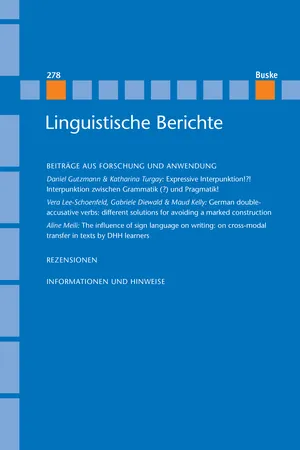
– Daniel Gutzmann & Katharina Turgay: Expressive Interpunktion!?! Interpunktion zwischen Grammatik (?) und Pragmatik!
Abstract: Whereas the use of most punctuation marks is thought to be governed by grammatical rules, some punctuation marks can be used in a more expressive way that rather reflects emotions and/or attitudes of the writer instead of grammatical properties. In this paper, we will discuss the distinction between grammatical and expressive punctuation and suggest that pragmatic punctuation marks exhibit certain features that the more grammatical punctuation marks do not: They are expressive, they can occur rather freely inside a sentence, they can be repeated to intensify their effect, and they can be combined with other expressive punctuation. A comparison of commas and exclamation points illustrates the difference between grammatical and pragmatic punctuation marks. We will investigate the most common punctuation marks with respect to these properties and assign them a place in what may be called the grammar-pragmatics continuum of punctuation. We will conclude with a comparison between expressive punctuation and emojis which can be used to fulfill similar roles and present a case study of the combination "!?!".
– Vera Lee-Schoenfeld, Gabriele Diewald & Maud Kelly: German double-accusative verbs: different solutions for avoiding a marked construction.
Abstract: Extending Lee-Schoenfeld & Diewald's (2017) corpus investigation and formal analysis of 'lehren' ('teach') to the other four German double-accusative verbs, 'abfragen', 'abhören' (both meaning 'quiz/test'), 'kosten' ('cost'), and 'fragen' ('ask'), we show that each verb follows its own individual path to overriding the highly marked ACC > ACC pattern, with the latest usage data revealing notably different results as to the verbs' most typical syntactic patterns, meaning variants, and contextual features. Specifically, we propose that this small group of verbs makes use of three different "strategies" for avoiding the ACC > ACC pattern: (i) change of major valency frame from a ditransitive to a monotransitive pattern ('abhören' and 'abfragen'), (ii) limiting the second object to primarily a clausal or prepositional one ('fragen'), and (iii) semantic diversification / polysemy combined with different preferences as to the valency pattern per meaning ('kosten'). We back up these claims by comparing the usage patterns of the verbs in four time periods between 1800 and 2010 via corpus analyses using DWDS (Digitales Wörterbuch der deutschen Sprache, https://www.dwds.de/). We also present the results of a synchronic search using the German web corpus deTenTen.
– Aline Meili: The influence of sign language on writing: on cross-modal transfer in texts by DHH learners.
Abstract: Literacy is an important competence not only in a scholarly setting, but also for actively taking part in a literate society. For deaf users of a sign language, however, the 'written word' is challenging for the following two reasons. First, signers of a face-to-face, unwritten visual language need to transfer their message into a written modality. Second, as there is no widely accepted standardized written form for signed languages, the code which they must use is that of the written representation of an oral language, which is often a second language (L2) to users of a sign language. The study reported here addresses these challenges with written German data collected from Swiss German Sign Language (DSGS) deaf signers. The variations found in these written German texts are the result not only of second language acquisition processes common to both hearing and deaf L2 learners of German, but also of cross-modal (visual/spatial – acoustic/oral) interferences unique to deaf L2 learners of the oral language.
Information
Inhaltsverzeichnis
- Cover
- Impressum
- Innentitel
- Inhalt
- Beiträge aus Forschung und Anwendung
- Rezensionen
- Informationen und Hinweise
375,005 Studierende vertrauen auf uns
Zugang zu über 1,5 Millionen Titeln zu einem fairen monatlichen Preis.
Mit unseren Lerntools kannst du noch effizienter lernen.
Häufig gestellte Fragen
Ja, du kannst dein Abo jederzeit über den Tab Abo in deinen Kontoeinstellungen auf der Perlego-Website kündigen. Dein Abo bleibt bis zum Ende deines aktuellen Abrechnungszeitraums aktiv. Erfahre, wie du dein Abo kündigen kannst
Nein, Bücher können nicht als externe Dateien, z. B. PDFs, zur Verwendung außerhalb von Perlego heruntergeladen werden. Du kannst jedoch Bücher in der Perlego-App herunterladen, um sie offline auf deinem Smartphone oder Tablet zu lesen. Erfahre, wie du Bücher herunterladen kannst, um sie offline zu lesen
Perlego bietet zwei Pläne an: Essential und Complete
- Essential ist ideal für Lernende und Fachkräfte, die es genießen, eine Vielzahl von Themen zu erkunden. Greife auf die Essential Library mit über 800.000 vertrauenswürdigen Titeln und Bestsellern in den Bereichen Wirtschaft, persönliche Weiterentwicklung und Geisteswissenschaften zu. Enthält unbegrenzte Lesezeit und Standard-Vorlesestimme.
- Complete: Perfekt für fortgeschrittene Lernende und Forschende, die vollen, uneingeschränkten Zugriff benötigen. Entsperre über 1,5 Millionen Bücher zu Hunderten von Themen, einschließlich akademischen und spezialisierten Titeln. Der Complete-Plan enthält außerdem fortschrittliche Funktionen wie Premium Vorlesen und Forschungsassistent.
Wir sind ein Online-Lehrbuch-Abonnement-Service, bei dem du für weniger als den Preis eines einzelnen Buchs pro Monat Zugriff auf eine gesamte Online-Bibliothek erhältst. Bei über 1,5 Millionen Büchern zu mehr als 990 Themen bist du bestens versorgt! Erfahre mehr über unsere Mission
Achte auf das Symbol zum Vorlesen bei deinem nächsten Buch, um zu sehen, ob du es dir auch anhören kannst. Bei diesem Tool wird dir Text laut vorgelesen, wobei der Text beim Vorlesen auch grafisch hervorgehoben wird. Du kannst das Vorlesen jederzeit anhalten, beschleunigen und verlangsamen. Erfahre mehr über die Funktion „Vorlesen“
Ja! Du kannst die Perlego-App sowohl auf iOS- als auch auf Android-Geräten nutzen, damit du jederzeit und überall lesen kannst – sogar offline. Perfekt für den Weg zur Arbeit oder wenn du unterwegs bist.
Bitte beachte, dass wir Geräte, auf denen die Betriebssysteme iOS 13 und Android 7 oder noch ältere Versionen ausgeführt werden, nicht unterstützen können. Mehr über die Verwendung der App erfahren
Bitte beachte, dass wir Geräte, auf denen die Betriebssysteme iOS 13 und Android 7 oder noch ältere Versionen ausgeführt werden, nicht unterstützen können. Mehr über die Verwendung der App erfahren
Ja, du kannst auf Linguistische Berichte Heft 278 von Markus Steinbach,Nina-Kristin Meister,Günther Grewendorf,Arnim von Stechow im PDF- und/oder ePUB-Format sowie auf andere beliebte Bücher in Literatur & Sprachwissenschaft zugreifen. In unserem Katalog stehen über 1,5 Millionen Bücher zur Verfügung.