eBook - PDF
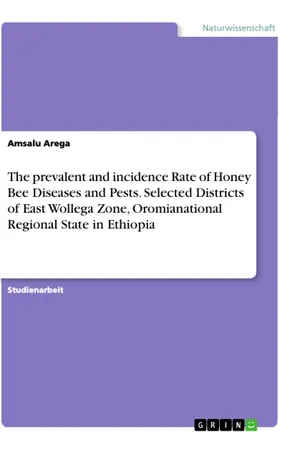
The prevalent and incidence Rate of Honey Bee Diseases and Pests. Selected Districts of East Wollega Zone, Oromianational Regional State in Ethiopia
- 102 Seiten
- German
- PDF
- Über iOS und Android verfügbar
eBook - PDF
The prevalent and incidence Rate of Honey Bee Diseases and Pests. Selected Districts of East Wollega Zone, Oromianational Regional State in Ethiopia
Über dieses Buch
Studienarbeit aus dem Jahr 2018 im Fachbereich Biologie - Krankheiten, Gesundheit, Ernährung, , Sprache: Deutsch, Abstract: The study was conducted in East Wollega Zone, Oromia Regional State, Ethiopia, from December, 2016 up to August, 2017 to determine the prevalent and incidence rate of honeybee disease and pests. Questionnaire survey and laboratory diagnostic methods were used for the study. The questionnaire was administered to 146 beekeepers (97,1% males)and two honeybee colony samples from each beekeeper totally (292 honeybee colonies) were collected from transitional and frame box hives for laboratory diagnosis.
The honeybee samples collected were examined in laboratory for the prevalent and incidence rate of honeybee disease pathogens and pests. Majority of the respondents started beekeeping after 2010 (28.03%) by catching colonies as honey bee colony source (54.8%). The major dearth period of the area was late march to early may. The trend of beekeeping in the study area was shifting from traditional to modern beekeeping and the trend of honeybee colony and its yield was decreasing due to honeybee health problem of the area (pests, predators, pathogenic disease, high cost of bee equipment and agro-chemical application).
In the study area the major pests and predators considered as challenges were ants, beetles, wax moth, varroa destructor and some predators like honey badgers, bee eater birds, dead head hawks moth, lizards, wasps and birds respectively. Varroa, Nosema, Amoeba and chalk brood disease were confirmed while tracheal mite, stone brood, Ameriacan and Europian foul brood did not confirmed during the study period. The prevalentand incidence of varroa destructor was higher in dry season than wet season while the prevalent/incidence rate of nosema and chalk brood disease was limited during dry season. Amoeba disease was distributed in both seasons.For the reason of time restraint in this study area, farther study on economic threshold of honeybee disease and pests is suggested by monitoring throughout the year.
Information
Thema
BiowissenschaftenThema
PhysiologieInhaltsverzeichnis
375,005 Studierende vertrauen auf uns
Zugang zu über 1,5 Millionen Titeln zu einem fairen monatlichen Preis.
Mit unseren Lerntools kannst du noch effizienter lernen.
Häufig gestellte Fragen
Ja, du kannst dein Abo jederzeit über den Tab Abo in deinen Kontoeinstellungen auf der Perlego-Website kündigen. Dein Abo bleibt bis zum Ende deines aktuellen Abrechnungszeitraums aktiv. Erfahre, wie du dein Abo kündigen kannst
Nein, Bücher können nicht als externe Dateien, z. B. PDFs, zur Verwendung außerhalb von Perlego heruntergeladen werden. Du kannst jedoch Bücher in der Perlego-App herunterladen, um sie offline auf deinem Smartphone oder Tablet zu lesen. Erfahre, wie du Bücher herunterladen kannst, um sie offline zu lesen
Perlego bietet zwei Pläne an: Essential und Complete
- Essential ist ideal für Lernende und Fachkräfte, die es genießen, eine Vielzahl von Themen zu erkunden. Greife auf die Essential Library mit über 800.000 vertrauenswürdigen Titeln und Bestsellern in den Bereichen Wirtschaft, persönliche Weiterentwicklung und Geisteswissenschaften zu. Enthält unbegrenzte Lesezeit und Standard-Vorlesestimme.
- Complete: Perfekt für fortgeschrittene Lernende und Forschende, die vollen, uneingeschränkten Zugriff benötigen. Entsperre über 1,5 Millionen Bücher zu Hunderten von Themen, einschließlich akademischen und spezialisierten Titeln. Der Complete-Plan enthält außerdem fortschrittliche Funktionen wie Premium Vorlesen und Forschungsassistent.
Wir sind ein Online-Lehrbuch-Abonnement-Service, bei dem du für weniger als den Preis eines einzelnen Buchs pro Monat Zugriff auf eine gesamte Online-Bibliothek erhältst. Bei über 1,5 Millionen Büchern zu mehr als 990 Themen bist du bestens versorgt! Erfahre mehr über unsere Mission
Achte auf das Symbol zum Vorlesen bei deinem nächsten Buch, um zu sehen, ob du es dir auch anhören kannst. Bei diesem Tool wird dir Text laut vorgelesen, wobei der Text beim Vorlesen auch grafisch hervorgehoben wird. Du kannst das Vorlesen jederzeit anhalten, beschleunigen und verlangsamen. Erfahre mehr über die Funktion „Vorlesen“
Ja! Du kannst die Perlego-App sowohl auf iOS- als auch auf Android-Geräten nutzen, damit du jederzeit und überall lesen kannst – sogar offline. Perfekt für den Weg zur Arbeit oder wenn du unterwegs bist.
Bitte beachte, dass wir Geräte, auf denen die Betriebssysteme iOS 13 und Android 7 oder noch ältere Versionen ausgeführt werden, nicht unterstützen können. Mehr über die Verwendung der App erfahren
Bitte beachte, dass wir Geräte, auf denen die Betriebssysteme iOS 13 und Android 7 oder noch ältere Versionen ausgeführt werden, nicht unterstützen können. Mehr über die Verwendung der App erfahren
Ja, du kannst auf The prevalent and incidence Rate of Honey Bee Diseases and Pests. Selected Districts of East Wollega Zone, Oromianational Regional State in Ethiopia von Amsalu Arega im PDF- und/oder ePUB-Format sowie auf andere beliebte Bücher in Biowissenschaften & Physiologie zugreifen. In unserem Katalog stehen über 1,5 Millionen Bücher zur Verfügung.