eBook - ePub
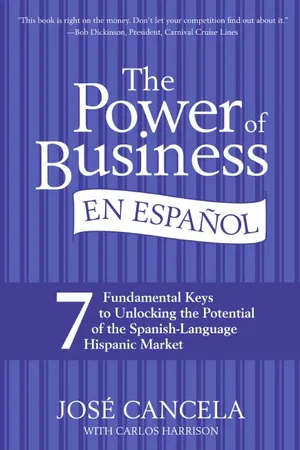
The Power of Business en Espanol
7 Fundamental Keys to Unlocking the Potential of the Spanish-Language Hispanic Market
- 224 páginas
- Spanish
- ePUB (apto para móviles)
- Disponible en iOS y Android
eBook - ePub
The Power of Business en Espanol
7 Fundamental Keys to Unlocking the Potential of the Spanish-Language Hispanic Market
Descripción del libro
Este libro da a los lectores las claves simples para entender a la gente, el mercado y la cultura, de cómo hacer frente a muchos dialiects de españoles, a aprender, donde este consumidor español dominante realmente vive y gasta el dinero.
Información
Editorial
HarperCollins EspanolAño
2009ISBN de la versión impresa
9780061234996
9780061234996
ISBN del libro electrónico
9780061749728
Categoría
BusinessCategoría
Consumer BehaviourChapter 6
WE WANT TO BE COURTED IN THE LANGUAGE WE MAKE LOVE IN
Advertisers always look for the hot button. They want to find the trigger point that will make an individual react, to buy the goods or services that are being offered. For Latinos, the first and foremost is language. We want to be courted in the language we make love in.
For some, that’s English. For most of us, it’s español.
This is probably the hottest topic among marketers today: Should I use English or Spanish to reach out?
The answer is both. There’s a place for English in your Hispanic marketing plan, no doubt. But you’ll hit many more Latinos, across the broadest spectrum of young to old, in Spanish. Spanish remains the lingua franca of U.S. Hispanics, no matter where they were born. Four out of five Latinos in this country speak some Spanish. Of those, two out of three prefer it.
That’s out of all the Hispanics in the United States—immigrants, their children, and their children’s children. Of the 38 million or so Latinos over age 5 in the United States, almost 33 million are bilingual or speak Spanish only.
I know it’s hard to believe. But those are census bureau numbers, backed up by studies by the Pew Hispanic Center, Yankelovich, Inc., the Roslow Research Group, Synovate, and Geoscape International, to name a few. Those are some pretty well respected researchers. And they all came up with similar results.
Sure, the percentage of Spanish speakers declines significantly by the time you get to the third generation and beyond. But third-generation Hispanics who don’t speak any Spanish at all are less than 12 percent of the total market. They may be low-hanging fruit, but there’s a heck of a lot of tree you’re missing if you stick to English only.
That’s a bad idea. Ask the networks.
SEEING IS BELIEVING
While ratings for the English-language networks continue to erode, Spanish-language networks are gaining viewers. Univision reported that its prime-time 18–49 audience grew 17 percent in 2005, much more than ABC, NBC, CBS, or Fox.
Univision consistently ranks fifth and often fourth of all broadcast networks in the 18–49 age bracket in prime time. It regularly beats WB and UPN. In 2005, it beat them all on fifty-five nights, placing first among 18-to 34-year-olds.
That’s a demo where the Spanish-language networks are particularly strong and growing. Univision counts 1.4 million of them as regular viewers in prime time. Its prime-time telenovela, Barrera de Amor, premiered with 18-to 34-year-old ratings that were second only to American Idol.
That’s good for the Spanish-language nets, today and tomorrow. Univision knows that today’s 18-to 34-year-olds are tomorrow’s 34-to 49-year-olds. And tomorrow’s 18-to 34-year-olds are more likely to be Hispanic as well. Hispanics are the fastest-growing segment of the population, and more than a third are under 18. And, study after study has shown, they’re more likely to hold on to their Spanish-language roots.
They’re doing it on their own, and their parents are pushing them to. More than half of the third-generation Latinos, ones whose parents are also U.S.-born, say they want their kids to learn Spanish—even if they don’t speak it themselves. In fact, in a Yankelovich study in 2005, 65 percent of Hispanics said they feel “my native language is an important aspect of my culture and traditions that is important to preserve.” Seven out of ten said the Spanish language is more important to them than it was five years ago.
Caliente Is Hot
Hispanics, like most consumers, make their decisions based on emotions. We may discuss all the logical reasons for buying a sedan or a minivan, but in the end we pick the one we connect with emotionally, the one we “like” the most.
Spanish is our language of emotion. It’s home. Mom. Love. And passion. Make that Passion, with a capital P. English may connect to our brains, but Spanish connects to our hearts. Connect to our hearts and you connect to our pockets. Take it to the bank.
Even if we only speak English, Spanish connects with us on a visceral level. It reaches our roots and brings out a smile. It has the same effect on us that Italian has on Italian-Americans, even fifth-generation ones. Their Italian may be limited to “pass the Parmesan,” but they still perk up an ear when they hear, “Mama mia!” They feel the words “that’s amore” in their souls. “Paisan” rings a potent hereditary bell. It’s a hot button that tells them, “We’re one of you. We know what you like.” It sets off a series of favorable reminders: of home, family, culture.
They don’t know very many words, though. So the words that work are more limited than they are with a fluent Italian speaker. They share a limited dictionary.
The same holds true with Latinos. Spanish connects with our souls—even with those of us who don’t speak very much. We all use the same dictionary, even if it’s a smaller one.
Beck’s beer made the point perfectly with a recent ad. It just showed a bottle and the words: Vives en inglés. Pero sientes en español. You live in English. But you feel in Spanish.
Underneath, the tagline added: Así eres. That’s the way you are.
Great lines. And true. Beck’s knows. Spanish connects with Hispanics of every generation.
It also affects our perception of you and your company. Remember the reaction when then-candidate George W. Bush spoke Spanish? It endeared him to us. When we hear you speaking in Spanish, it tells us you noticed us. It tells us you care enough to try. It says you know what’s important to us, and that it’s important to you. That’s important.
Español, Alive and Well
Some say, why bother? They expect Spanish to give way to English as Latinos become increasingly assimilated. They’ve been waiting a long time.
Twenty-five years ago, in the early days of Spanish-language media in this country, everyone talked about Spanish having a ten-year lifespan. We were all going to be out of it, and working for NBC. Here we are twenty-five years later, and people are still talking about it having a ten-year lifespan. And by the way, many in the Hispanic media business are working for NBC, which now owns Telemundo, the country’s second Spanish-language television network.
The reality is that Spanish shows no signs of dying out. In fact, just the opposite. In hard numbers, according to the census, the number of people aged 5 and up who speak a language other than English at home actually increased by 47 percent between 1990 and 2000. Most of them, 59.9 percent, speak Spanish.
And it’s going to continue increasing, every day.
An exclusive study conducted by the Roslow Research Group shows that the number of Spanish-dominant and bilingual Latinos will go up by 45 percent over the next two decades. By 2025, more than 40 million Spanish speakers will live in the United States. That’s another 12.5 million Spanish speakers since 2000—more than the population of Pennsylvania.
It’s not just because of continuing immigration. Unlike other immigrant groups, even third-generation Hispanics continue to speak Spanish in extraordinarily large numbers.
The study based its forecast on a statistical analysis of existing information from the Pew Hispanic Center’s 2004 estimates, the census, and a variety of other sources, along with reasonable assumptions about such factors as future immigration estimates, life expectancy and fertility rates, population aging, and lastly, Spanish-language use by generation/place of birth.
Among the results:
- Fully two-thirds of Hispanics 5 and older will speak Spanish as a first language or as comfortably as they do English twenty years from now.
- On average, 35 percent of third-generation Latinos in the United States speak Spanish.
- The 18-and-older Spanish-speaking population will increase by 53 percent, to 15.2 million by 2025.
- The key 18-to 49-year-old demographic will grow by 7.5 million to include 59 percent of all the Spanish speakers.
- Another 1.5 million will be in the youngest demographic group, the 5-to 17-year-olds.
WE WANT OUR MTV
MTV sees the potential.
The premier youth-oriented network, which practically defined television targeted at 12-to 34-year-olds, launched the bilingual MTV Tr3s network in the fall of 2006. That’s right, bilingual. Pronounced tres, meaning “three” in Spanish, the reformatted and redesigned ...
Índice
- Cover
- Title Page
- Introduction
- Chapter 01
- Chapter 02
- Chapter 03
- Chapter 04
- Chapter 05
- Chapter 06
- Chapter 07
- Conclusion
- Could Not Have Done This Without Them
- Bibliography
- About The Author
- Credits
- Copyright
- About the Publisher
Cuenta con la confianza de 375,005 estudiantes
Acceso a más de 1,5 millones de títulos por un precio mensual justo.
Estudia de forma más eficiente usando nuestras herramientas de estudio.
Preguntas frecuentes
Sí, puedes cancelar tu suscripción en cualquier momento desde la pestaña Suscripción en los ajustes de tu cuenta en el sitio web de Perlego. La suscripción seguirá activa hasta que finalice el periodo de facturación actual. Descubre cómo cancelar tu suscripción
No, los libros no se pueden descargar como archivos externos, como los PDF, para usarlos fuera de Perlego. Sin embargo, puedes descargarlos en la aplicación de Perlego para leerlos sin conexión en el móvil o en una tableta. Descubre cómo descargar libros para leer sin conexión
Somos un servicio de suscripción de libros de texto en línea, donde puedes acceder a toda una biblioteca digital por menos del precio de un solo libro al mes. Con más de 1,5 millones de libros en más de 990 categorías, ¡te tenemos cubierto! Conoce nuestra misión
Busca el símbolo de lectura en voz alta en tu próximo libro para ver si puedes escucharlo. La herramienta de lectura en voz alta lee el texto en voz alta por ti, resaltando el texto a medida que se lee. Puedes pausarla, acelerarla y ralentizarla. Obtén más información sobre la lectura en voz alta
¡Sí! Puedes usar la aplicación de Perlego en dispositivos iOS y Android para leer cuando y donde quieras, incluso sin conexión. Es ideal para cuando vas de un lado a otro o quieres acceder al contenido sobre la marcha.
Ten en cuenta que no será compatible con los dispositivos que se ejecuten en iOS 13 y Android 7 o en versiones anteriores. Obtén más información sobre cómo usar la aplicación
Ten en cuenta que no será compatible con los dispositivos que se ejecuten en iOS 13 y Android 7 o en versiones anteriores. Obtén más información sobre cómo usar la aplicación
Sí, puedes acceder a The Power of Business en Espanol de Jose Cancela,Carlos Harrison en formato PDF o ePub, así como a otros libros populares en Business y Consumer Behaviour. Tenemos más de 1,5 millones de libros disponibles en nuestro catálogo para que explores.