- 204 pages
- French
- ePUB (adapté aux mobiles)
- Disponible sur iOS et Android
eBook - ePub
French Grammar Made Easy
À propos de ce livre
French Grammar Made Easy is the ideal introduction to the basics of French grammar for anyone new to the language or looking to refresh their knowledge.
The Grammar features:
-
- concise and jargon-free explanations supported by examples
-
- exercises throughout to reinforce learning
-
- a "fast-track" option for more advanced learners
-
- a full answer key, making the Grammar ideal for self-study.
French Grammar Made Easy presents the essential patterns and rules of the French language in a clear and accessible manner. It is the ideal Grammar for those wishing to supplement their learning and move beyond the phrasebook level.
Foire aux questions
Oui, vous pouvez résilier à tout moment à partir de l'onglet Abonnement dans les paramètres de votre compte sur le site Web de Perlego. Votre abonnement restera actif jusqu'à la fin de votre période de facturation actuelle. Découvrez comment résilier votre abonnement.
Pour le moment, tous nos livres en format ePub adaptés aux mobiles peuvent être téléchargés via l'application. La plupart de nos PDF sont également disponibles en téléchargement et les autres seront téléchargeables très prochainement. Découvrez-en plus ici.
Perlego propose deux forfaits: Essentiel et Intégral
- Essentiel est idéal pour les apprenants et professionnels qui aiment explorer un large éventail de sujets. Accédez à la Bibliothèque Essentielle avec plus de 800 000 titres fiables et best-sellers en business, développement personnel et sciences humaines. Comprend un temps de lecture illimité et une voix standard pour la fonction Écouter.
- Intégral: Parfait pour les apprenants avancés et les chercheurs qui ont besoin d’un accès complet et sans restriction. Débloquez plus de 1,4 million de livres dans des centaines de sujets, y compris des titres académiques et spécialisés. Le forfait Intégral inclut également des fonctionnalités avancées comme la fonctionnalité Écouter Premium et Research Assistant.
Nous sommes un service d'abonnement à des ouvrages universitaires en ligne, où vous pouvez accéder à toute une bibliothèque pour un prix inférieur à celui d'un seul livre par mois. Avec plus d'un million de livres sur plus de 1 000 sujets, nous avons ce qu'il vous faut ! Découvrez-en plus ici.
Recherchez le symbole Écouter sur votre prochain livre pour voir si vous pouvez l'écouter. L'outil Écouter lit le texte à haute voix pour vous, en surlignant le passage qui est en cours de lecture. Vous pouvez le mettre sur pause, l'accélérer ou le ralentir. Découvrez-en plus ici.
Oui ! Vous pouvez utiliser l’application Perlego sur appareils iOS et Android pour lire à tout moment, n’importe où — même hors ligne. Parfait pour les trajets ou quand vous êtes en déplacement.
Veuillez noter que nous ne pouvons pas prendre en charge les appareils fonctionnant sous iOS 13 ou Android 7 ou versions antérieures. En savoir plus sur l’utilisation de l’application.
Oui, vous pouvez accéder à French Grammar Made Easy par Rosi McNab en format PDF et/ou ePUB ainsi qu'à d'autres livres populaires dans Langues et linguistique et Langue française. Nous disposons de plus d'un million d'ouvrages à découvrir dans notre catalogue.
Informations
1
VERBS
1.1 Talking about doing things
Why verbs first? Because verbs are so important. They are the ‘glue’ that holds a language together. A noun is just the name of something or someone, it can be singular or plural, but a verb is used to tell [or ask] you something. In many languages verbs are ‘codified’ to tell you who or what is doing it or when it happens. In English we usually stick a lot of verbs together: He was running, I would like, Did you know? … but in French they usually add a different ending to the verb. Il courait, je voudrais, vous saviez?
►► If you know what a verb is, go on to 1.1.1.
You use a verb to talk about what someone or something does, is doing, has done or intends to do. A verb is often called a doing word.
To find out if a word is a verb, ask yourself if it is about doing something.
I Which of these words are things you can do?
- run
- jeans
- sleep
- make
- easy
- eat
- under
- blue
- think
- after
Some words can be used as verbs, nouns or adjectives, e.g. play can be a play at the theatre or part of the verb to play.
Ask: Are they ‘doing’ it? If they are, it is a verb.
II Which of the highlighted words are being used as verbs?
- Jason and Lily run a homework club in the church hall.
- They go for a run every morning.
- They both work at the local school.
- After work they go straight to the hall.
- Tonight they are having a meeting to discuss funding.
- They are meeting in the church hall.
- They need more chairs for the children.
- Jason usually chairs the meetings.
- Lily records the proceedings and types them up.
- The records show that they have met three times this year.
1.1.1 What is the infinitive?
►► If you know what the infinitive is, go on to 1.1.2.
When you look up a verb in a dictionary, you will find the infinitive. This is the ‘name’ of the verb.
In English, the infinitive consists of to + verb, e.g. to read, to buy, to travel.
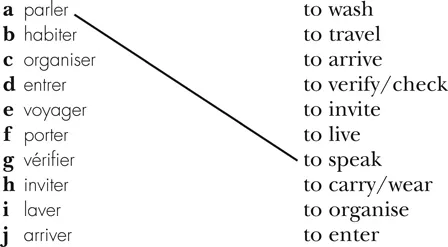
III Here are some French infinitives. You probably know some of them already or can guess what they mean. See how many you can match up with their English counterparts.
Try to look for similarities between the French and the English. Some are obvious: for example, organiser means to organise. Others are less obvious, such as laver meaning to wash (a lavatory was the place where people used to wash) and porter meaning to carry (a porter was someone who carried something).

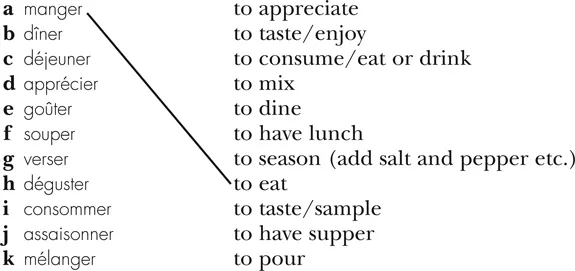
IV The verbs in III are usually referred to as ‘-er’ verbs (pronounced E.R.) because they end in -er. Here are some more -er verbs. How many of them do you know already? They all have to do with food and eating.

If you find it difficult to learn new words, try to find a ‘hook’ to hang them on: e.g. manger, a manger where you put the food for an animal. And if you have travelled in France, you will almost certainly have seen signs at places selling wine, saying Dégustation, which means they are inviting you to sample their wines.
More than 50% of English words derive from French words or have the same stem. If you don’t know a verb, try saying the English word with a French accent – you have a 50% chance of being understood!
New words made into verbs are usually -er verbs: e.g. faxer = to fax; surfer = to surf; monopoliser = to monopolise, etc.
V What do you think the French for these verbs would be? Cover up the French and see if you can work it out.
| a to decide... |
Table des matières
- Cover
- Half Title
- Series Page
- Title Page
- Copyright Page
- Contents
- Introduction
- 1 Verbs
- 2 Nouns and Determiners
- 3 Pronouns
- 4 Adjectives
- 5 Adverbs
- 6 Prepositions
- 7 Conjunctions and other useful words
- Verb tables
- Answers