The goal of this book is to demonstrate that sermons are "rhetorical" speeches by nature. The simplest argument is that it would be difficult to imagine a sermon without intent, and all international speeches are rhetorical by definition. This work focuses on the fact that rhetoric, as the intrinsic cohesive power of speech, is not a question of form, style or representation but a practical skill based on "common sense" that produces effective speech in the most optimal way possible.
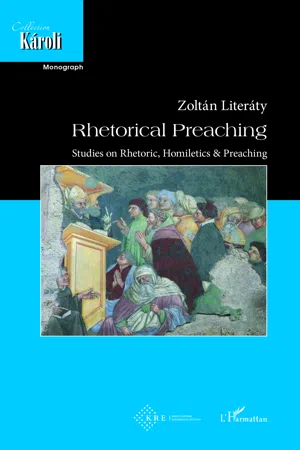
- 122 pages
- French
- ePUB (adaptée aux mobiles)
- Disponible sur iOS et Android
eBook - ePub
À propos de ce livre
Informations
Sujet
Sciences socialesSujet
SociologieARGUMENTS

PATHOS ANCIENT PATHOS
IN NEW PREACHING
PATHOS: PERSUASIVE APPEALS TO LISTENERS’ EMOTIONS
The question guiding homiletic pathos is: “Why should my listener care?” The preacher searches for ways to engage the worldview and emotions of the congregation in order to persuade them that what is being said is true and should be taken seriously. Preachers use empathy and identification to enter the lives of the congregation in search of ways to connect the message with things that truly matter to listeners. […] The goal of sermon pathos is an open, empathetic correlation of the sermon’s message with important concerns in the lives of listeners, so that they will personally invest in what is being said.1
NEW HOMILETICS
The movement called New Homiletic developed in America and had its heyday during the last quarter of the 20th century. This meant that it coincided with the narrative perception of faith, borrowing many impulses from the latter. Generally it is difficult to understand this development, which resulted in New Homiletics being what it is. While in Europe homiletics of Barthian “theology of the Word”2 dogmatically secluded itself from experimental practice, the same Barthian theological movement in the US believed that dogmatic and definitive assessment does not provide suitable answers to problems encountered in practice. Thus, experimentation was natural in America. There is a great difference between American and European homiletics in the 70s.
The “quo modo” of preaching thus gained greater and greater emphasis overseas, but at the same time it did not separate itself from those directions of homiletics, which search the depth of preaching. An important breakthrough in forms of preaching was achieved, among others, by the analogy of Grady Davis, in which he compared the development of a sermon to living organisms, like a tree.3 The indistinguishable unity of form and content began to show up in such analogies to living, natural beings, and became definitive in homiletic thinking of the age. In other words, only what is alive can develop within its own framework.
New Homiletic is new in the sense that in contrast to traditional and kerygmatic types of preaching. New Homiletic is based on speech event and methodically on inductive orientation. New Homiletic found its philosophical principles in new hermeneutics. New hermeneutics promulgated that with the aid of “hermeneutical circle” the person and the text develop together. This means that the commentator not only explains the text to his audience, but tells it in a new way, accommodating to the new situation, because the language of the text sometimes makes it unclear. It is not enough to outline the text for the present situation, but both the text and present case must be interpreted, if possible, unifying these two horizons.4 Fuchs called this “speech event”.5
Achievements of speech event (or speech act theory) therefore appear not only at theoretical, but also at practical levels in homiletics. Thus, most practising homiletics regarded this as a “litmus test” to see, “what happens in the sermon”. Here not simply the fact that the sermon has happened and transmitted the truth is important, but, from the practical point of view, what happens during the half hour, when the preacher talks to his audience. The aim was that the audience should become an active participant in the speech event – in other words that the listener should gain new knowledge and experience during this process. The sermon, in the presence and reality of God, becomes a real event. The most important criterion of this event is the unbreakable unity of content and form.
As in real life, every content can be understood within its own form, even abstract concepts of faith and theology depend on the formal characteristics of their expressions.
The other supporting pillar of new homiletics, besides the unity of content and form, is that the sermon is an event which occurs continuously in time, in other words, it can be observed only as part of a historical process. It cannot be regarded on its own as an abstract concept; it must be examined as a process. Thus, observation and experience become dominant features of homiletic discussions.
The methodology of new homiletics is based on induction. It should not try to use general, but concrete truths of faith when speaking to the audience, who then can themselves draw the relevant conclusions. If the sermon is developed well and reached its target, then the conclusion of the listener and the general truth of the Bible become identical. This method is secured by the unity of the aesthetically examined reality and the language, thus the language becomes not simply the instrument of existing realities, but its product. Thus, a sermon while strictly adhering to truth, can only express it through the language and to make it an event.
The above mentioned phenomena resulted in the strengthening of pathos as a rhetorical argument in New Homiletics. The action, involvement, emotive participation, empathy and encounter all aimed to strengthen to the maximum the link between the speaker with his theme and the audience. The homiletic context of the sixties and seventies was the context of ineffectual preaching. Most homiletic textbooks tried to find a solution to newly establish the relevancy of preaching, asking the question, how can a Christian sermon become effective again? Naturally, there were theologians who wanted to base this on theological principles, but New Homiletics found these fundamentals in New Hermeneutics, its motto being: in dialogue with the receiver (listener). Therefore New Homiletics concentrated all its efforts on the listener of the sermon, with whom it tried to pursue a dialogue. This approach was based on the reasoning of pathos, which they expressed as: “turn to the listener” or “hearer-driven homiletic”.
For homileticians, New Hermeneutics and movements in linguistic theory inspired a new appraisal of the role of listeners, their perceptions, and needs as integral to the preaching event. This move toward anthropological concerns resulted in listeners becoming central to the preacher’s consideration of not only what to say but how to say it. Sermons were understood as capable of making their appeal not only through rational arguments but evocation, imagination, and addressing listeners’ emotional needs as well.6
New Homiletics found the answer to how in the narrative paradigm; therefore I will try to present the connections between narratology, rhetoric, theology and homiletics.
NARRATIVE TURN
Our everyday life, culture, history, care of ourselves and self-reflection are narrative in style. One expresses his own world, his life and identity in narrative terms. Reflections on our past, present and future are all embedded in the structure of time, resulting clearly in the historical understanding of life.
However, narrative thinking nowadays has outgrownthe simple explanation and classification of events. The innovations of the seventies, which influenced substantially the development of science, are nowadays often termed as the narrative turn. This means that narrative is a much more general category than the study of fairy tales and short stories. Besides structural analysis of texts it is also applied in other disciplines. It is characteristic mainly of the social sciences (history, philosophy, sociology, politics, psychology and recently also in theology) that their object is of narrative nature. This means that in these various sciences similar phenomena occur in relation to the nature of the discipline and their discursive strategies. These common phenomena, with parallel rules, form the scientific structures of narrative, which can be applied also in theological investigations.
In narrative discourse Walter Fischer introduced the concept of narrative paradigm.7 According to his interpretation all forms of communications, which affect our intellect, have to be understood as such an eventuality, which is shaped by history, culture and character. Fisher’s aim was that besides didactical or descriptive communication narrative communication has a basic importance. The concept of narrative paradigm was an answer to the view of science in the seventies. In other words, according to Thomas Kuhn8 the solid structure of any science is indicated by generally accepted paradigms. Researchers of communication tried to define such a paradigm, which perfectly explains the behaviour of communication, and therefore provides a solid basis for the theories of communication. Thus, he suggests, among others, that narrative paradigm should not be approached as special rhetoric, but as a fundamental, on which the entire rhetoric can be built.9 His main work referenced above begins with a quotation from Scripture: “in the beginning was the word (Logos)”. As he explains, the Greek word means an event, argument, discourse, principle, concept, thought, in other words, all forms of communication. According to him in those times imagination and thought were not separated. With philosophical writing one can observe that special usage, where the meaning of Logos moves towards thought and assertion. As a result, imagination, aesthetics and art are of secondary importance. Eventualities [tales, stories] do not fit pure logics, as they only affect sentiments; they become tools of delusion rather than those of noble persuasion.
This struggle between pure logics, sentimental effect, rationality and emotions not only characterised the classical age, but has continued to do so ever since in our cultural life and in homiletics, too.
NARRATIVE IN CLASSICAL RHETORIC
In Aristotle’s Rhetoric one can read that “narration” is that part of speech, which is positioned in the first part of “tractation”, in the invention. Introduction (exordium) is followed by the narration just before the propositio and argumentatio. “In political oratory there is very little opening for narration; nobody can ‘narrate’ what has not yet happened. If there is narration at all, it will be of past events, the recollection of which is to help the hearers to make better plans for the future.”10 The fact, that according to Aristotle narration can not only be used after the introduction, but at other parts of the speech, or that it can be applied in all kinds of talk, can also be suggested through the paradigm mentioned before – not only for pragmatic reasons (information, understanding) but also by anthropological reasoning. Thus, events, happenings, persons and characters linked to these, and the whole environment is secured and interpreted as a great personal history.
One can distinguish several types of narrati...
Table des matières
- Couverture
- 4e de couverture
- Titre
- Copyright
- TABLE OF CONTENTS
- Prologue to rhetorical preaching
- ANTIQUITY
- MIDDLE AGES
- HUMANISM
- MODERNISM
- POSTMODERN
- ARGUMENTS
- References
- Adresse
Approuvé par les 375,005 étudiants
Accès à plus de 1,5 million de titres pour un prix mensuel raisonnable.
Étudiez plus efficacement en utilisant nos outils d'étude.
Foire aux questions
Oui, vous pouvez résilier à tout moment à partir de l'onglet Abonnement dans les paramètres de votre compte sur le site Web de Perlego. Votre abonnement restera actif jusqu'à la fin de votre période de facturation actuelle. Découvrir comment résilier votre abonnement
Non, les livres ne peuvent pas être téléchargés sous forme de fichiers externes, tels que des PDF, pour être utilisés en dehors de Perlego. Cependant, vous pouvez télécharger des livres dans l'application Perlego pour les lire hors ligne sur votre téléphone portable ou votre tablette. Apprendre à télécharger des livres hors ligne
Perlego propose deux formules : Essential et Complete
- Essential est idéal pour les apprenants et les professionnels qui aiment explorer une grande variété de sujets. Accédez à la Essential Library avec plus de 800 000 titres de confiance et best-sellers dans les domaines du business, du développement personnel et des sciences humaines. Inclut un temps de lecture illimité et la voix Standard Read Aloud.
- Complete : Parfait pour les apprenants avancés et les chercheurs ayant besoin d'un accès total et sans restriction. Débloquez plus de 1,5 million de livres dans des centaines de sujets, y compris des titres académiques et spécialisés. Le forfait Complete inclut aussi des fonctionnalités avancées telles que Premium Read Aloud et Research Assistant.
Nous sommes un service déabonnement à des manuels scolaires en ligne, qui vous permet d'accéder à une bibliothèque en ligne entière pour moins que le prix d'un seul livre par mois. Avec plus de 1,5 million de livres sur plus de 990 thèmes, nous avons ce qu'il vous faut ! Découvrir notre mission
Recherchez le symbole Écouter sur votre prochain livre pour voir si vous pouvez l'écouter. L'outil Écouter lit le texte à haute voix pour vous, en surlignant le passage qui est en cours de lecture. Vous pouvez le mettre sur pause, l'accélérer ou le ralentir. En savoir plus sur la fonctionnalité Écouter
Oui ! Vous pouvez utiliser l'application Perlego sur les appareils iOS et Android pour lire à tout moment, n'importe où, même hors ligne. Parfait pour les trajets quotidiens ou lorsque vous êtes en déplacement.
Veuillez noter que nous ne pouvons pas prendre en charge les appareils fonctionnant sur iOS 13 et Android 7 ou versions antérieures. En savoir plus sur l'utilisation de l'application
Veuillez noter que nous ne pouvons pas prendre en charge les appareils fonctionnant sur iOS 13 et Android 7 ou versions antérieures. En savoir plus sur l'utilisation de l'application
Oui, vous pouvez accéder à Rhetorical Preaching de Zoltan Literaty aux formats PDF et/ou ePub, ainsi qu'à d'autres livres populaires dans Sciences sociales et Sociologie. Nous avons plus de 1,5 million de livres disponibles dans notre catalogue pour vous.