We are facing history book that speaks about the suffering and martyrdom of a Church, wich has not been defeated by the Communist atheism that chained Romania between 1945-1989. The facts described here come to answer pertinent questions that any good faith reader asks to find the truth: "How did the Romanian Greek Catholic Church survive during the Communist persecution, what were the reason for being persecuted?"The present book, titled "The Forbidden Church" written by Mr. Silviu Sana Ph.D., comes to answer the pertinent questions, in light of the fact that in the nearly 50 years of the Catacombs, the Greek Catholic Church continued to exist, being a landmark of Christian principles among Romanians, in a "society" that denies Christianity and even the existence of God.
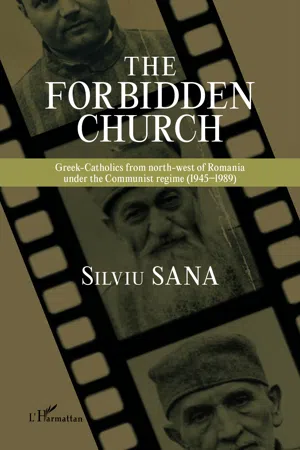
- 120 pages
- French
- ePUB (adaptée aux mobiles)
- Disponible sur iOS et Android
eBook - ePub
À propos de ce livre
Informations
Sujet
Social SciencesSujet
SociologyThe Portrait of a Martyr
The Archbishop Valeriu Traian Frentiu3
His Excellency, Valeriu Traian Frentiu – Bishop of Lugoj (1912 – 1922), Bishop of Oradea (1922 – 1952) and Apostolic Administrator in Blaj (1941 – 1947) – was one of the most outstanding hierarchs of Romanian United Church in a time marked by the two world wars and by the two “worlds”: The Austro-Hungarian Monarchy and the Romanian Kingdom. He distinguished himself as a priest by exemplary piety and godliness and, after-wards, as a bishop by a very good administration of the territory belonging to the Eparchy of Oradea.
Origins and Childhood
Valeriu Traian Frentiu was born on April 25, 1875, in Resita (Caras-Severin county) to his parents Ioachim Frentiu, priest, and Paraschiva-Rozalia, born Demeter4. On May 23, 1875, he receives the Sacrament of Holy Baptism, being given the name Valeriu Traian Adolf, the service being officiated by the Dean of Bocsa, Mihai Gianu, while his godparents were Adelhaida and Adolf Diaconovici5. His father, Ioachim Frentiu6, was a priest in the town Resita Montana7 and his mother, Rozalia, was a housewife. God blessed the family with other children, as well, two girls (Maria and Lucretia8) and a boy (Cornel)9.
His first years of life are defined by the family background from which he came and, since his father was a priest, his entire education is characterized by the calling which God intended for him. His father, Ioachim, fulfilled his sacerdotal services in a parish where the majority of parishioners came from the workers in the mining industry and the ones in the metallurgic industry. In the middle of these parishioners, but also among the priests from the eparchy, Ioachim Frentiu proved to be renowned for his distinguished piety10. At the age of 5 he became an orphan upon his mother’s death, Rozalia’s duties being taken over by his elder sister, Lucretia, who stood by Valeriu Traian his entire life11.
Studies
He attended primary school in Resita. Then he continued by attending the Gymnasium from Resita12, from where he transferred to the Superior Gymnasium in Blaj, which he graduated in 189213. In 1890 we find him as 4th grade alum of the Seminary from Blaj14.
The paternal role model gave young Valeriu Frentiu the impulse to follow the sacerdotal calling. But his leaving for theological studies in Budapest15 was due to his intellectual and spiritual qualities, his potential being exploited in this place16.
In 1895 he attends the pastoral theology and canonical law courses at the University of Budapest17, being and alumn of the Central Seminary in Pesta. This is his second place where Valeriu Frentiu develops intellectually and where, through the Philosophy and Theology courses, he comes in contact with the ideas and currents belonging to Catholic theology. It appears that his father’s pietist heritage was augmented in this place by the novelties coming from the Roman-Catholic Church, especially that of devotion for the Sacrament of Holy Communion, his entire life being marked by the cult for the Holy Communion18. On the other hand, Valeriu Traian Frentiu moulds himself as a good Romanian – despite the denationalization politics led by the Budapest government – frequenting together with other students “Salba” Reading Society which belonged to the Romanian students19.
He completes his Theology studies at the University of Pesta in 189820.
After being consecrated priest on September 20, 1898, he continues his theology studies in Vienna, at the famous „Augustinianum” Theology Institute from the Viennese University21, where, on April 29, 1902, he defends successfully his doctoral thesis22.
During the time spent in Vienna, upon Augustin Bunea’s request, who was in Blaj, he copied many of the manuscripts from the Archives of the Court of Vienna, helping the erudite professor from Blaj with the book “Petru Pavel Aron and Dionisie Novacovici”23. Moreover, Valeriu Frentiu would have wanted to stay longer in Vienna to study architecture24.
Both in Budapest and in Vienna, Valeriu Traian distinguished himself due to his extremely strong devoutness and irreproachable clerical conduct25.
The Priesthood
He receives the sacrament of Holy Priesthood on September 20, 1898, in the Cathedral from Lugoj, on The Feast of the Nativity of the Blessed Virgin Mary, being consecrated celibate priest by his eparchy bishop, Demetriu Radu26. According to the document emitted on the occasion of his consecration, Valeriu Traian was consecrated to honor his priestly duty in the capital city of the Empire27, but also to fulfil his military priest position for the Romanians from the Viennese garrison28. He offered this special pastoral zeal to redeem souls to the Romanian soldiers and to the Romanian Catholics who went through spiritual troubles29.
Every day he celebrated the Divine Liturgy in the Greek-Catholic church Saint Barbara, where his remarkable piety and devoutness brought many Romanians back to God, people who had not confessed for 20 – 25 years30. For the 500 – 1000 Romanian soldiers he lectured about religion to determine the youngsters to become aware of the importance of faith in their lives, a fact which was described by a newspaper as follows:
“For these services he did not receive payment, he got only spiritual consolation when a soldier asked to be Dienfrei [For Free] and came to confess and to take communion, or when a soldier, who previously did not want to know anything about Christian duties, returned to faith”31.
In 1902 he returns home, being named by the bishop in the eparchy chancellery. Thus, from December 190232 until 1904, he held diverse positions in the administrative body fo the Diocese from Lugoj: archivist, librarian, consistory registrar33. During this time, he was trusted with preparing the historical schematism for printing, with moving the eparchy library and archives in the newly built wing of the see34.
On April 2, 1904, due to the vacation of the dean position in Orastie, Bishop Vasile Hossu names Frentiu as dean administrator in place of priest Iuliu Ratiu35. After this trial period, when he proved to have real pastoral qualities, came the decree by which he was named dean, signed on September 15, 190436.
The fact that he received this ecclesiatical title at the age of only 29, to be responsible for a wide ecclesiastic territory with such a colourful ethnic and denominational diversity was attributed to hi...
Table des matières
- Cover
- Back cover
- Title
- Copyright
- Contents
- Foreword
- To the Readers…
- The Portrait of a Martyr. The Archbishop Valeriu Traian Frentiu
- Fr. Alexandru Ratiu – An American Priest in the Visor of the Securitate (1945-1948)
- Bishop under surveillance. Iuliu Hirtea in the records of the Securitate (1947-1978)
- Greek-Catholics under the Orthodox Church The “Unification” from 1948 in Augustin Paul’s Report from 1957
- The Library of the Greek-Catholic Eparchy of Oradea (1948-1950)
- Bibliography
- Abbreviations
Approuvé par les 375,005 étudiants
Accès à plus de 1,5 million de titres pour un prix mensuel raisonnable.
Étudiez plus efficacement en utilisant nos outils d'étude.
Foire aux questions
Oui, vous pouvez résilier à tout moment à partir de l'onglet Abonnement dans les paramètres de votre compte sur le site Web de Perlego. Votre abonnement restera actif jusqu'à la fin de votre période de facturation actuelle. Découvrir comment résilier votre abonnement
Non, les livres ne peuvent pas être téléchargés sous forme de fichiers externes, tels que des PDF, pour être utilisés en dehors de Perlego. Cependant, vous pouvez télécharger des livres dans l'application Perlego pour les lire hors ligne sur votre téléphone portable ou votre tablette. Apprendre à télécharger des livres hors ligne
Perlego propose deux formules : Essential et Complete
- Essential est idéal pour les apprenants et les professionnels qui aiment explorer une grande variété de sujets. Accédez à la Essential Library avec plus de 800 000 titres de confiance et best-sellers dans les domaines du business, du développement personnel et des sciences humaines. Inclut un temps de lecture illimité et la voix Standard Read Aloud.
- Complete : Parfait pour les apprenants avancés et les chercheurs ayant besoin d'un accès total et sans restriction. Débloquez plus de 1,5 million de livres dans des centaines de sujets, y compris des titres académiques et spécialisés. Le forfait Complete inclut aussi des fonctionnalités avancées telles que Premium Read Aloud et Research Assistant.
Nous sommes un service déabonnement à des manuels scolaires en ligne, qui vous permet d'accéder à une bibliothèque en ligne entière pour moins que le prix d'un seul livre par mois. Avec plus de 1,5 million de livres sur plus de 990 thèmes, nous avons ce qu'il vous faut ! Découvrir notre mission
Recherchez le symbole Écouter sur votre prochain livre pour voir si vous pouvez l'écouter. L'outil Écouter lit le texte à haute voix pour vous, en surlignant le passage qui est en cours de lecture. Vous pouvez le mettre sur pause, l'accélérer ou le ralentir. En savoir plus sur la fonctionnalité Écouter
Oui ! Vous pouvez utiliser l'application Perlego sur les appareils iOS et Android pour lire à tout moment, n'importe où, même hors ligne. Parfait pour les trajets quotidiens ou lorsque vous êtes en déplacement.
Veuillez noter que nous ne pouvons pas prendre en charge les appareils fonctionnant sur iOS 13 et Android 7 ou versions antérieures. En savoir plus sur l'utilisation de l'application
Veuillez noter que nous ne pouvons pas prendre en charge les appareils fonctionnant sur iOS 13 et Android 7 ou versions antérieures. En savoir plus sur l'utilisation de l'application
Oui, vous pouvez accéder à The Forbidden Church de Silviu Sana aux formats PDF et/ou ePub, ainsi qu'à d'autres livres populaires dans Social Sciences et Sociology. Nous avons plus de 1,5 million de livres disponibles dans notre catalogue pour vous.