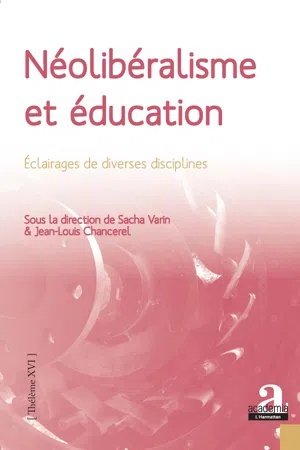
L'ouvrage analyse les effets de la pensée néolibérale sur les fonctionnements et structures de l'éducation et de la formation. Progrès dans la gouvernance et la gestion? Bienfaits d'une application de principes nés dans le champ de l'économie au domaine éducatif? Les idées développées le sont à partir de divers champs disciplinaires. La toute-puissance de l'État est remise en question, on assiste à une globalisation et, paradoxalement, à la nécessité de considérer chaque individu dans sa singularité.
eBook - ePub
Néolibéralisme et éducation
Eclairages de diverses disciplines
- 242 pages
- French
- ePUB (adaptée aux mobiles)
- Disponible sur iOS et Android
eBook - ePub
À propos de ce livre
Informations
Sujet
ÉducationSujet
Éducation généraleRiding the tiger of growing trade in higher education services : smart regulation needed instead or laissez-faire hyperopia or prohibition policy myopia
FROM RAYMOND SANER
Trade in education is debated between market liberalizers and protectionists and is played out within countries and their different stakeholders, for example between government ministries (e.g. ministry of trade versus ministry of education) and between government and the private sector (privately owned schools versus publically run schools). A balance needs to be struck between consumer protection and the rights of governments to pursue high quality education without falling into the trap of closing market access to foreign education service providers. In other words, policy makers and educational sector experts need to find the right balance between of laissez-faire hyperopia1 or prohibition policy myopia2.
This paper depicts trends in international trade of educational services, particularly of higher education, and how countries – be they developed or developing – use policies which vary between laissez-faire or market liberalising policies or protectionist policies alluding to the title of this paper – ranging between policies that could be grouped in analogy to visual impairments to policies of farsightedness (focused on the future) versus near – sightedness (focused on the past and present). Both policy orientations if taken as rigid ideological positions expose a country’s educational system to risks be that in relation to missed growth and development opportunities (if too protectionist) or to loss of accumulated know-how and equity (if too market oriented).
The focus of this paper is the growing thread of internationalisation of higher education, how countries cope with it and what kind of policy options have been applied by different countries. The analysis will use WTOGATS related trade statistics and draw on previous published documents of the author namely Lim, Aik Hoe & Saner, Raymond (2011), `Rethinking Trade in Education Services : A Wake-Up Call for Trade Negotiators’ Lim, Hoe & Saner, Raymond (2011), `Trade in Education Services : Market Opportunities and Risks, Life Long Learning in Europe’ and Saner, Raymond & Fasel, Sylvie (2003), `Negotiating Trade in Educational Services within the WTO/GATS context’.
Economic and developmental importance
Education is widely considered as a key factor in promoting economic growth and involves the use of significant resources. In APEC economies, for instance, total spending on education is at least US$1,600 billion annually or 6.7 per cent of GDP (Center for International Economics 2008 : 8). Economic studies have shown that the impact of education on growth varies according to an economy’s level of development3. Higher education has been shown to have an important impact on all economies, with primary and secondary education contributing the most to growth in low income economies (Ibid.).
Economic benefits flow not only to the individual but also to society (OECD 2009). For OECD members, the net public return from an investment in tertiary education exceeds US$50,000 on average for each student (Ibid.). In addition to economic effects, education has been shown to bring widespread societal benefits such as lower crime, better governance, better health and interpersonal trust (World Bank 2003 OECD 2009). Taking into account both public and private expenditure, OECD economies spent on average in 2009, 6.1 per cent of their collective GDP on education (OECD 2009 : 215). In developing countries, public expenditure on education has consistently been within the range of 4.5 to 5 per cent over the period from 2001 to 20084.
The share of private expenditure in education is sizeable. In all OECD members, for which comparable data is available, private funding on educational institutions represents around 15 per cent of all expenditure (OECD 2009 : 226). In Australia, Canada and the United Kingdom, as well as in Israel, private funds are reported to constitute around 25 per cent of all educational expenditure. The proportion exceeds 30 per cent in Japan, Korea and the United States and Chile (OECD 2009 : 227). In Australia, Canada, Japan, the United States and Israel private funding for higher education reaches above 40 per cent, and above 75 per cent in Korea and Chile. In Australia and New Zealand, the high proportion of private expenditure is reportedly accounted for by the large number of international students enrolled on university programmes.
In more than one-half of developing countries, private spending accounts for more than 10 per cent of total education expenditure, with important variations5. For instance, the share rises to one-third, or more, in Chile, Colombia and Indonesia (Ibid.). In general, most private spending goes towards private institutions, although a proportion is also spent on public schools (UNESCO 207 : 44). Private returns from education are high for both developed and developing countries, which is why individuals have an incentive to invest in education. In developing countries, the wage differential between a secondary school leaver and a university graduate has been estimated at about 200 per cent (OECD 2009 : 63). Education is also generally a good insurance against unemployment, particularly in the context of economic downturns (Id. : 120). The growing size of private expenditure has important implications for the structure of the education market and its increasingly international nature.
Structural changes in the education market
In recent decades, significant change has taken place in the structure, governance and financing of public sector institutions, especially with respect to higher education (Task Force on Higher Education and Society 2000 : 30). At the same time, demand for education has grown. In that context, private education has taken a more prominent role, with growing numbers of for-profit institutions, as well as private philanthropic institutions, in the education sector6. That being said, in most economies, education at the primary and secondary levels is still predominantly publicly provided. In the OECD area, for instance, on average 91 per cent of primary and 85 per cent of secondary school students are enrolled with public institutions. Similarly high percentages can also be observed in developing countries. Given its importance for human and social development, governments throughout the world tend to consider instruction up to a certain level – commonly primary and secondary education – as a basic entitlement. It is thus normally provided free of charge, or with a nominal fee, by public authorities and, in most economies, participation is mandatory.
The situation changes, however, with respect to higher education. Although students enrolled at publicly funded institutions still outnumber those in private institutions, over the last decade, private providers have made significant inroads at both the national and international level. Today, private institutions globally account for some 30 per cent of all students in higher education (Altbach & al. 2009 : xi-xiii). In some regions of the world, private higher education institutions are part of a fast growing international education market. The private sector represents slightly more than 10 per cent of total tertiary enrolments in Spain and France, about 30 per cent in Poland, the US and Mexico (Vincent-Lancrin 2009b : 261). In Asian economies, such as Japan, Korea, Indonesia and the Philippines, over 75 per cent of enrolments are with private education providers, while in Mexico, Brazil, South Africa and Chile it is about 50 per cent (Altbach & al. 2009). One of the most remarkable developments in the African continent’s higher education system is the mushrooming of private colleges. However, the demand for access is still far from being fulfilled, with a total enrolment of rate of about 5 per cent of eligible school leavers in higher education (Id.).
A related trend has been the increasing involvement of public universities in revenue generating activities7. While higher education in the OECD area continues to be heavily subsidised for domestic students, universities are increasingly expected to generate new sources of revenue. The generation of funds from private sources has given rise to a new generation of government-dependent private institutions, as distinct from the traditional model of a fully government-dependent institution8. One consequence of this trend has been greater competition for more fee-paying students, especially international students. In this respect, Australia, New Zealand, United States and the United Kingdom are amongst the market leaders with public universities authorised to provide education services at non-subsidised rates to foreign students (OECD 2004 : 26)9. Asian countries, such as Malaysia and Singapore have also started to enter the private education market, and serve as important regional hubs.
Education services : trade LINKAGES and key trends
An important feature of education services trade has been the increasing international mobility not only of students, but also of programmes and institutions. Abetting that mobility has been the innovative use of information and communication technologies providing alternate ways to deliver education services. New institutional arrangements involving a greater and more diverse number of partners, ranging from educational institutions to corporations, have also created new commercial opportunities such as the franchising and twinning of academic programmes.
...Table des matières
- Couverture
- 4e de couverture
- COLLECTION « Thélème »
- Titre
- Préface
- Introduction
- Les auteurs
- De l’influence du néolibéralisme sur l’enseignement scolaire et universitaire
- Analyse économique, libéralisme et politique éducative
- Riding the tiger of growing trade in higher education services : smart regulation needed instead or laissez-faire hyperopia or prohibition policy myopia
- Neoliberalism, Neoconservatism, and the Capitalist Assault on Public Education : A Marxist Analysis
- Le néolibéralisme se niche-t-il au sein même des dispositifs pédagogiques scolaires ?
- Perspectives néolibérales dans l’évaluation académique des étudiants
- De la définition du néolibéralisme et de quelques notions relatives
- Postface
- Table des matières
Approuvé par les 375,005 étudiants
Accès à plus de 1,5 million de titres pour un prix mensuel raisonnable.
Étudiez plus efficacement en utilisant nos outils d'étude.
Foire aux questions
Oui, vous pouvez résilier à tout moment à partir de l'onglet Abonnement dans les paramètres de votre compte sur le site Web de Perlego. Votre abonnement restera actif jusqu'à la fin de votre période de facturation actuelle. Découvrir comment résilier votre abonnement
Non, les livres ne peuvent pas être téléchargés sous forme de fichiers externes, tels que des PDF, pour être utilisés en dehors de Perlego. Cependant, vous pouvez télécharger des livres dans l'application Perlego pour les lire hors ligne sur votre téléphone portable ou votre tablette. Apprendre à télécharger des livres hors ligne
Perlego propose deux formules : Essential et Complete
- Essential est idéal pour les apprenants et les professionnels qui aiment explorer une grande variété de sujets. Accédez à la Essential Library avec plus de 800 000 titres de confiance et best-sellers dans les domaines du business, du développement personnel et des sciences humaines. Inclut un temps de lecture illimité et la voix Standard Read Aloud.
- Complete : Parfait pour les apprenants avancés et les chercheurs ayant besoin d'un accès total et sans restriction. Débloquez plus de 1,5 million de livres dans des centaines de sujets, y compris des titres académiques et spécialisés. Le forfait Complete inclut aussi des fonctionnalités avancées telles que Premium Read Aloud et Research Assistant.
Nous sommes un service déabonnement à des manuels scolaires en ligne, qui vous permet d'accéder à une bibliothèque en ligne entière pour moins que le prix d'un seul livre par mois. Avec plus de 1,5 million de livres sur plus de 990 thèmes, nous avons ce qu'il vous faut ! Découvrir notre mission
Recherchez le symbole Écouter sur votre prochain livre pour voir si vous pouvez l'écouter. L'outil Écouter lit le texte à haute voix pour vous, en surlignant le passage qui est en cours de lecture. Vous pouvez le mettre sur pause, l'accélérer ou le ralentir. En savoir plus sur la fonctionnalité Écouter
Oui ! Vous pouvez utiliser l'application Perlego sur les appareils iOS et Android pour lire à tout moment, n'importe où, même hors ligne. Parfait pour les trajets quotidiens ou lorsque vous êtes en déplacement.
Veuillez noter que nous ne pouvons pas prendre en charge les appareils fonctionnant sur iOS 13 et Android 7 ou versions antérieures. En savoir plus sur l'utilisation de l'application
Veuillez noter que nous ne pouvons pas prendre en charge les appareils fonctionnant sur iOS 13 et Android 7 ou versions antérieures. En savoir plus sur l'utilisation de l'application
Oui, vous pouvez accéder à Néolibéralisme et éducation de Sacha Varin,Jean-Louis Chancerel aux formats PDF et/ou ePub, ainsi qu'à d'autres livres populaires dans Éducation et Éducation générale. Nous avons plus de 1,5 million de livres disponibles dans notre catalogue pour vous.