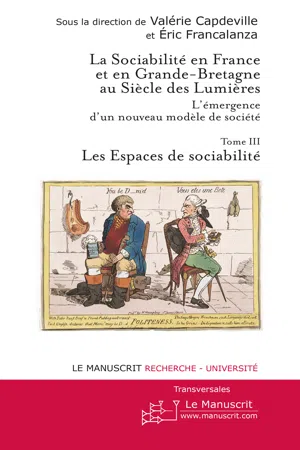
Ce volume de Transversales constitue le troisième volet des travaux de spécialistes internationaux des études sur le dix-huitième siècle français et britannique. Dans le cadre d'un projet de la Maison des Sciences Humaines de Bretagne (MSHB), « La sociabilité en France et en Grande-Bretagne au siècle des Lumières: l'émergence d'un nouveau modèle de société », ces chercheurs tentent de redéfinir les modes opératoires de la sociabilité pour chacune des deux nations, à partir de sources célèbres ou méconnues, et s'interrogent sur la réalité de la supériorité du modèle français de sociabilité. La notion d'espace, dans ses acceptions diverses, sert de trame théorique à ce recueil dans lequel les espaces de sociabilité sont envisagés selon plusieurs angles d'analyse.This volume is the third in the Transversales series published by a group of researchers of different nationalities, with the support of the Maison des Sciences Humaines de Bretagne (MSHB), on the topic of sociability in France and Britain during the Enlightenment. The research is focusing on the extent to which a new model of sociability emerged in these nations during that period, and the similarities and differences in the ways this model developed on each side of the Channel. The study of both famous and unknown sources may eventually question the superiority of the French model of sociability. The concept of space, in its various dimensions, is taken as the framework for the analysis of sociable spaces from different perspectives.The Transversales Series Editor is Annick Cossic-Péricarpin.
eBook - ePub
La sociabilité en France et en Grande-Bretagne au siècle des Lumières. Tome III
Les espaces de sociabilité
- French
- ePUB (adaptée aux mobiles)
- Disponible sur iOS et Android
eBook - ePub
La sociabilité en France et en Grande-Bretagne au siècle des Lumières. Tome III
Les espaces de sociabilité
À propos de ce livre
Informations
Sujet
HistoryBig City, Bright Lights ?
Night Spaces in Paris and London, 1660-1820122
Jonathan Conlin
University of Southampton, UK
University of Southampton, UK
John Vanbrugh’s unfinished play A Journey to London (1720) tells of the marital tribulations of Lord Loverule and his fashionable wife Arabella. In London the pair are confronted with a whirl of assembly rooms, routs and other resorts popular with members of the privileged elite. Their ability to enjoy these resorts and activities is dependent, however, on their ability to adjust to the temporal rhythm of London, one very different from that they were accustomed to in the country. Lady Arabella adjusts quickly to this Augustan jet-lag, resetting her body clock to enable her to stay out until 3 or 4 am. Her husband retires at ten, loath to change his habits. “I thought, to go to Bed early and rise so,” he observes, “was ever esteem’d a right Practice for all People.” For Arabella, such behaviour smacks of “a Mechanick, who must get to Bed betimes, that he may rise early to open his Shop. Faugh !” Early to bed and early to rise ? Lady Loverule’s reply is curt : “Beasts do it”.123
Thanks to the so-called “spatial turn”, Anglophone urban historians and cultural geographers have enriched our understanding of how the modern city emerged in seventeenth- and eighteenth-century Europe.124 We are able to relate the hard facts of street architecture and the geographic distribution of retail outlets to Georgian consumer culture, for example, allowing us to observe the emergence of “shopping as a place to go”.125 We can revisit royal gardens with the help of medical treatises and etiquette books, and discover in them spaces where city dwellers learned to promenade, giving both leg muscles and imaginations a healthy workout.126 In such narratives it seems that the modern city is spawning new spaces for new urban practices. “A space for everything”, we might conclude, “and everything in its space”.
But what of the fourth dimension, time ? Writing in The Spectator in 1712, Joseph Addison was well aware that a single urban location could be used for different purposes at different times of day by people “as different from each other as those who are Born in different Countries”. “Men of Six-a-clock” were different, he noted, from those of nine, from “the Generation of Twelve”, as well as from “the fashionable World, who have made Two-a-clock the Noon of the Day”.127 Sadly, historians have largely failed to note this process, so characteristic of the city, by which one location could operate as several different spaces. Vanbrugh’s comical contrast between the lady of fashion and the stolid man of sense suggests a tension between a natural rhythm, where darkness is for restorative sleep, and a polite rhythm, where darkness is for exhausting pleasures. This contrast, for Arabella at least, is also a contrast of sociability and anti-sociability, as well as of class and gender. The polite world’s day reaches its peak long after the artisan’s day ends. This lady of fashion gambles while her husband stays at home, alienating them so much that their marriage breaks down.128
This essay considers how new street lighting and new types of resort such as cafes and pleasure gardens changed the way in which the hours after sunset were used in the city. It takes Paris and London as its focus, starting from the late seventeenth century, when the first experiments in city-wide street lighting were made, to the early nineteenth century, when gaslight was introduced in London. The history of the urban night is still in its infancy, and any historian must confront a number of obstacles. Many denizens of the city night failed to indicate what time they engaged in this or that activity. How “late” is “late” ? When does “evening” become “night” ? Another challenge is the tendency to exaggerate the benefits of each change in lighting technology. James Sayer...
Table des matières
- Présentation de la collection
- Comité Scientifique
- Les auteurs
- Introduction Les espaces de sociabilité
- Première partie Lieux et formes de sociabilité
- Cafés et coffeehouses. Pour une histoire transnationale des cafés comme lieux de sociabilité
- London Clubs or the Invention of a ‘Home-made’ Sociability
- Big City, Bright Lights ? Night Spaces in Paris and London, 1660-1820
- Les loisirs urbains à Paris et à Londres au XVIIIe siècle : civilité, politeness et la construction sociale des comportements
- ‘Plaire en instruisant’ :Learning Manners and Politeness in Eighteenth-Century England and France
- Deuxième partie Cercles et vecteurs de sociabilité
- Un réseau de sociabilité et d’information au siècle des Lumières : la chambre de lecture
- La sociabilité dans les cercles huguenots d’Angleterre au XVIIIe siècle
- Mise en scène du foyer : sociabilité de la réussite chez les négociants rochelais
- Entre amitié et vertu : sociabilités de Schoppenwihr à Vizille au tournant de la période contemporaine
- Conclusion Des espaces de la sociabilité en France et en Grande-Bretagne au XVIIIe siècle ou les leçons d’une géométrie dans l’espace
Approuvé par les 375,005 étudiants
Accès à plus de 1,5 million de titres pour un prix mensuel raisonnable.
Étudiez plus efficacement en utilisant nos outils d'étude.
Foire aux questions
Oui, vous pouvez résilier à tout moment à partir de l'onglet Abonnement dans les paramètres de votre compte sur le site Web de Perlego. Votre abonnement restera actif jusqu'à la fin de votre période de facturation actuelle. Découvrir comment résilier votre abonnement
Non, les livres ne peuvent pas être téléchargés sous forme de fichiers externes, tels que des PDF, pour être utilisés en dehors de Perlego. Cependant, vous pouvez télécharger des livres dans l'application Perlego pour les lire hors ligne sur votre téléphone portable ou votre tablette. Apprendre à télécharger des livres hors ligne
Nous sommes un service déabonnement à des manuels scolaires en ligne, qui vous permet d'accéder à une bibliothèque en ligne entière pour moins que le prix d'un seul livre par mois. Avec plus de 1,5 million de livres sur plus de 990 thèmes, nous avons ce qu'il vous faut ! Découvrir notre mission
Recherchez le symbole Écouter sur votre prochain livre pour voir si vous pouvez l'écouter. L'outil Écouter lit le texte à haute voix pour vous, en surlignant le passage qui est en cours de lecture. Vous pouvez le mettre sur pause, l'accélérer ou le ralentir. En savoir plus sur la fonctionnalité Écouter
Oui ! Vous pouvez utiliser l'application Perlego sur les appareils iOS et Android pour lire à tout moment, n'importe où, même hors ligne. Parfait pour les trajets quotidiens ou lorsque vous êtes en déplacement.
Veuillez noter que nous ne pouvons pas prendre en charge les appareils fonctionnant sur iOS 13 et Android 7 ou versions antérieures. En savoir plus sur l'utilisation de l'application
Veuillez noter que nous ne pouvons pas prendre en charge les appareils fonctionnant sur iOS 13 et Android 7 ou versions antérieures. En savoir plus sur l'utilisation de l'application
Oui, vous pouvez accéder à La sociabilité en France et en Grande-Bretagne au siècle des Lumières. Tome III de Valérie Capdeville aux formats PDF et/ou ePub, ainsi qu'à d'autres livres populaires dans History et African American History. Nous avons plus de 1,5 million de livres disponibles dans notre catalogue pour vous.