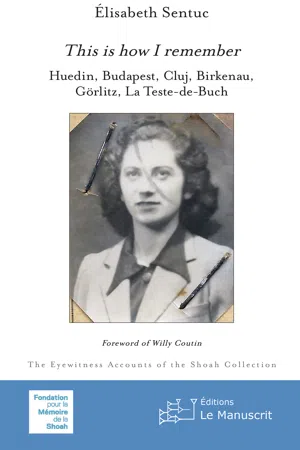
Hungary, spring-summer 1944. In less than two months, nearly 440, 000 Jews crammed into 147 trains were deported from Hungary to be transported for the great majority to the gates of the Auschwitz-Birkenau's Krematorium. The Brodi family, from Huedin, Transylvania, arrives there on the night of June 1 to 2. Elisabeth is 20 years old, she will never see her family again.Elisabeth's mourning story plunges us into the modest family life, marked by the attachment to the traditions of her parents, within the Jewish community of a small provincial town in northern Romania. This area at the crossroads of the borders, remodeled in the aftermath of the Great War, is annexed by Hungary in 1940 and its entry into the war worsens the persecutions against the Jews. The Brodi family suffers the effects until the invasion of the country by the Nazis (March 19, 1944) which precipitates them in the Cluj ghetto, the last stage before the deportation.The memory of her family, her strength of character, her endurance forged in the permanent danger of a terrible year and happy encounters, allow Elisabeth to go through hardships. For her new life, she chooses France and to join the one she loves in Gironde. They met in Görlitz (Lower Silesia), in a shelter under the Allied bombardments, she, a slave, he, a prisoner of war, exploited by the Nazi war industry. It was in La Teste-de-Buch that they got married, and that Elisabeth built a beautiful and large family (8 children, 17 grandchildren,...) in the form of victory over the annihilation promised by Hitler. She has never ceased passing on the memory of her family and lavishing the lessons of her courage and resilience to the younger generations for a quarter of a century.
eBook - ePub
This is how I remember
Huedin, Budapest, Cluj, Birkenau, Görlitz, La Teste-de-Buch
- French
- ePUB (adaptée aux mobiles)
- Disponible sur iOS et Android
eBook - ePub
À propos de ce livre
Informations
Imprimer l'ISBN
9782304049138
Shlomo’s story
It’s by a neighbor of our house in Huedin, Vince, to whom I wrote, that I had news, dated April 27, 1946, from my brother Alexander. He had the same idea to write to her to hear from our family. My aunt from Cluj, Serolta, came to sell the house, and her daughter, Rachel, was in the same refugee camp than Alexander, in Italy, in Santa Cesarea, in Puglia. It’s in the camp that Rachel got married, my brother was present at the ceremony. The two of them were waiting for a boat to go to Palestine. I received thereafter a letter from the British administration, signed by a rabbi, telling me he was in a new camp on the island of Cyprus. I then decided to send him a package, with chocolate, whose weight was to be limited to one kilogram, which never reached him. Settled in Israel, my brother, whose first name had become Shlomo, started a regular letter correspondence with me, for twenty-five years. He and I couldn’t afford to travel to meet. It was in 1970 that I embarked, alone, for the trip to Israel, to find my brother there, to see him for the first time since that day in June 1944.
Here is the story my brother tells of this period of his life, ranging from our separation on the Birkenau Bahnrampe to his arrival in Palestine and the start of his new life in Israel.
* * *
I was born on April 6, 1929 in Huedin. My name was Alexandru (Sandor, in Magyar). I was 11 years old when the war started. I lived in a part of Romania which was ceded to Hungary during the war. I don’t remember many dates, but I will recount what I remember.
I thought our situation would improve when the Hungarians entered Romania42. My father held the bathhouse of the Jewish community of Huedin. The company had been closed, and the Romanian army, present in our region, wanted my father to open his establishment again, but on a Friday afternoon, soldiers arrived. My father, who was religious, refused to open its baths on Shabbat. The soldiers threatened my father with a weapon; the five children that we were in the family were there on the stairs, we were crying. The commander of these soldiers intervened, asked what was happening; the soldiers replied that my father refused to open the sauna. He then ordered to leave my father in peace and get out of the house. In the region, many young men have been enlisted in the Hungarian army. As a child, these are the first memories of the war that marked me.
The Hungarian army later demanded from my father the nationality certificates of our family, which weren’t given to strangers recently settled in Romania. Without these documents, we were transferred, the whole family, to Budapest, to a concentration camp, on Szabolcs Street. We didn’t stay there long according to my memories, we were released and returned to Huedin, but without my father, who stayed in Budapest in 1941. We had nothing to live on and I started to do small jobs, which didn’t bring in a lot of money, like selling potatoes, to supply what was needed to feed the family. My mother, before the war, also worked at the baths, taking care of the ritual baths (mikveh) for the women. But when we returned, the baths company had been confiscated and we were unable to work there again. We went to Budapest in 1941, and my father returned to Huedin, home, only in October 1942.
Before the Germans entered Hungary43, posters advertised in the city streets that whoever would hide a Jew or sell property to a Jew would be sentenced to death. The yellow star was already worn, before the Germans arrived, by all the Jews in Hungary. Once they entered the country, the Germans deported all the Jews from our city and surrounding countryside in a concentration camp in Cluj (Kolozsvár in magyar, Klausenburg in German). We were deported after Passover44, which we had spent at home, around the Shavuot holiday45. We were taken in a line, on foot, to the station where cattle cars were waiting for us. Hungarian gendarmes were brutally pushing us into the wagons. The whole family stayed together in the same car. We were crowded, without water, without toilet; the trip lasted at least three days. My mother had managed to take with her a small pot where she had prepared a sort of roux made from flour and oil. Each child was entitled to one spoon of this preparation. The wagon door wasn’t completely closed; an opening of fifteen centimeters near the door handle allowed all passengers in the wagon to breathe during the trip. The train was making stops, the Germans were going out, breathing in fresh air, but we stayed in the wagon and there was no water distribution.
We arrived at Birkenau at night. I only learned the name of that place afterwards. People slept in the cart. Everyone was brutally woken up by the impact of the train against the stop at the end of the track, which was passed on through all the cars. We had a little hope of arriving in a place where we would be fine. But suddenly the door opened, the Jewish Kapos threw themselves on us, shouting “Raus! Raus!” I saw my brother leave from afar, everyone was running in all directions, there was a general panic. We couldn’t take anything with us, our luggage was ripped from our hands, we were pushed, we were brutalized to panic us and to get us out of the train faster. I followed my father and my big brother46.
We were asked to s...
Table des matières
- Editorial Board for the Collection
- Biography of Elisabeth Sentuc born Brodi
- Foreword
- A family who disappeared in the Holocaust
- Happy childhood in Huedin
- 1940, transition to Hungarian administration
- Family arrests and displacements in Budapest
- From Huedin to Cluj, then the deportation
- Arrival at Auschwitz II-Birkenau
- June-September 1944 at Auschwitz II-Birkenau
- At Görlitz forced labor camp
- From liberation to marriage
- Shlomo’s story
- Family life with Charles
- The years of testimony
- Afterword. Being the child of a Holocaust survivor by the children of Elisabeth Sentuc
- Table of illustrations
- Other titles available in the same collection
Approuvé par les 375,005 étudiants
Accès à plus de 1,5 million de titres pour un prix mensuel raisonnable.
Étudiez plus efficacement en utilisant nos outils d'étude.