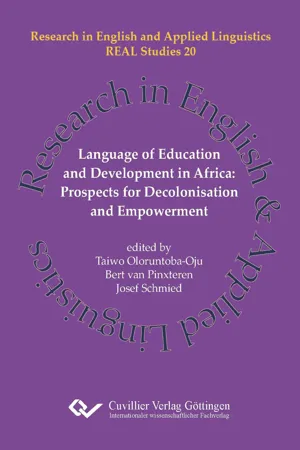
Language of Education and Development in Africa... tells the story of Africa's apparent linguistic powerlessness, while engaging the prospects of sustained decolonization and empowerment. Reviewing existing pessimistic narratives of the African language situation, and the repercussions of these narratives for development, scholars from different parts of Africa and from Europe weigh in by proposing a change paradigm, and a more optimistic view of the future. Language is critical to development; therefore, painting a static picture of Africa, as one that is forever tethered to colonial languages, is not only untrue but also serves negatively to imit African agency. A triadic new mantra is proposed and pursued in this volume, that is: Change is necessary, change is possible, and change is inevitable. Substantive representations from various parts of Africa are showcased in the book, along with expertise shared by international education communities such as UNESCO and SIL, in order to put forward an exciting new narrative of decolonization and empowerment.
eBook - PDF
Language of Education and Development in Africa
Prospects for Decolonisation and Empowerment
- 207 pages
- French
- PDF
- Disponible sur iOS et Android
eBook - PDF
Language of Education and Development in Africa
Prospects for Decolonisation and Empowerment
À propos de ce livre
Informations
Imprimer l'ISBN
9783736976214
Édition
1Table des matières
- Acknowledgements
- Empowering African Languages: An Introduction
- Decolonizing the Politics of Language in African EducationSystems
- Culture and language – empowering and disempowering ideas
- Language inequality and legal discourse in Cameroon:A critical approach
- Linguistic and cultural barriers to learning and developmentin Africa: The example of Burkina Faso
- Les politiques linguistiques et le rôle des langues nationalespour un développement durable en Angola
- Linguistic and sociocultural implications of Yoruba slangsin students’ narratives in Lagos, Nigeria
- Nigerian ‘duelling’ languages and the backlash phenomenon:Prognosis for the resurgence of indigenous African languages
- Equatorial Guinea seeks sustainable language use throughcommunity-based language development
- Local language teaching practices in Cameroon and thechallenges of building a collaborative network betweengovernment and language committees:An observation from within
- Emergence of new language practices in Africa:The case of the Republic of the Congo
- The Amharic language: History of its use in Ethiopia andpeculiarities of Ethiopia's language policy
- Alter/natives and im/perfect futures: Education sites andcommunication for transformative democracy in Africa
Approuvé par les 375,005 étudiants
Accès à plus de 1,5 million de titres pour un prix mensuel raisonnable.
Étudiez plus efficacement en utilisant nos outils d'étude.