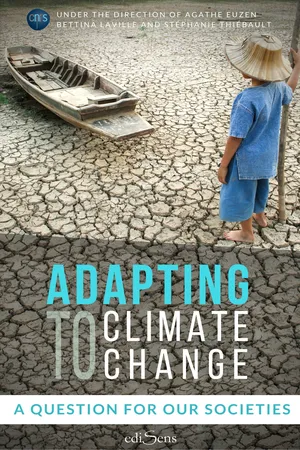
Adapting to climate change and global change have become vital goals for all societies. These same societies are faced at times with unexpected meteorological phenomena that are becoming increasingly frequent and intense, including flooding, droughts and tornadoes. They are also having to wrestle with rising temperatures and the follow-on effects on the balance of ecosystems, the evolution of species, and animal and plant life, not to mention the development of human populations, their living conditions and social organisation. Although the capacity of ecosystems to adapt or convert has been demonstrated by studies on climate variations over time, the growing pace of some phenomena may well lead to a point of no return. In fact, with the global rise in temperature — caused by human activities in particular — we might already have reached this stage.
This book, which consists of some fifty articles by scientists and experts,is unique. It makes us think about what lies behind the notions of adaptation and maladaptation, drawing on several disciplines, sectors and regional fields. It also highlights the checks and limitations of adaptation, as well as reflecting and suggesting ways of acting and adjusting.
The contributions made to this work serve to reinforce the implementation of the Paris Climate Agreement (2015), especially the COP 23 climate conference (23rdConference of the Parties to the United Nations Framework Convention on Climate Change, Bonn, 2017), where adaptation, its objectives and financing, are some of the priorities.
This book is the result of a partnership between the CNRS and Comité 21. It was jointly directed by Agathe Euzen (deputy scientific director at the CNRS Ecology and Environment Institute); Bettina Laville (state councillor and Comité 21 chair); and Stéphanie Thiébault (director of the CNRS Ecology and Environment Institute).