Biological Sciences

Budding in Yeast
Budding in yeast is a form of asexual reproduction where a small daughter cell forms on the surface of the parent cell. This process involves the unequal division of the cytoplasm and organelles between the parent and daughter cells. Budding is a characteristic feature of yeast and is important for its growth and propagation.
Written by Perlego with AI-assistance
Related key terms
1 of 5
9 Key excerpts on "Budding in Yeast"
 eBook - ePub
- Leo H Arnold(Author)
- 2018(Publication Date)
- CRC Press(Publisher)
Chapter 3 MOLECULAR BIOLOGY OF BUDDING M. L. Slater TABLE OF CONTENTS
I. INTRODUCTIONI. Introduction II. Bud Emergence A. Genetic Control and Evolution B. Ultrastructure C. Nutrition III. Bud Growth IV. Septum Formation V. Conclusions References The great majority of yeast species undergo vegetative reproduction by budding. In this chapter Saccharomyces cerevisiae is taken as the model because of the preponderance of data on this species. A perusal of the micrographs of Volume I, Chapter 2 , will give some idea of the number of untouched morphological problems associated with more exotic architecture.The molecular biology of budding is inherently interesting in terms of the underlying mechanisms which attend three dimensional changes in the cell envelope. Moreover, the yeast cell provides some unique features of eukaryotic cell division. For example, the great dissimilarity in mass between mother and separated daughter cell (under modest growth rates) has no parallel in organisms that divide by binary fission.1 ,2Elucidation of budding mechanisms can be approached with a variety of techniques which are primarily biochemical and genetic in scope. However, one should emphasize at the outset that the bud is identifiable by light microscopy and no other procedure is required in this regard. The bud is recognized by its shape rather than its composition, and that shape is intimately associated with the structure of the cell wall.3 The composition of the wall can explain its ability to maintain cell-shape, and consequently the distinction between the bud and the rest of the cell. But how the shape is determined is not so easily explained!The events of budding as observed in the light microscope are summarized diagrammatically in Figure 1 . Consider an unbudded cell (1A) in a growth-supporting medium. This cell first enlarges as an ellipsoid (1B) and then a bud emerges (1C). The bud continues to increase and finally a septum appears (1D). Separation follows and yields mother (IE) and daughter (IF) cells. The large mother cell can undergo another round via the shorter path indicated in Figure 1 , (i.e., E → C → D) whereas the daughter cell must first enlarge before a bud appears (i.e., it engages in the longer path (F → A → B → C → D). We can mention here, and develop later, that the unequal distribution of mass between mother and daughter at separation is dependent on growth rate. The difference is much less pronounced under maximal rates of growth.1 ,2 eBook - PDF
- T Boekhout, V Robert(Authors)
- 2003(Publication Date)
- Woodhead Publishing(Publisher)
12 Momholm of veasts Buds may arise either on yeast cells or on hyphal cells. Budding is termed holoblastic or enteroblastic, depending on how the bud is formed in terms of the fine structure of the cell wall. All layers of the wall of the mother cell are involved in the formation of a holoblastic bud, and the bud separates,usually on a narrow base. Enteroblasticbudding is characteristic of basidiomycetousyeasts and their anamorphic states. Here the inner layers of the cell wall rupture the cell wall at the site of bud formation. Subsequentbudding at the same site leaves distinct scars. The site of budding is eventually surrounded by a collarette due to the recur- rent formation and abscission of a successionof buds arising from the inner layer of the wall of the cell. Fig. 1.6-2 Veget8tive reproduction of yeast cells (Bar = 10 pm). Fig. 1 .&PA, Polar and sympodial budding in Crypfococcus maceram CBS 2208 ; Fig. 1.6-26, Budding on stalks in Fe//omyces porybonrs CBS 8072; Fig. 1.&2C, Fila- ments and pseudohyphae of Metochnikowia gmessii CBS 611; Fig. 1.6-24 Bipolar budding of Hanseniaspora osmopbi/a CBS 313; Fig. 1.6-2E, Multipolar budding of Debaryomyces vanripsevar. vanriiiaeCBS 3024; Fig. l.&2F, Multipolar budding in RcM8 n8bseiCBS 5141; Fig. 1.6-26, Fission (arthroconidiogenesio) in Scbizosaccharomyces pombe var. pombe CBS 356; Fig. 1.6-2H, budding cells of Rchia membmifaciens CBS 107. 13 Morphology of yeasts Fig. 1.6-3 Scanning electron image of ballistomnidia of Bu//emmyces dbus CBS 501. Budding can also be subdivided in terms of the position of the site where it occurs (Figs 1.6- 2, 1.6-3, 1.6-4). Budding restricted to one pole of the cell is termed monopolar (Fig. 1.6-4); budding at both poles of the cell is termed bipolar. The buds are often abstricted on a rather broad base by the formation of a cross wall, which is referred to as ‘budding on a broad base’ or ‘bud fission’. Bipolar budding is characteristic of the apiculate yeasts. eBook - PDF
Wine Microbiology
Science and Technology
- Claudio Delfini, Joseph V. Formica(Authors)
- 2001(Publication Date)
- CRC Press(Publisher)
The mother cell contaillS a large vacuole, Ihe daughter ceLL contains numerous but small vamoles. See Fig. 2Ga jor all explanation 0/ the s)'mboLI. oughly explained in The Yeasts by Rose and Harrison (1961;». Vegetative ,', 'production , To reproduce or multiply vegetatively means that the gL'neration of new cells was not preceded by the sexual processes of conjugation and meiosis, When those processes are impli-cated, reproduction is sexual. Usually vegetative or asexual multipli-cation occurs during phases of intense metabolic activity and therefore, under favorable growth condition , This means haploid or diploid cells can carry out asex-ual multiplication in accordance with the status of the culture (vide infra), The most prevalent form of vegetative reproduction is budding (Fig, 26a, bl. This consists of the formation of a bud by the mother ceJ] which starts out as an , • , • • Fig. 27a. F!oeckera apiculata. a) vegetative cells .eell hy bright-field; hJ the Sl1/11e cellI sem hy phase-contrast. Note the extensive polymorphism. o o c Fig. 28a, b. Saccharomyces cereviIiae: multipolar budding in (a) Saccharomyces cerevisiae, v. bayanus and in (hl Saccharomyces cereviI/Cle, v. fermentii. evagination with a narrow neck. When the bud reaches a critical size, it detaches from the mother cell by forming a cross-wall across the neck. The separation of the bud leaves a scar on the cell waU of the mother cell, which can be seen microscopically (Fig. 26a). Three types of budding have been identified: 1) bipolar budding, which occurs at opposite ends of cells, is found in the genera Kloeckera and Hansenia-spora) (Fig. 27a, b). 2) Tripolar budding occurs at the three points of triangular-shaped cells in the genus Trygonopsis. 3) And finally, the most common form, mul-tipolar or multilateral budding, is found among yeasts like Saccharomyce'i ,p., Can-dida and Rhodolomla (Fig. 29; 31). 10. Taxonomy, biology, cytology and morphology of wine-associated yeasts 171 Fig. eBook - ePub
- Heinz D. Osiewacz(Author)
- 2002(Publication Date)
- CRC Press(Publisher)
In the yeast form (YF), cells divide by budding, followed by complete separation of the mature bud from the mother cell. Pseudohyphae (PH) originate from the budding of elongated cells that remain attached to each other, resulting in the formation of pseudohyphal filaments or pseudomycelium. Hyphae (H) and hyphal mycelium develop by continuous tip growth of hyphal cells, followed by fission of cells through the formation of septa. The molecular mechanisms underlying dimorphism are far from being understood in detail, despite the fact that a wealth of information on the cellular and molecular biology of model yeasts like S. cerevisiae has become available [ 5 ]. A profound understanding of yeast-mycelial dimorphism requires the molecular analysis of all growth forms of yeasts and of the signals and regulatory networks that control interconversion among them. In a first step, easily tractable model organisms serve as initial source of molecular information. At a later stage, however, molecular studies must include analysis of dimorphic yeast species from a broad range of taxa. 2 GROWTH FORMS OF YEAST 2.1 The Yeast Form By definition, yeasts prefer unicellular growth as their favorite mode of vegetative reproduction. The typical yeast cell reproduces by either budding, exemplified by S. cerevisiae, or fission, as in S. pombe [ 5 ]. Budding and fission both confer a unique relationship between cell growth and the sequence of events that constitute the cell division cycle. Budding is initiated by the emergence of a bud as a small protuberance from the cell surface (Fig. 1). Until cytokinesis, further growth is restricted to the bud. The bud lengthens in parallel to DNA synthesis (during S phase) and then swells to achieve its characteristic form during mitosis (M phase). Once the bud receives a daughter nucleus, it separates from the mother cell via septation and enters G1 as an independent daughter cell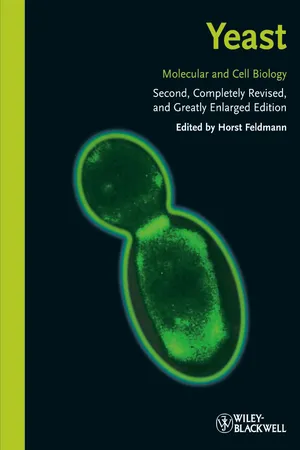 eBook - ePub
Yeast
Molecular and Cell Biology
- Horst Feldmann(Author)
- 2012(Publication Date)
- Wiley-Blackwell(Publisher)
7 Yeast Growth and the Yeast Cell Cycle7.1 Modes of Propagation
As already briefly indicated, yeast can follow two modes of reproduction: (i) asexual budding , the most common mode of vegetative reproduction in yeasts, or (ii) mating of haploid cells of opposite mating-type that can propagate vegetatively or – under starving conditions – be induced to sporulate. In budding cells, the chromosomes are duplicated in a mitotic cycle, and distributed between mothers and daughters followed by cell separation, while sporulation involves meiosis to generate four (haploid) ascospores. Various unique aspects of these lifestyles of yeast, including budding, cell polarity, spindle formation, cytokinesis, cell division, and sporulation, have been intensively studied at the cellular and molecular levels.7.1.1 Vegetative Reproduction
Budding is the most common mode of vegetative growth in yeasts and multilateral budding is a typical reproductive characteristic of ascomycetous yeasts, including Saccharomyces cerevisiae . The eukaryotic cell cycle involves both continuous events (cell growth) and periodic events (DNA synthesis and mitosis). Commencement and progression of these events in yeast can formally be distinguished into pathways for DNA synthesis and nuclear division, spindle formation, bud emergence and nuclear migration, and cytokinesis. However, from a molecular viewpoint these processes are intimately coupled.The cell cycle can be defined as the period between division of a mother cell and subsequent division of its daughter progeny. The regulatory mechanisms that order and coordinate the progress of the cell cycle have been intensely studied (overviews: Mata and Nurse, 1998; Futcher, 2000; Lauren et al. , 2001). The cell cycle (Figure 7.1 ) consists of two separable phases – interphase and mitosis. While in interphase three sections (G1 , S, and G2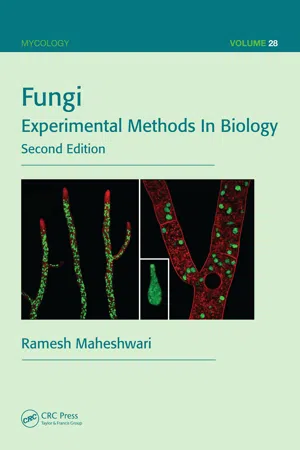 eBook - PDF
Fungi
Experimental Methods In Biology, Second Edition
- Ramesh Maheshwari(Author)
- 2016(Publication Date)
- CRC Press(Publisher)
Each time I have identified an intriguing aspect of the cancer problem, I have found that it could be approached more effectively in the simpler eukaryotic cell, Saccharomyces cerevisiae , than the human cell” (Hartwell, 2002). This chapter gives some remarkable examples of yeast in the study of biological processes in the eukaryotes and the likely further developments. 9.1 MOLECULAR MECHANISMS OF DNA REPLICATION AND CELL DIVISION One of the most significant contributions of Saccharomyces cerevisiae (brewer’s, baker’s, or bud-ding yeast) and the fission yeast Schizosaccharomyces pombe to biology is in the understanding of the eukaryotic cell cycle. Unlike unicellular bacteria and fission yeast that coordinate input from cell geometry and size in their decision to divide, the budding yeast Saccharomyces cerevisiae uses a different set of cell-intrinsic cues to control the timing of cell division (Moseley and Nurse, 2010). It has been proposed that the cell surveys the integrity of the bud neck and proper organization of the cytoskeleton before initiating cell division (Keaton and Lew, 2006). The positioning of the spindle Haploid vegetative cycle Nuclear fusion Cell fusion Haploid vegetative cycle Diploid vegetative cycle Nitrogen starvation Meiosis Ascus containing 4 haploid ascospores α n n n n a α 2n n n n n 2n n n n n a 2n 2n Mating Figure 9.1 Life cycle of Saccharomyces cerevisiae. Both haploid and diploid cells multiply by budding. Diploid (2n) cell undergoes meiosis to form four haploid (n) cells, which are enclosed in a cell called an ascus. YEAST 163 at the bud neck requires that the neck is properly organized and has a correctly organized actin cytoskeleton. The organized actin structure ensures that the spindle formed in the mother cell is pulled into the bud neck by actin cables emanating from the daughter cell (Siller and Doe, 2009).
- Richard P. Shefferson, Owen R. Jones, Roberto Salguero-Gómez(Authors)
- 2017(Publication Date)
- Cambridge University Press(Publisher)
Cells that have completed their first budding represent approximately 25 per cent of the population, while those that produced two daughters represent approximately 12.5 per cent of the population. Thus, the cells that completed six or fewer cycles cover approximately 99 per cent of the population. Standard cells produce about twenty-five daughters; hence, the contribution of mothers that have produced higher numbers of daughters is insignificant from the point of view of yeast population growth. Figure 18.1 Cell division results in bud scars located within the cell wall of the mother cell. A-Bud scars visualised under scanning electron microscopy (courtesy of Jagiellonian University); B,C-Bud scars stained with calcofluor and visualised under fluorescence microscopy. The arrows indicate the isthmus between mother and daughter cells. Specific Features of Budding Yeast Biology 365 Replicative Ageing of the Budding Yeast The ‘replicative life span’ (RLS) is defined as the number of daughter cells produced until unavoidable cell arrest. In 1980, a group of scientists posed the question of whether the numeric value of the reproduction limit (RLS) depended on the so-called v n G1 S G2 n n D D D D D D D v v actin cables microtubules nuclear envelope polarisome bud neck Figure 18.2 Diffusion of cell constituents to and from the bud is very limited. The intersection of the channel (isthmus) connecting both cells corresponds to less than 1 per cent of the cell surface of the mother cell. Growth of the bud is strictly connected with transport of vesicles along the actin cables. During the M phase of the cell cycle, the isthmus is blocked by the nucleus migrating to the bud, which has to be strongly constricted to pass through the channel. Microtubules allow for the active transport of chromosomes into the bud nucleus. The free diffusion of episomes, devoid of centromeres, is thus limited (D = damage; n = nucleus; v = vacuole). 366 Yeast Ageing eBook - PDF
- Arora, Dinesh(Authors)
- 2021(Publication Date)
- Biotech(Publisher)
bud sport a somatic mutation arising in a bud and producing a genetically different shoot. Bud sports include changes due to gene mutation, somatic reduction, chromosome deletion or polyploidy. budding 1. a method of asexual reproduction in which a new individual is derived from an outgrowth (bud) that becomes detached from the body of the parent. 2. among fungi, budding is characteristic of the yeast Saccharomyces cerevisiae. 3. a form of grafting in which a single vegetative bud is taken from one plant and inserted into the stem tissue of another plant so that the two will grow together. The inserted bud develops into a new shoot. See grafting. buffer 1. a solution that maintains the specific pH range needed for a physiological reaction. 2. a solution that resists change in pH when an acid or alkali is added, or when solutions are diluted. buoyant density the intrinsic density which a molecule, virus or sub-cellular particle has when suspended in an aqueous solution of a salt, such as CsCl, or a sugar, such as sucrose. DNA from different species has a characteristic buoyant density, which reflects the proportion of G=C base pairs. The greater the proportion of G=C, the greater the buoyant density of the DNA. bypass a surgical procedure in which a new pathway for the flow of body fluids is created. bystander effect the term describing the beneficial therapeutic effects elicited when a primary therapeutic agent triggers events in neighbouring cells and tissues via other mediators. c cytosine residue in either DNA or RNA. This ebook is exclusively for this university only. Cannot be resold/distributed. caat box (also cat box) a conserved sequence found within the promoter region of the protein-encoding genes of many eukaryotic organisms. It has the consensus sequence GGCCAATCT and occurs around 75 bases prior to the transcription initiation site and it is one of several sites for recognition and binding of regulatory proteins called transcription factors. eBook - ePub
Brewing
Science and Practice
- D E Briggs, P A Brookes, R Stevens, C A Boulton(Authors)
- 2004(Publication Date)
- Woodhead Publishing(Publisher)
Rose and Harrison, 1971 ). An assistant of Hansen, Schiönning reported the occurrence of a sexual phase in the yeast life cycle. This was confirmed in the 1930s when Øjvind Winge also working at the Carlsberg Foundation provided a full description of the yeast haploand diplophases.As early as 1897, Büchner demonstrated the formation of ethanol and carbon dioxide from sugar using a cell-free extract of yeast, thereby providing the foundation for the development of modern biochemistry. Yeast has been used as a convenient experimental organism in many subsequent investigations. The zymologist, A. H. Rose, proposed in the introduction to the second volume of the first edition of The Yeasts (Rose and Harrison, 1971 ) the initiation of 'Project Y'. This suggested that yeast be used as a model eukaryotic organism in an integrated approach to the study of cell biology. This challenge has been taken up and the academic literature devoted to yeast in general and Saccharomyces cerevisiae in particular is now immense. Many of the discoveries in cell biology, physiology, biochemistry and genetics were made using yeast cells. Probably, S. cerevisiae is the most extensively studied cell. This has culminated in the sequencing of the entire genome of S. cerevisiae , the first species for which this has been accomplished (Goffeau et al. , 1996).11.2 Taxonomy
Taxonomy is the science of the classification of organisms. Using criteria such as morphology, life cycle, immunological properties, biochemical capabilities and genetic analysis, organisms are grouped into hierarchies of relatedness and difference. Systems of taxonomy indicate functional and evolutionary relationships between groups of organisms and they provide a framework for identifying unknown types. Taxonomy has practical importance in brewing. It allows the identification of proprietary yeast strains and the ability to distinguish these from contaminants such as wild yeasts.
Index pages curate the most relevant extracts from our library of academic textbooks. They’ve been created using an in-house natural language model (NLM), each adding context and meaning to key research topics.

